Your AI Agent Just Got a New Boss: Plain English
Your AI Agent Just Got a New Boss: Plain English
Someone finally wrote the unified theory of training AI with words instead of numbers — and it lands at the exact moment your competitors are building autonomous agents that learn from human feedback in real time. If this taxonomy is right, the reward function is dead. Long live the memo.
What happened
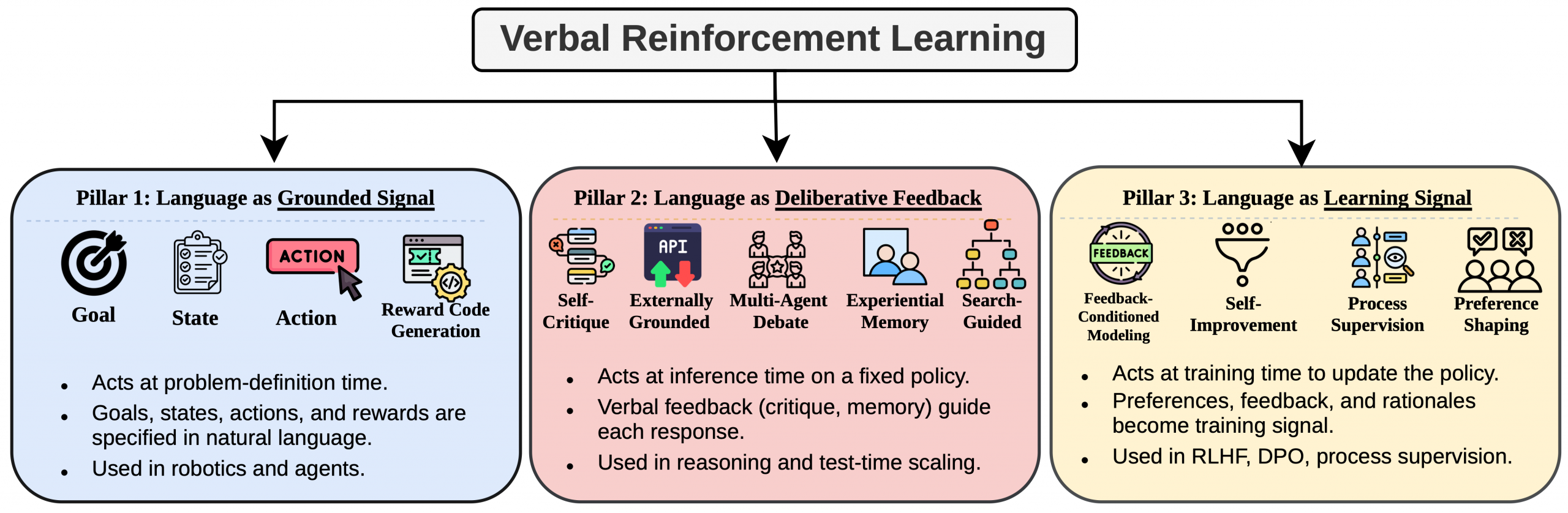
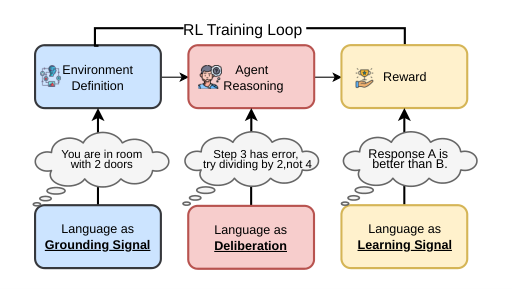
A team from IBM Research published what they claim is “the first unified account” of Verbal Reinforcement Learning (VRL) — a paradigm where natural language replaces or supplements numerical reward signals in training and guiding AI agents. They organize the entire field around one axis: when verbal feedback kicks in and what it changes. This produces three pillars: Language as Grounding Signal (language defines goals, states, and reward structures upfront), Language as Deliberative Feedback (language steers reasoning at inference time without touching model weights — think in-context learning), and Language as Learning Signal (verbal feedback actually reshapes model parameters during training). The paper is a survey and taxonomy, not an empirical study — no new benchmark numbers, no novel model, no ablations. It synthesizes existing work into a single conceptual frame, arguing that verbal feedback is “reshaping agent development” while also identifying open challenges around capability and alignment. The agentic workflow implications are the obvious commercial hook: if you can steer an agent’s behavior with a written correction rather than a labeled dataset, the cost of iteration collapses.
Cold read
This is a literature review dressed in manifesto clothing — the phrase “first unified account” is doing heavy lifting for a paper that presents zero experimental validation of its own taxonomy. The three-pillar framework is tidy, but tidiness is not evidence; the authors do not demonstrate that this categorization predicts anything or outperforms rival framings. The abstract makes no claim about how well VRL actually works versus numerical RL, which is the only number that matters to anyone building a product. Survey papers like this tend to arrive after a field matures, not before — which raises the question of whether VRL is a genuine paradigm shift or a retroactive label slapped on a cluster of loosely related prompt-engineering tricks. The alignment benefits are asserted, not proven; verbal feedback from humans is still noisy, gameable, and subject to the same hallucination failure modes as the models receiving it.
What it means for you
- Signal maturity: 2/5 — taxonomy paper, no new empirical results, field still in definitional phase
- Who gets hurt: RLHF tooling vendors whose value prop rests on numerical reward modeling pipelines — if verbal feedback generalizes, their labeled-data moat erodes
- What breaks if this is true: Fine-tuning budgets shrink dramatically; the competitive advantage of large proprietary training datasets weakens if a well-written correction memo does equivalent work
- Why it might not land: Verbal feedback is interpretable to humans, but that doesn’t make it a reliable training signal — ambiguity, inconsistency, and adversarial users can corrupt it faster than scalar rewards can be gamed
- Watch for: A benchmark head-to-head showing VRL matching or beating numerical RLHF on a standard agentic workflow task; that’s the moment this stops being taxonomy and starts being a roadmap
Forecast as of 2026-09-02
By Q3 2027, at least two frontier-model labs will publish empirical results directly comparing verbal feedback loops to traditional numerical RLHF on agentic benchmarks — and at least one will show verbal feedback underperforming on tasks requiring precise quantitative optimization, cooling the paradigm-shift narrative while confirming a genuine niche for human-readable correction signals.
Source: The Rise of Verbal Reinforcement Learning — Kshitij Tayal, Arun Sharma, Genta Indra Winata, Anirban Das, Sambit Sahu. https://arxiv.org/abs/2609.01597v1