Your AI Agent Just “Forgot” Everything After That Model Upgrade
Your AI Agent Just “Forgot” Everything After That Model Upgrade
You swapped the model. The memory store stayed. Your agent is now a stranger to its own past. Goyal and Ray put four memory architectures through controlled model swaps — and the results should make any founder running a persistent-memory product very uncomfortable.
What happened
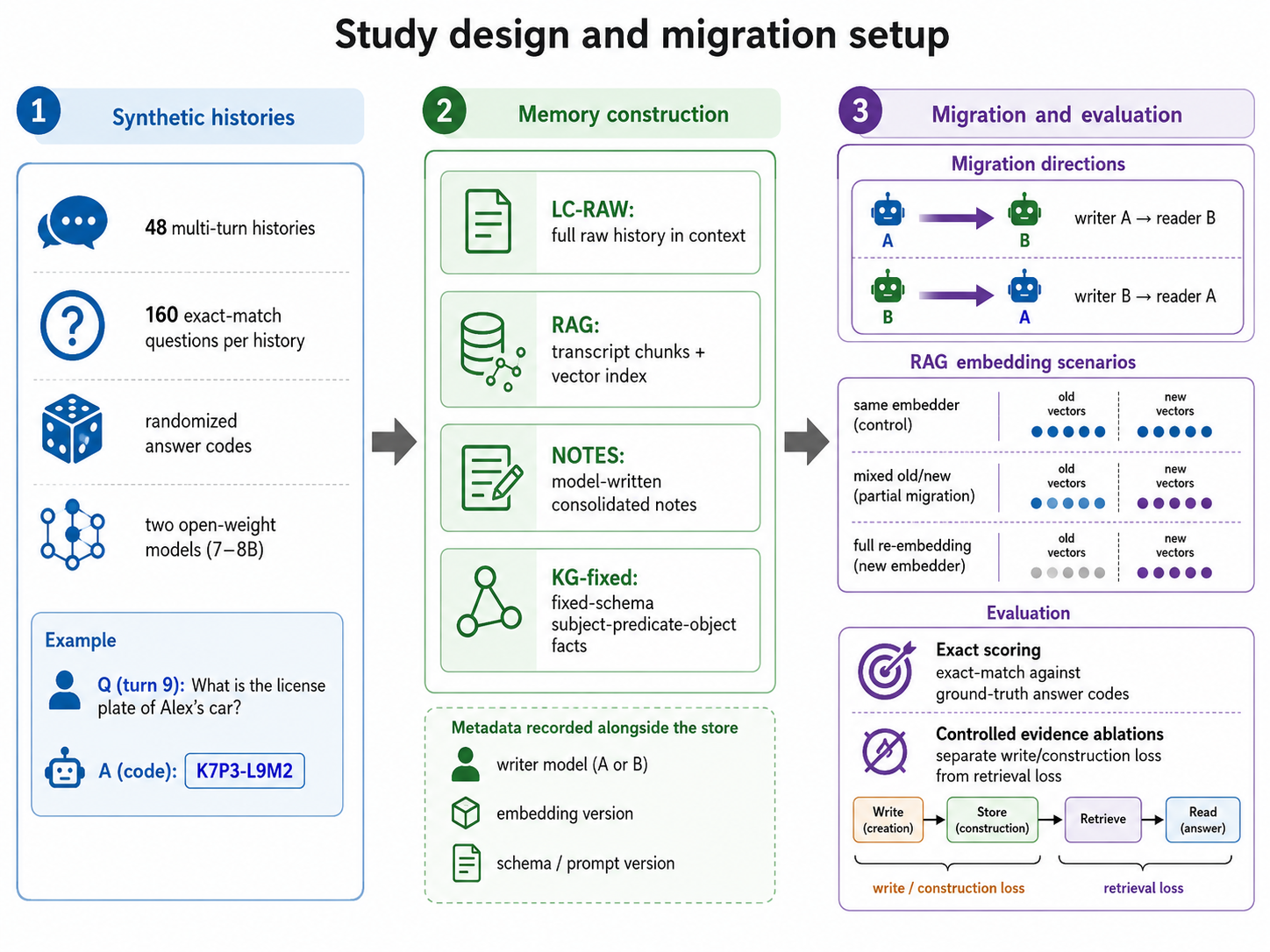
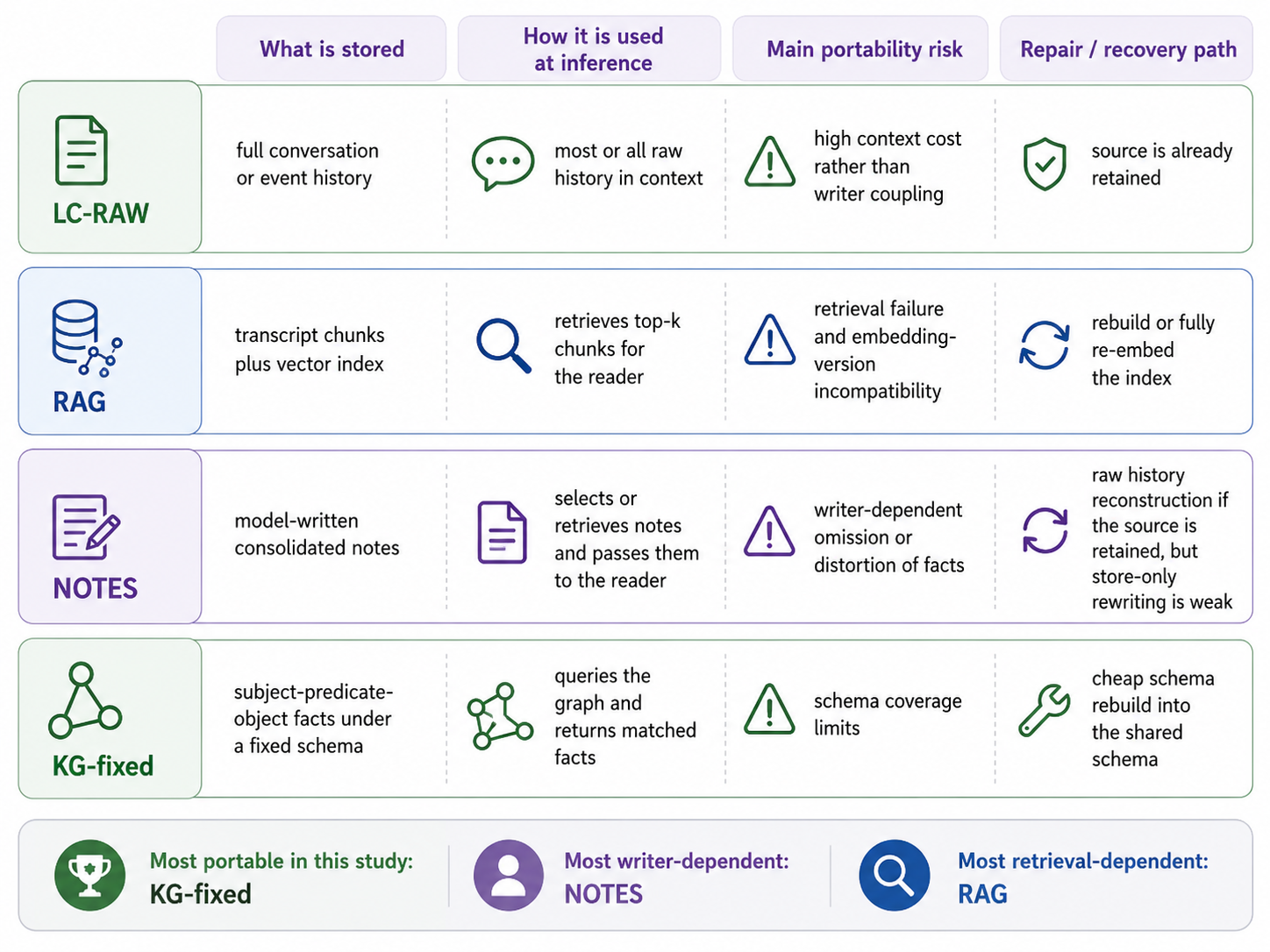
The researchers tested four ways an agent can store memory — verbatim long-context logs (LC-RAW), chunked retrieval-augmented generation (RAG), model-compressed natural-language notes (NOTES), and fixed-schema knowledge graphs (KG-fixed) — across 48 synthetic histories using two sub-10B open-weight models. The headline number: KG-fixed accuracy barely budged across a model swap, changing only +0.0004 ± 0.0020. NOTES, by contrast, swung +9.91 or −13.28 percentage points depending on migration direction — meaning the same swap can hurt or help depending on which model wrote the notes and which reads them. For RAG, a “just migrate half the embeddings” shortcut (50/50 mixed index) recovered only 4.96 points of accuracy improvement, leaving most of an 11.90-point full-re-embedding gain on the table. Most damning: store-only repair of NOTES failed to hit 90% performance recovery in all 48 test cases, while keeping raw source history enabled recovery in 34 of 48 cases — meaning deleting your raw logs is a one-way door to permanent degradation.
Cold read
This is 48 synthetic histories on sub-10B open-weight models — a narrow, controlled lab setup that may not reflect the messiness of production agent memory at GPT-4-class scale or with real, heterogeneous user data. The agent memory vs. context window problem in production typically involves far more complex retrieval pipelines, hybrid indexes, and human-written notes than what’s tested here. The paper measures accuracy on “randomized answer codes” — a clean scoring method, but one that may not capture the subtler degradation patterns (confident wrong answers, topic drift) that actually hurt real products. The finding that direction matters asymmetrically is important but only two migration directions were tested; with three or more models in the mix, the combinatorics could look very different. Nothing here speaks to proprietary embedding providers or closed-model APIs, which is where most production agentic workflows actually live.
What it means for you
- Signal maturity: 3/5 — rigorous method, narrow scope; directionally credible but not production-validated
- Who gets hurt: Any B2B SaaS team shipping persistent-memory agents (CRM copilots, customer-success bots, AI assistants with “long-term memory” as a feature) who treats model upgrades as zero-risk infra changes
- What breaks if this is true: Your model upgrade SLA is secretly also a memory integrity SLA — and you have no test suite for it
- Why it might not land: Most teams using managed memory layers (e.g., Mem0, Zep, hosted vector DBs) assume the vendor handles migration; this paper studies the format problem, not the vendor problem — the practical fix may be abstracted away before most founders hit it
- Watch for: Any major agent-memory vendor publishing a migration benchmark, or a wave of “memory portability” tooling hitting the market — that would signal the industry has quietly confirmed this is a real production pain point
Forecast as of 2026-09-07
By Q3 2027, at least two of the top five agent-memory infrastructure vendors (Mem0, Zep, LangMem, or equivalents) will have published explicit model-migration testing protocols or compatibility guarantees — driven by enterprise customer pressure after real-world accuracy regressions following model upgrades become documented and public.
Source: Does Your Agent’s Memory Survive a Model Upgrade? A Controlled Study of Memory Portability — Ankit Goyal, Jaideep Ray. https://arxiv.org/abs/2609.05339v1