Fake Citations Are Already in the Archival Record — And Peer Review Missed Them
Fake Citations Are Already in the Archival Record — And Peer Review Missed Them
The scientific literature is the training data for the next generation of AI. Now there’s evidence that hallucinated references — citations to papers that don’t exist — are already embedded in proceedings at NeurIPS, ICML, ICLR, and USENIX Security. Not as drafts. As accepted, camera-ready, archival papers. One of them may be award-winning.
What happened
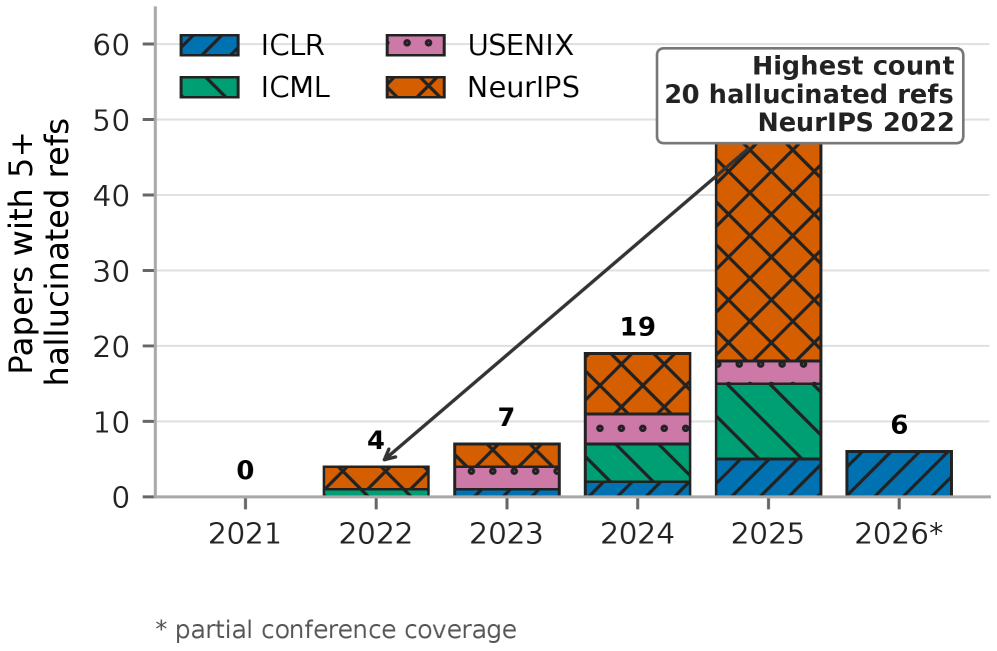
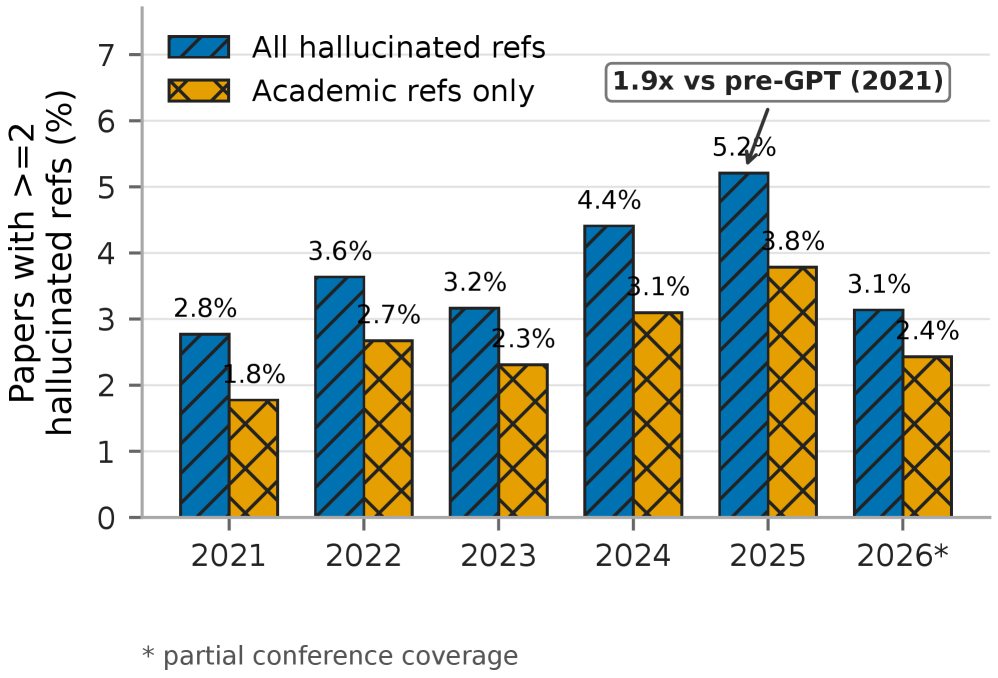
A team including Microsoft’s Mark Russinovich built RefChecker, an automated pipeline that resolves bibliography entries against multiple bibliographic databases, escalating unresolved cases to web-search re-verification. They applied it to camera-ready accepted papers from four top-tier venues — ICLR, ICML, NeurIPS, and USENIX Security — using a deliberately conservative definition of hallucination: only non-existent works and substantial author-list mismatches qualify. Minor bibliographic drift (wrong year, venue, publication-status updates) was explicitly excluded. The headline number: roughly 1 in 20 NeurIPS and USENIX Security papers from 2025 contains at least two likely hallucinated references under this strict definition. Reference-level rates stay below 1%, but proceedings are large enough that paper-level failures accumulate visibly. They also document a post-ChatGPT increase across venues and a tail of papers with 5+ phantom citations in a single bibliography — and flag likely hallucinated citations in award-winning papers. The audit cost: approximately $0.04 per paper at venue scale, and the tool is open-sourced. This is a factual consistency failure at industrial scale, validated against what should be the most scrutinized documents in the field.
Cold read
The authors are admirably conservative — they explicitly exclude the messier cases of bibliographic drift that would inflate the numbers — but that conservatism cuts both ways: the true contamination rate is almost certainly higher than reported, not lower. The study measures citation identity failures only; it says nothing about whether the content of hallucinated-adjacent papers is fabricated, which is the deeper epistemological threat. “Post-ChatGPT increase” is a correlation, not a controlled attribution — other factors (submission volume growth, more international authors, reference management software bugs) could contribute. The pipeline itself relies on bibliographic databases and web search, both of which have coverage gaps, meaning some phantom references may be miscategorized as real if a hallucinated title happens to collide with a real one. And “roughly 1 in 20 papers” sounds alarming, but if those papers’ arguments are sound and only a peripheral citation is phantom, the practical scientific harm may be modest — though the integrity harm is not.
What it means for you
- Signal maturity: 4/5 — methodology is tight, numbers are specific, tool is reproducible
- Who gets hurt: Any company building products on top of LLM-generated research summaries, literature reviews, or RAG pipelines that ingest academic corpora — your golden dataset may already be poisoned at the source
- What breaks if this is true: Source attribution as a trust signal collapses; “cited in a peer-reviewed paper” stops being a reliable provenance anchor for any AI-generated claim
- Why it might not land: Journals and venues have strong institutional incentives to minimize this story; without mandatory pre-publication checks, the status quo is sticky
- Watch for: Whether ICLR, NeurIPS, or ACL formally adopt RefChecker or an equivalent as a submission requirement by the 2027 conference cycle — that’s the concrete forcing function
Forecast as of 2026-07-02
By Q1 2027, at least one top-tier ML or security venue will announce a mandatory or strongly recommended automated citation-verification step in its camera-ready submission process, citing reproducibility and integrity concerns — but the majority of venues will still have no such requirement, and contamination rates will not meaningfully decline in 2026 proceedings.
Source: Phantom References: Hallucinated Citations That Survive Peer Review at Top-Tier Conferences — Mark Russinovich, Ram Shankar Siva Kumar, Ahmed Salem. https://arxiv.org/abs/2607.00738v1