The AI Benchmark You Trusted Was Measuring the Wrong Thing
The AI Benchmark You Trusted Was Measuring the Wrong Thing
That leaderboard score you used to pick your model vendor? It may have been measuring the inference framework, not the model. A new study finds the backend — HuggingFace, vLLM, Ollama — can swing results in ways that have nothing to do with the model itself. You’ve been buying cars based on a speedometer that was reading the road, not the engine.
What happened
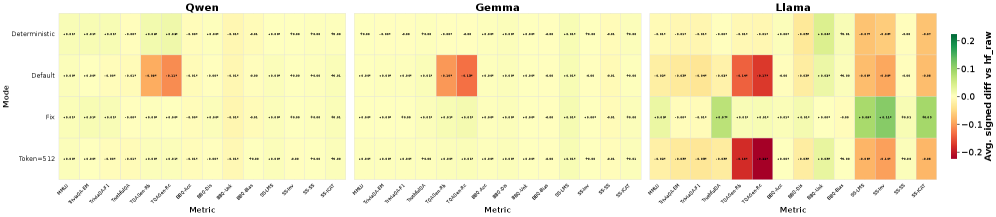
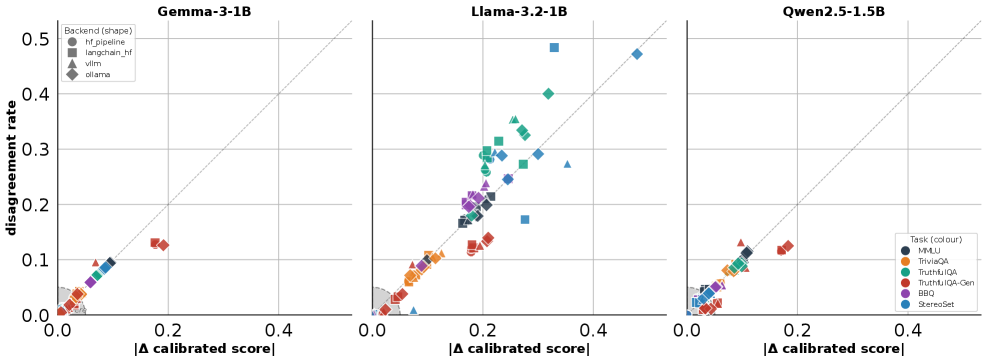
Researchers at Johannes Kepler University ran a fully-crossed experiment: three instruction-tuned models, five inference frameworks, six benchmarks, four generation modes — every combination. The headline finding: switching the backend alone, even under greedy (noise-free) decoding, can significantly alter model performance. This isn’t random jitter. The authors call the effect “structural and strongly model-dependent,” meaning certain models are systematically hurt or helped by certain backends in consistent, repeatable ways. Decomposing the variance, they found roughly 39% of the performance variability a practitioner encounters out-of-the-box can be traced to the backend choice — not the model, not temperature settings, not the prompt. The remaining variance comes from sampling noise and each framework’s default generation parameters, both of which are, in principle, avoidable. Effects were more pronounced on factual benchmarks than on social-bias benchmarks. The paper’s recommendation is blunt: always disclose the backend, its version, and the full generation configuration — treating them the same way you’d treat any other experimental variable. Think of this as the inference-layer cousin of benchmark contamination: your numbers are real, they just aren’t measuring what you think.
Cold read
This study covers three models and six benchmarks — a meaningful but not exhaustive slice of the landscape. We don’t know which models, which backends won or lost, or by how much, from the abstract alone, so the practical “which backend should I use” question goes unanswered here. The 39% variance figure is for out-of-the-box usage — once you lock down your generation config, the paper explicitly says much of that variance becomes avoidable, which means sophisticated teams who already pin their configs may be largely unaffected. The finding that effects are “model-dependent” also limits generalization: there’s no clean universal correction factor you can apply, just a new variable you have to control. And this research describes evaluation environments, not production — if your product uses one backend consistently, the benchmark mismatch hurts your model selection decisions, not your end users directly.
What it means for you
- Signal maturity: 3/5 — Finding is real and reproducible, but actionability is narrow without knowing which models and backends diverge most
- Who gets hurt: AI product teams doing model selection from public leaderboards, and any vendor whose flagship benchmark scores were run on a favorable backend they didn’t disclose
- What breaks if this is true: Any procurement or build/buy decision based on leaderboard scores becomes suspect; internal golden datasets and evals only hold if backend is pinned end-to-end
- Why it might not land: Most production teams already standardize on one backend; the gap only bites during model comparison, not deployment — the pain is real but episodic
- Watch for: Major benchmark aggregators (LMSYS, Open LLM Leaderboard) adding mandatory backend + version disclosure fields; that’s when the research crosses from academic finding to industry norm
Forecast as of 2026-08-06
By Q2 2027, at least one major public leaderboard (LMSYS Chatbot Arena or Hugging Face Open LLM Leaderboard) will add a required backend/version disclosure field as a direct or indirect response to findings like these — or will face a documented public controversy where two benchmark submissions for the same model differ materially due to undisclosed backend differences.
Source: What We Observe as LLM Behavior Can Be a Side-effect of Inference Backend — Shahed Masoudian, Passant Shafaei, Monorama Swain, Markus Schedl. https://arxiv.org/abs/2608.04714v1