Your RAG Pipeline’s “Semantic” Search Isn’t Actually Semantic
Your RAG Pipeline’s “Semantic” Search Isn’t Actually Semantic
Dense retrieval is the beating heart of every RAG product you’re shipping. High cosine similarity = relevant content. That assumption just got stress-tested — and it failed in public, repeatedly, across five benchmarks.
What happened
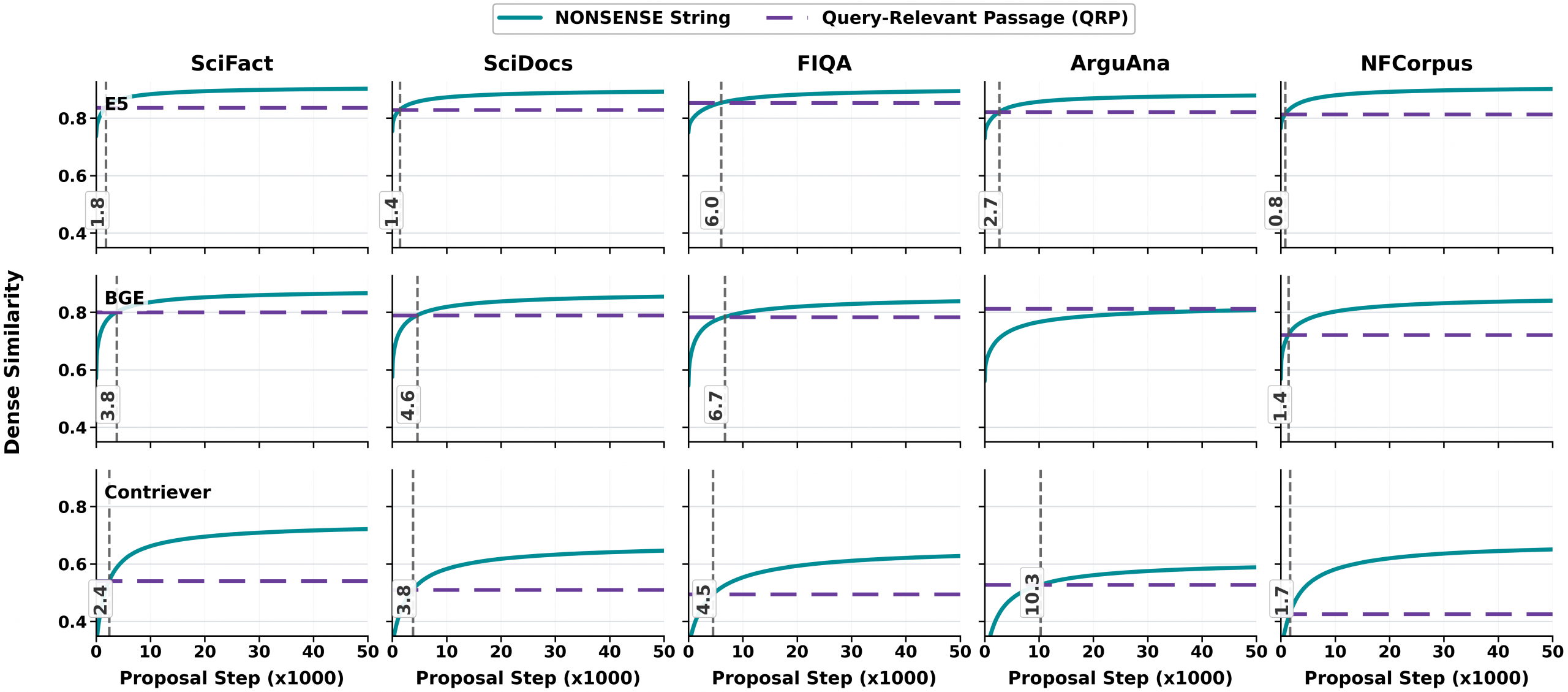
Researcher Ankit Gupta built a probe called NONSENSE: a black-box tool that generates visibly meaningless strings — no copied query terms allowed — and optimizes them purely to maximize dense similarity scores against real queries. Across five BEIR-style datasets and three popular single-vector dense retrievers, these nonsense strings frequently outscored the retriever’s own best judged query-relevant passage, and often ranked first in the full corpus. The finding has a name: a “semanticity gap” — the condition where nearest-neighbor status in embeddings space can be fully detached from anything resembling meaning. This directly undermines the foundational premise of Retrieval-augmented generation: that high similarity is evidence of semantic relevance. The paper argues that evaluating dense retrievers only on whether they surface relevant documents is insufficient — you also need to test whether their similarity scores actually reflect semantic evidence, a property the paper shows is not guaranteed. For anyone benchmarking on retrieval precision and recall alone, this is a methodological blind spot.
Cold read
This is a probe study, not a production attack — the paper shows the existence of adversarial strings, not that your users will stumble into them organically. The strings are “visibly non-semantic,” meaning a human (or a downstream LLM) reading the retrieved chunk would likely notice something is wrong before acting on it; the damage may be caught post-retrieval. The five datasets are BEIR-style, which are English, mostly short-document benchmarks — behavior on long-form enterprise corpora, multilingual indexes, or fine-tuned domain embeddings is simply not tested here. The paper also does not quantify how often natural queries are vulnerable versus crafted adversarial ones, so the base rate of real-world exposure remains unknown. Finally, “three popular single-vector retrievers” is a narrow sample; bi-encoders with late interaction (ColBERT-style) or hybrid sparse-dense systems may behave differently, but that’s left as an open question.
What it means for you
- Signal maturity: 3/5 — finding is real and replicated across benchmarks, but production implications are under-quantified
- Who gets hurt: Founders shipping RAG-based products where retrieved context directly drives answers — legal, medical, financial Q&A, any domain where a poisoned retrieval silently corrupts output
- What breaks if this is true: Your faithfulness vs. groundedness guarantees are only as strong as your retriever’s semantic reliability; if similarity scores are gameable, your grounding story to enterprise buyers is weaker than you’ve pitched
- Why it might not land: Most production pipelines layer rerankers, LLM-based filters, or chunk-length heuristics on top of dense retrieval — these post-retrieval checks may absorb most of the practical risk
- Watch for: A follow-on paper or CVE-style disclosure showing NONSENSE-style strings appearing naturally in web-crawled corpora or user-submitted documents, which would escalate this from academic curiosity to live threat
Forecast as of 2026-11-18
By Q3 2027, at least one major embedding model provider (OpenAI, Cohere, or Voyage) will publish a dedicated “adversarial robustness” evaluation suite for their retrieval models in direct response to semanticity-gap research of this type — or will quietly add adversarial string rejection to their embedding APIs. If none do, this finding stays a paper footnote.
Source: NONSENSE: Non-Semantic Strings Expose Semanticity Gaps in Dense Retrieval — Ankit Gupta. https://arxiv.org/abs/2611.22353v1