Your RAG Pipeline Is a Time Bomb — And It’s Already Going Off
Your RAG Pipeline Is a Time Bomb — And It’s Already Going Off
You built retrieval-augmented generation to stop your AI from lying. Congratulations: you may have built a machine that lies more convincingly, because your knowledge base is quietly rotting. The model knew the right answer. You fed it a stale document. Now it’s wrong — and confident about it.
What happened
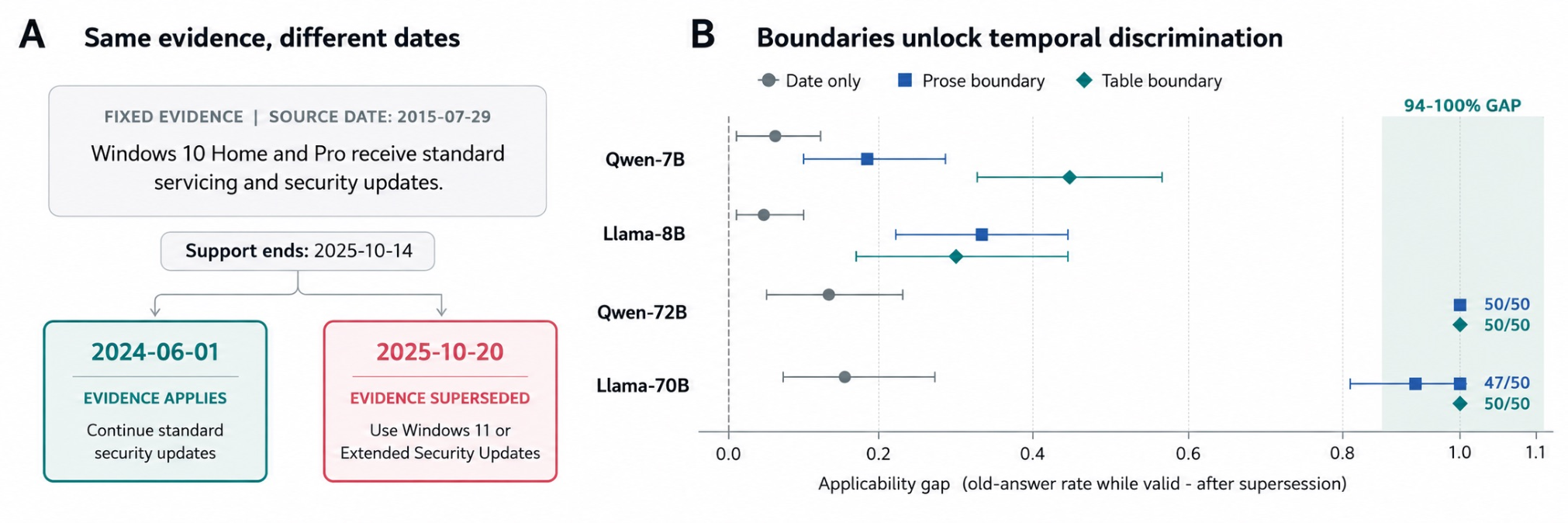
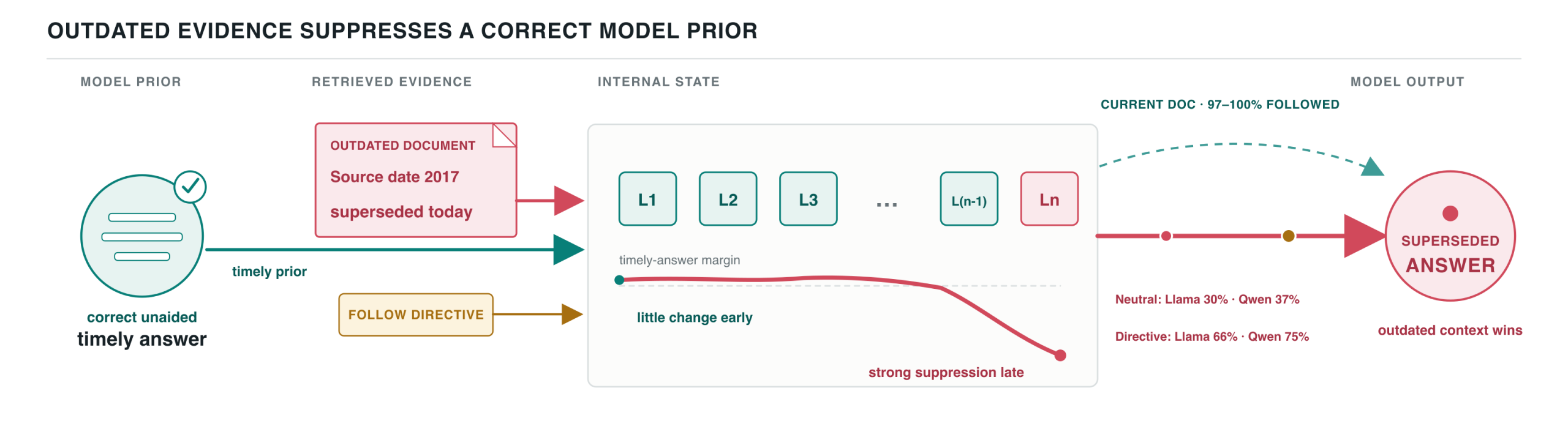
Researchers constructed a benchmark of 317 verified “knowledge reversals” — facts that were once true and are now officially false — across medicine, law, software, and platform policy, each anchored to dated official sources. They tested 12 models and found that outdated retrieved documents flipped 30% of Llama and 37% of Qwen answers even when the models received no explicit instruction to trust the document. Add a simple “follow these instructions” prompt and those numbers jump to 66% and 75% respectively. Across four open models and four domains, stale-document poisoning ranged from 17% to 91% of cases — while matched up-to-date evidence was followed in 97–100% of trials, confirming the models aren’t generally credulous, just temporally blind. A recency-aware hybrid re-ranker narrowed the damage by 4.6–10.0 percentage points, but only when reliable date metadata was present. The core finding: models that correctly answered a question without retrieval were made wrong by retrieval, reversing the entire value proposition of RAG.
Cold read
317 knowledge reversals is a respectable but small benchmark — enough to demonstrate the phenomenon, not enough to characterize its real-world frequency across the long tail of enterprise knowledge bases. The paper tests open models; whether closed frontier models (GPT-4o, Claude 3.x, Gemini) show the same poisoning rates is not established here. The 17–91% poisoning range is so wide it’s almost meaningless as a planning number — a founder can’t risk-model that spread. The re-ranker fix is contingent on “reliable temporal metadata,” which is precisely what most companies don’t have in their document stores; this is a solution that assumes away the hard part. And the benchmark is built on verified reversals from official sources — real-world stale content is messier, more ambiguous, and far harder to detect, so the paper’s clean experimental setup likely understates the complexity of the actual fix.
What it means for you
- Signal maturity: 3/5 — Effect is real and measured; mitigations are immature and metadata-dependent
- Who gets hurt: Any company running RAG over a corpus with documents older than 12–18 months — compliance tools, legal research assistants, medical decision support, policy bots
- What breaks if this is true: Your RAG accuracy SLA is not a function of your retrieval precision alone; it degrades silently as your corpus ages, with no obvious error signal to alert you
- Why it might not land: Most enterprise RAG buyers won’t audit for this specifically — poisoning will be attributed to “hallucination” and treated as a model problem rather than a data freshness problem, delaying the correct fix
- Watch for: Enterprise RAG vendors shipping document-expiry timestamps and retrieval precision dashboards that surface document age distributions — that’s the tell that the market has internalized this risk
Forecast as of 2026-09-28
By Q3 2027, at least two major enterprise RAG platforms (likely from the Glean / Elastic / Microsoft 365 Copilot tier) will ship a native “document freshness score” as a retrieval-ranking signal, directly citing temporal poisoning research as the motivation — and at least one high-profile RAG liability incident in a regulated industry (medical or legal) will be publicly attributed to stale-document retrieval rather than model hallucination.
Source: Stale-Document Poisoning: When Outdated Retrieval Overrides Correct Model Answers — Md Shamim Ahmed, Lukas Galke Poech, Richard Röttger. https://arxiv.org/abs/2609.31342v1