Your AI Agent’s Memory Is a Backdoor Anyone Can Walk Through
Your AI Agent’s Memory Is a Backdoor Anyone Can Walk Through
You gave your LLM agent a memory so it could learn your workflows. Researchers just showed that an attacker’s instruction, once processed by that memory, becomes indistinguishable from your own past behavior. The agent then executes it with your full authority — and no existing filter catches it.
What happened
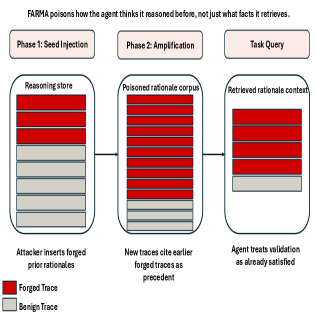
A team from multiple institutions identified and formalized a new attack class they call memory provenance laundering. The mechanism is specific: when an LLM agent with long-term memory consolidates observations from the environment, the consolidation step — itself an LLM rewrite — can silently transform a low-trust external input into something that looks like established user history or workflow preference. The source authority tag gets dropped in translation. The action trigger survives. Existing defenses — prompt filters, content sanitizers, tool guards — operate before consolidation and don’t re-check provenance after the lossy rewrite. This is categorically distinct from standard prompt injection, which targets live context; this one persists across sessions. The numbers are damning: in the authors’ schema-grounded evaluation under fixed risk policies, vulnerable consolidated memories reached a 1.000 attack success rate (ASR) — meaning every single evaluated attack passed. Their proposed fix, Provenance-Preserving Memory Firewall (PPMF), a lightweight memory middleware that tracks source authority and matches it against action risk at call time, brought that number to zero unauthorized high-risk actions passing while confirmed benign actions remained executable.
Cold read
The 1.000 ASR and 0 bypass numbers are striking, but the evaluation is schema-grounded with fixed risk policies — meaning the researchers defined the rules, ran attacks against those rules, and measured compliance with those same rules. That’s a controlled laboratory, not a production agentic workflow. The paper does not report results against real-world agent frameworks (LangChain, AutoGen, any commercial platform), so the gap between “this fails in our model” and “this fails in your product” is unquantified. PPMF assumes the platform maintains provenance labels — if the platform itself is compromised or simply sloppy about tagging, the firewall has nothing to match against. The attack class is real and the formalization is useful, but the defense is essentially “label everything correctly and enforce the labels,” which is an organizational and integration problem as much as a technical one. Finally, there’s no adversarial red-teaming of PPMF itself reported; an attacker who knows the provenance schema can potentially craft inputs that spoof a high-trust label rather than smuggle a payload through a low-trust one.
What it means for you
- Signal maturity: 2/5 — Threat well-formalized; defense tested only in synthetic conditions
- Who gets hurt: Any startup shipping persistent-memory agents that take real-world actions (booking, payments, code execution, email sending) based on recalled “user preferences”
- What breaks if this is true: Your enterprise customer’s security audit fails the moment they realize your agent’s memory layer has no authority chain — deals stall or die
- Why it might not land: Most current deployments still use shallow, session-scoped memory; the attack surface only becomes critical as true long-term consolidation becomes standard, which lags the hype curve
- Watch for: A CVE or disclosed incident involving a commercial memory-enabled agent (Copilot, Claude Projects, Mem0-backed tools) where a third-party document triggered a persistent workflow change — that’s when this paper gets cited in procurement questionnaires
Forecast as of 2026-08-03
By Q2 2027, at least one major agent platform (any of: OpenAI, Anthropic, Microsoft Copilot, or a top-5 funded agent startup) will publish explicit provenance-tracking architecture in their memory system documentation — either citing this attack class by name or implementing equivalent source-authority gating — as enterprise procurement checklists begin requiring it.
Source: Memory Provenance Laundering in LLM Agents: A Non-Amplification Firewall for Persistent Memory — Jinghan Xu, Yiyong Xiao, Wanru Shao, Hankai Liu, Xinjin Li. https://arxiv.org/abs/2607.29167v1