Your LLM Stack Is Wasting Half Its Time Counting Words
Your LLM Stack Is Wasting Half Its Time Counting Words
Every time your coding agent finishes a tool call and fires the next request, the server re-reads the entire transcript from scratch — just to split text into tokens. At high cache-hit rates, that overhead isn’t a rounding error; it’s eating your latency budget. One paper just put a number on how bad it is, and the number is embarrassing.
What happened
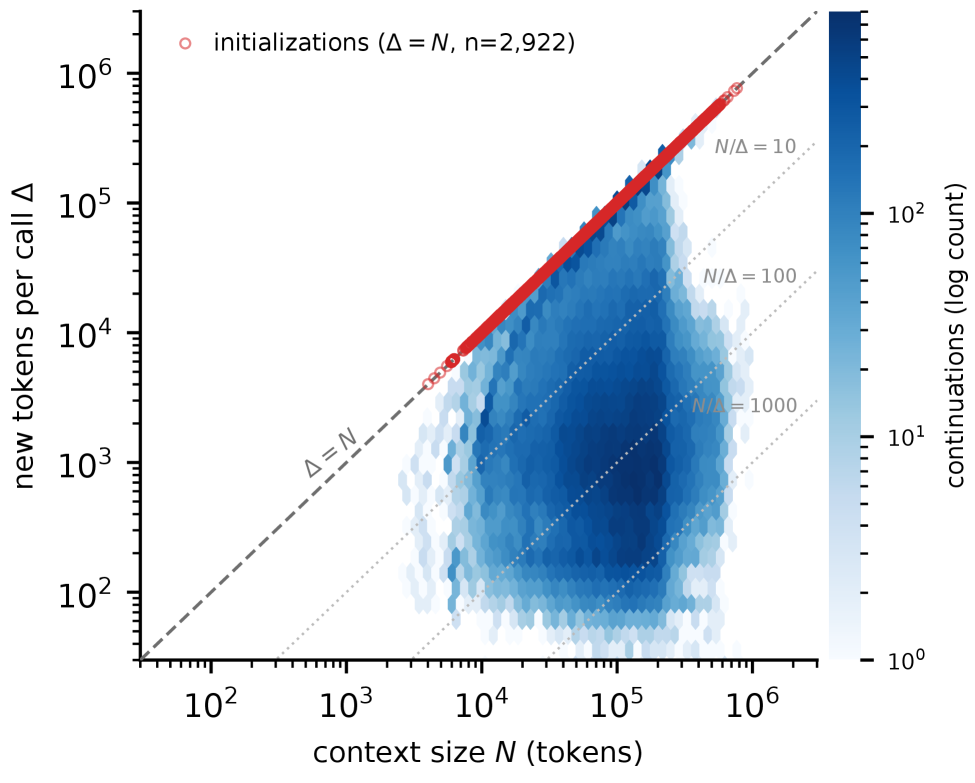
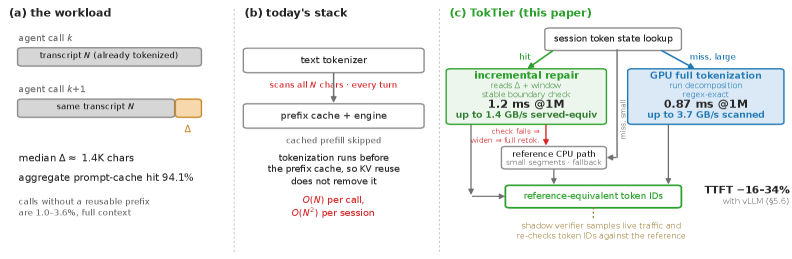
Researchers at (presumably) a large serving operation analyzed 153,951 real calls from two agent ecosystems and found that the median call appends only ~1,400 characters to an existing session — a trivial delta — yet the front end re-tokenizes the entire accumulated transcript every single time. At a 94.1% fleet prompt-cache hit rate, tokenization alone accounts for up to 64% of time to first token — meaning the dominant latency cost is no longer inference, it’s string parsing. Their system, TokTier, fixes this with a stateful tokenization service that re-tokenizes only a small window around the new append, then verifies a stable boundary before splicing. For full cold-start requests, it decomposes GPT-family regex pre-tokenization into GPU-parallelizable rules. Results: incremental repair on a 1M-character context runs in 0.5–1.1 ms, up to 437× faster than HuggingFace tokenization and 2.1× faster than the best cache-based baseline (Gigatoken) fully pre-warmed. GPU full tokenization of a 1M-character request completes in 0.87 ms, 491× below HF. In agentic workflow serving with vLLM, median time to first token drops 16–34% and P99 drops 23% under recorded bursts. The correctness guarantee is not approximate: they claim zero divergence across 1.5×10¹⁰ split checks, a 12.4 TB text corpus, and 93,000+ replayed agent steps across 17 tokenizer families.
Cold read
The headline numbers (437×, 491×) compare against un-optimized HuggingFace tokenization — a notoriously slow baseline that any competent infra team already avoids. The more honest comparison is the 2.1× improvement over Gigatoken fully pre-warmed, which is a real but modest win and comes with significant deployment complexity (stateful service, GPU sidecar, shadow verifier). The 16–34% TTFT reduction is measured on recorded bursts from their specific workloads — context window distributions, tool-call cadence, and cache-hit rates will differ substantially for most startups, especially those not running million-character sessions. The correctness claim of “zero divergence” is validated by a sampled shadow verifier, not exhaustive proof; boundary-case failures in production tokenization are exactly the bugs that surface at the tail. Finally, this paper describes infrastructure that makes sense at fleet scale with dedicated GPU capacity for tokenization alone — a four-repair-core-plus-one-GPU setup sustaining 1,821 req/s versus 40 req/s on a 16-core stateless front end is a compelling throughput argument, but it assumes you’re already saturating that stateless front end.
What it means for you
- Signal maturity: 3/5 — real problem, real numbers, but only production-deployable at meaningful scale
- Who gets hurt: API wrapper startups and multi-agent orchestration platforms that resell inference margins — their cost structure quietly degrades as session lengths grow
- What breaks if this is true: The assumption that “just call the API” is cost-neutral at agent scale; long-session agentic products are bleeding latency budget on a solved problem
- Why it might not land: Most founders aren’t running their own serving stack — they’re on OpenAI or Anthropic APIs where tokenization is invisible and opaque; this is an optimization for infra teams, not product teams
- Watch for: vLLM, SGLang, or a major cloud provider (AWS Bedrock, GCP Vertex) shipping a stateful tokenization layer as a first-class feature — that’s the signal this crosses from research into operator reality
Forecast as of 2026-08-03
By Q2 2027, at least one major open-source LLM serving framework (vLLM most likely) will ship a stateful incremental tokenization feature citing this work or an equivalent — but fewer than 20% of self-hosted deployments will enable it by default due to the operational complexity of managing session state.
Source: TokTier: Exact Stateful Tokenization for Agentic LLM Serving — Zhenyu Zhang, Zhichao Cao. https://arxiv.org/abs/2607.29678v1