Your AI Agent’s Long-Term Memory Is a Rotting Markdown Folder
Your AI Agent’s Long-Term Memory Is a Rotting Markdown Folder
Every serious agent deployment today is built on a quiet assumption: that your LLM can keep its own filesystem memory organized as it grows. A new systematic study tested that assumption. The answer is mostly “no” — and the implications for every agent product in production right now are uncomfortable.
What happened
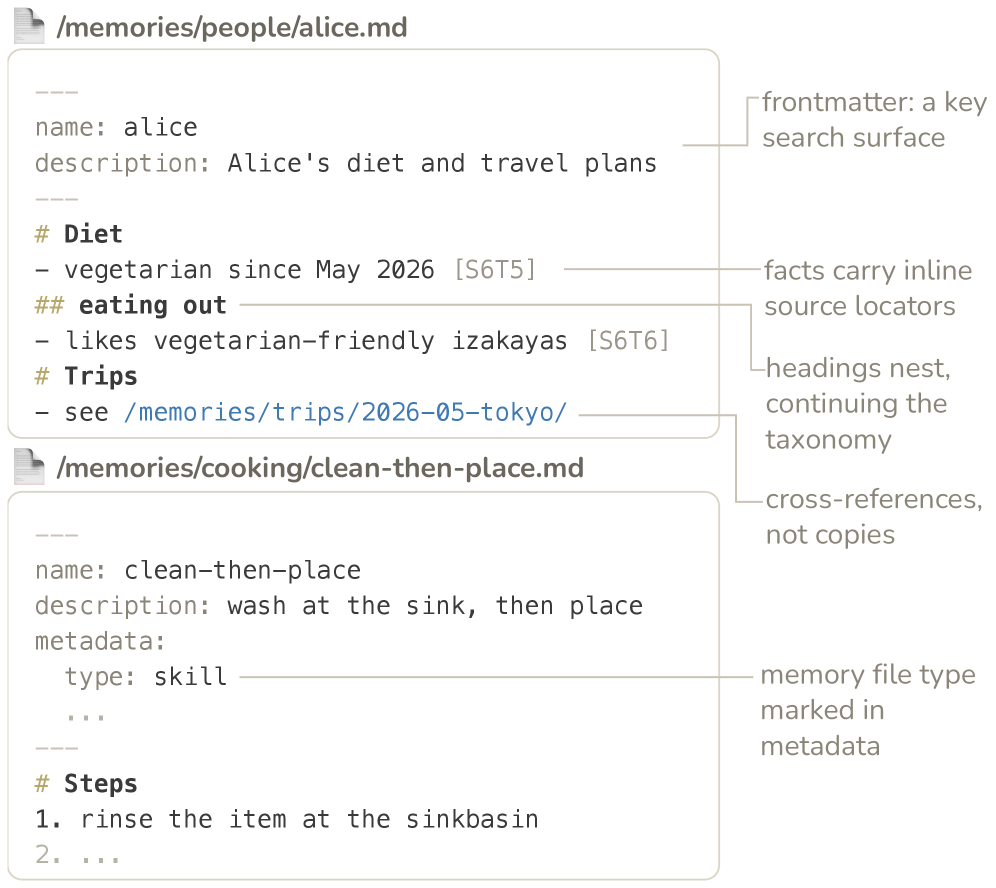
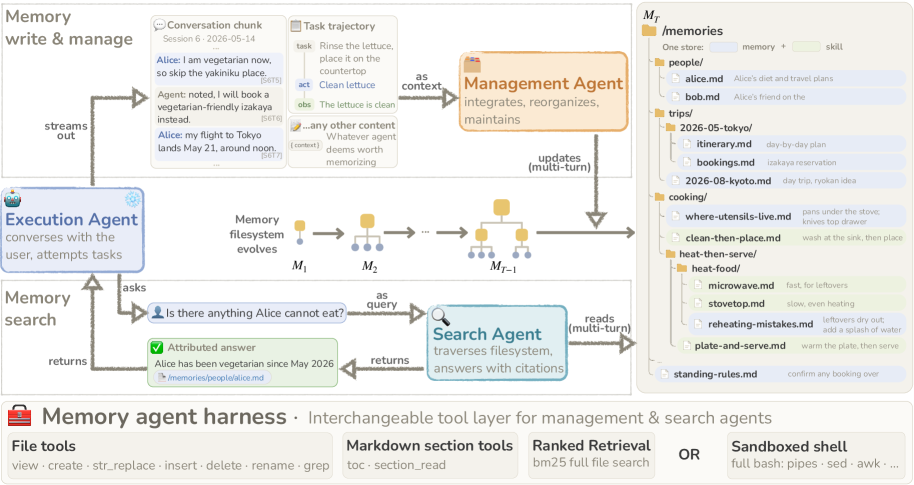
Researchers from UCSD, UIUC, and Adobe ran the first rigorous benchmark of filesystem-based agent memory — the now-common pattern where a deployed agent reads, writes, and reorganizes a directory tree of markdown files as its persistent store. They modeled three distinct roles: a management agent (organizes incoming content), a search agent (answers queries with cited sources), and an execution agent (distills task trajectories into reusable skills). They tested across long-conversation benchmarks and embodied tasks, varying memory shape (agent-organized hierarchy vs. verbatim dump vs. chunk retrieval), stream scale, and tool harness. The clearest finding: organized stores roughly halve retrieval cost when memory is large — real money at scale. The brutal finding: organization erodes over time for all but the strongest management agent, and no agent tested converted better organization into better answers. Perhaps most unsettling for teams treating model choice as the main lever: changing the tool set alone reshapes the store as strongly as swapping the model — a result with direct implications for anyone building on top of agentic workflows or multi-agent orchestration stacks.
Cold read
The cost savings (roughly halved retrieval cost) are real but narrow: they only materialize when the memory store is already large and well-organized — a condition the paper itself shows most agents can’t maintain. The benchmark tests are synthetic growth scenarios; real production memory streams are messier, more contradictory, and involve adversarial content the paper doesn’t model. The finding that “no agent converts organization into better answers” is damning, but the paper doesn’t isolate why — whether it’s a retrieval precision failure, a hallucination problem downstream, or a fundamental limit of the markdown-file representation. “Strongest management agent” is left loosely defined — founders can’t straightforwardly replicate that condition without knowing which model tier crossed the threshold. Finally, this entire study assumes you’re already committed to the filesystem pattern; it doesn’t compare against vector stores or RAG architectures as alternatives.
What it means for you
- Signal maturity: 3/5 — rigorous methods, narrow generalizability
- Who gets hurt: Startups shipping “autonomous agent” products that promise improving performance over time — your memory layer is probably degrading silently in production
- What breaks if this is true: The “agent gets smarter with use” retention narrative collapses; churn explains itself
- Why it might not land: Most teams will fix this by throwing a stronger model at the management role and calling it solved — until the next scale jump
- Watch for: Agent infrastructure vendors (LangChain, mem0, Letta) shipping explicit “memory health” metrics or store-reorganization services as a paid feature within the next two quarters
Forecast as of 2026-07-30
By Q2 2027, at least two major agent-framework vendors will have shipped a discrete “memory maintenance” or “store health” component as a first-class product feature — directly citing filesystem memory degradation as the motivation — and at least one will be charging for it separately from base inference costs.
Source: Filesystem-Based Memory for LLM Agents: Organization, Evolution, and Sustainability — Sizhe Zhou, Sheldon Yu, Hui Wei, Junda Wu, Siru Ouyang, Yizhu Jiao, Shijia Pan, Julian McAuley, Yu Zhang, Tong Yu, Jiawei Han. https://arxiv.org/abs/2607.26637v1