Your 80-Rule Prompt Is Already Dead and You Don’t Know It
Your 80-Rule Prompt Is Already Dead and You Don’t Know It
You’ve been shipping system prompts stuffed with brand guidelines, compliance rules, tone instructions, and edge-case handling. New controlled evidence says the model stopped listening somewhere around rule 50. Every call after that is a coin flip dressed up as obedience.
What happened
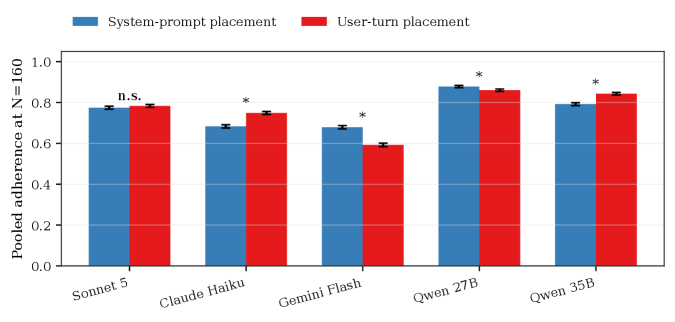
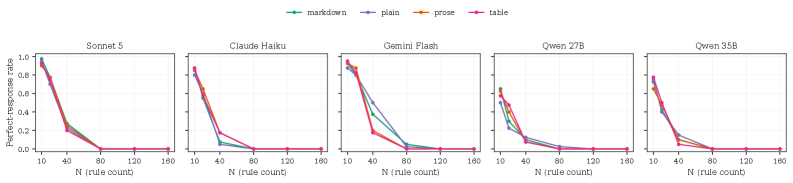
Researcher Netanel Eliav ran two controlled experiments on a purpose-built, contamination-free corpus — 8,780 uniquely-named synthetic entities in a “Book of Veyra,” regenerable from a fixed seed, specifically to sidestep benchmark contamination. Experiment 1 tested prompt engineering across instruction counts from 10 to 160, four formats (markdown, plain text, prose, tabular), and system-prompt vs. user-turn placement, across five models at 960 calls per model. The headline number: perfect-response rate collapses to zero by N=80 for every single model, format, and placement tested — no exceptions. Experiment 2 ran 5,520 calls per model on a 2k-to-512k-token context window ladder, measuring recall, hallucination, and sycophancy. Recall held near ceiling through 64–128k tokens, then fell sharply — one model’s accuracy spread hit 48 percentage points at 128k tokens depending on format alone. The alarming behavior near context limits wasn’t fabrication (0 instances across 5,760 probes) or sycophancy (≤8.3%); it was outright refusal to answer, climbing from 0% to 79–90% as models approached their ceilings. No reliable markdown advantage was found; one 35B model actually preferred plain text.
Cold read
This is one researcher, five undisclosed models, and a fully synthetic corpus — none of which is your production data, your users, or your actual task distribution. The “Book of Veyra” is designed to be clean and controlled, which is exactly the condition least likely to resemble your messy, real-world RAG pipeline or customer-facing chatbot. Neither of the pre-registered format ordering hypotheses held up, which is honest reporting — but it also means the study surfaces effects without reliably predicting direction, leaving you with “it matters” but not “here’s what to do.” The five models are unnamed in the abstract, so you cannot map these results to GPT-4o, Claude 3.7, or whatever you’re actually running in production. And the zero-fabrication finding, while reassuring, applies only to the narrow condition of factual recall from in-context text — not to open-ended generation, which is where hallucination actually bites operators.
What it means for you
- Signal maturity: 3/5 — Rigorous methodology, but synthetic corpus and unnamed models cap practical portability
- Who gets hurt: Any team running agentic workflows or multi-agent orchestration with long, rule-heavy system prompts — compliance, legal-tech, and enterprise SaaS builders especially
- What breaks if this is true: Every SLA built on “the model follows our 100-rule style guide” is fictitious; your QA process is catching noise, not systematic compliance
- Why it might not land: Models improve fast — the 80-rule cliff on the five models tested in 2025–2026 may shift on frontier models by the time you read this, and fine-tuning your own model on your ruleset sidesteps the prompt-count problem entirely
- Watch for: Model providers publishing their own controlled instruction-following benchmarks with explicit rule-count thresholds — if they go quiet on this, the results are replicating internally
Forecast as of 2026-07-22
By Q1 2027, at least two major enterprise LLM API providers (OpenAI, Anthropic, or Google) will publish official guidance or tooling — structured system-prompt schemas, instruction chunking, or equivalent — explicitly addressing instruction-count degradation, citing community benchmarks of this type as motivation. If that guidance doesn’t appear, the silence will itself confirm the industry is hoping operators don’t notice.
Source: Prompt Design at Scale: How Format, Instruction Count, and Context Length Shape Instruction Adherence and Hallucination in Large Language Models — Netanel Eliav. https://arxiv.org/abs/2607.19257v1