Your MoE Training Bill Just Dropped 62%—One Paper Claims to Know Why
Your MoE Training Bill Just Dropped 62%—One Paper Claims to Know Why
Training a billion-parameter mixture-of-experts model on a single 40 GB GPU was supposed to be impossible. A solo researcher just published results suggesting it isn’t—and the mechanism isn’t a new architecture, it’s a smarter opinion about where to put your optimizer’s notes.
What happened
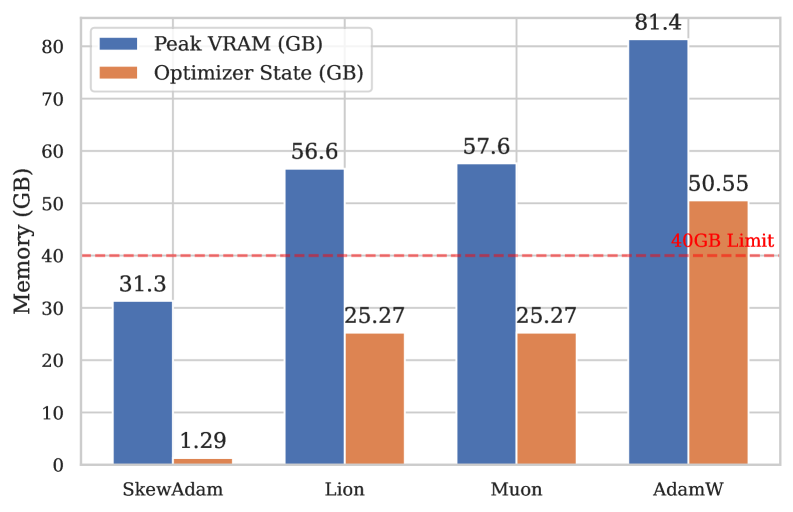
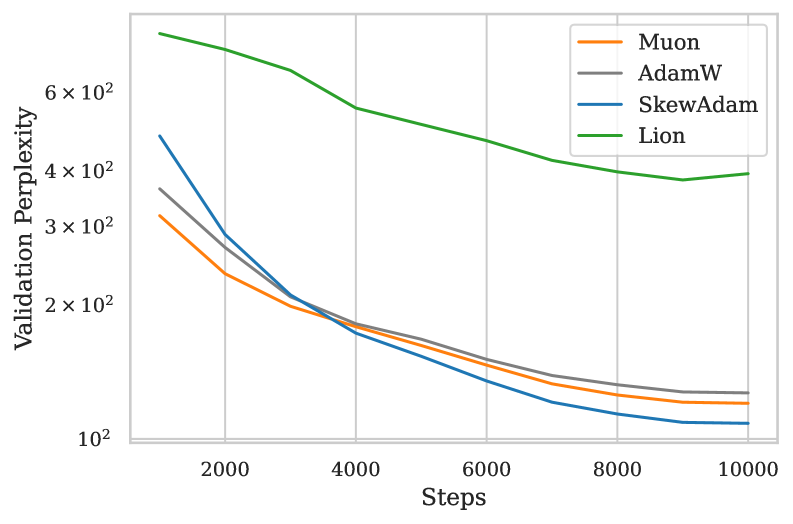
Nuemaan Malik studied a 6.78B-parameter large language model with a mixture-of-experts architecture and noticed something obvious in hindsight: AdamW treats all parameters identically, yet a MoE has three radically different parameter populations. The dense backbone is 5% of parameters, the expert layers are 95%, and the router is a rounding error at under 0.01%—but each has different gradient statistics. AdamW’s standard approach burns 50.6 GB storing first and second moments for 12.6 GB of weights, pushing peak training memory to 81.4 GB, well beyond a 40 GB accelerator. The proposed optimizer, SkewAdam, applies different state strategies per tier: full float32 momentum plus a factored second moment for the backbone, factored second moment only for the experts, and exact second moment for the tiny router. The result is a state footprint of 1.29 GB—2.6% of AdamW’s—and peak training memory collapses to 31.3 GB. In a controlled 82M-token run from identical initializations, SkewAdam reaches validation perplexity of 108.4 versus AdamW’s 126.8, Muon’s 120.2, and Lion’s catastrophic 393.7. Even carefully tuned AdamW only reaches 118.5. The paper’s most clarifying finding, useful for anyone building intuition about this on a benchmark contamination-aware basis: an ablation with twenty times the state matches SkewAdam’s perplexity, and Adafactor—which shares the factored estimator but drops momentum—plateaus 40 perplexity points behind. Memory savings come from the tiered allocation; accuracy comes from keeping momentum for the backbone.
Cold read
82 million tokens is a short run. For context, production-grade MoE models train on hundreds of billions to trillions of tokens; perplexity rankings established at 82M have a well-documented tendency to reorder themselves at scale. This is one architecture (6.78B-parameter MoE), one dataset, one researcher—no independent replication, no multi-seed variance reported, no confidence intervals on those perplexity numbers. The paper shows SkewAdam wins on validation perplexity, but perplexity and downstream task performance (the thing that actually matters for your product) are loosely correlated at best. The router load balance finding—settling within 1% of uniform floor—is genuinely interesting, but it is one number on one run, not a systematic study of collapse or instability modes that plague MoE training in practice. The core insight (different parameter populations deserve different optimizer treatment) is intellectually sound and not new in principle; what’s new is the specific recipe and the memory accounting. Whether that recipe survives contact with a real training run at 10× or 100× token budget is entirely unproven.
What it means for you
- Signal maturity: 2/5 — Single-author, short-horizon experiment; compelling mechanism, unproven at scale
- Who gets hurt: Cloud GPU providers whose value proposition rests on “you need our 80 GB A100 cluster to train anything interesting”—if 40 GB is sufficient for competitive MoE training, per-GPU economics shift
- What breaks if this is true: The assumption that MoE training is exclusively a hyperscaler game; smaller labs and well-funded startups could run competitive training jobs on commodity 40 GB hardware without multi-node optimizer state sharding
- Why it might not land: 82M tokens is a toy run; the perplexity gap may close or reverse at production token counts, and the factored second-moment approximation for 95% of parameters could degrade for very large expert counts or highly skewed routing distributions
- Watch for: An independent replication from a lab with actual compute—specifically, does SkewAdam’s perplexity advantage hold at ≥10B tokens, and does router load balance remain stable past early training
Forecast as of 2026-07-22
By Q1 2027, at least one independent research group will have replicated the SkewAdam approach at ≥10B tokens on a publicly documented MoE model; if the perplexity advantage shrinks below 5 points against tuned AdamW at that scale, the memory savings alone will still drive adoption as a cost optimization but the accuracy narrative will quietly disappear from the pitch.
Source: Where Should Optimizer State Live? Tiered State Allocation for Memory-Efficient Mixture-of-Experts Training — Nuemaan Malik. https://arxiv.org/abs/2607.19058v1