Your AI Safety Filter Has a Secret: It Speaks English
Your AI Safety Filter Has a Secret: It Speaks English
You built a multilingual product. You validated your evaluator on pairwise accuracy and shipped. Congrats — you just handed lower-resource-language users a systematically looser content filter. The bias is statistically significant, consistent across eight different models, and completely invisible to the metric you used to certify it.
What happened
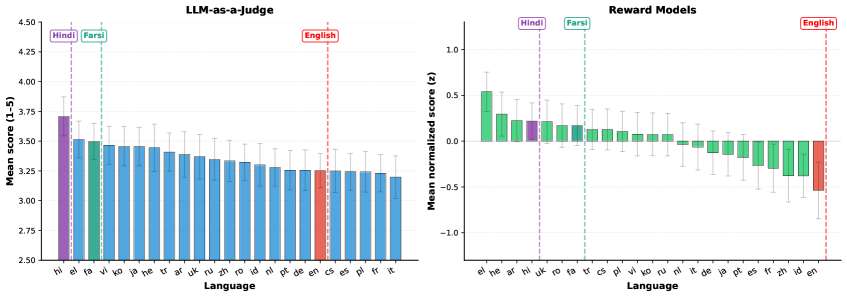
Researchers tested semantically identical instruction-response pairs across 23 languages using both trained reward models and LLM-as-judge evaluators. The core finding: multilingual evaluators assign meaningfully different scores to the same content depending on which language it’s written in. This isn’t noise — it’s structural. The bias held across eight open-weight evaluators of different architectures and persisted in frontier judges. The kicker is the directionality: lower-resource languages get scored more generously, not worse. That means the same harmful content has a materially higher chance of passing a safety filter if submitted in, say, Swahili than in English. The scale is not abstract — evaluators achieved above 90% pairwise accuracy (the standard golden dataset validation metric) while simultaneously showing up to 43% difference in acceptance rate across languages under a single global decision threshold. The authors also probed the mechanism: model uncertainty correlates with higher scores (less confident → more generous), and tokenization overhead for lower-resource languages likely drives that uncertainty — but language identity remains a significant predictor even after controlling for uncertainty, meaning this isn’t purely an artifact of content complexity.
Cold read
The 90% pairwise accuracy number sounds damning, but it’s worth noting that pairwise accuracy is a relative ranking metric — it was never designed to certify absolute score calibration across languages, so calling it a “failure” partly means using the wrong tool for the job. The study uses semantically identical pairs, a synthetic condition; in real products, content difficulty genuinely varies by language, which the authors acknowledge but cannot fully disentangle from the structural bias. We don’t know from the abstract whether the 43% acceptance-rate gap is uniform across languages or driven by a handful of extreme outliers among the 23 tested. The proposed fix — per-language thresholds — is immediately undermined by the authors themselves: code-switched prompts defeat language identification, so the attack surface may be larger than the remedy. Finally, “statistically significant” in a controlled academic setup does not automatically translate to operationally significant harm in any specific product deployment.
What it means for you
- Signal maturity: 4/5 — Robust methodology, eight models, quantified effect size; just short of production-validated.
- Who gets hurt: Any company running a moderation or quality-scoring pipeline on multilingual user content — trust & safety teams, RLHF-powered product teams, and anyone using a single LLM-as-judge evaluator across markets.
- What breaks if this is true: Your safety SLA is not uniform across markets. A product certified “safe” in English is providing weaker guardrails in Indonesian or Swahili — which is a regulatory and reputational liability in exactly the regions you’re trying to grow into.
- Why it might not land: Most startups aren’t doing adversarial multilingual probing; the attack requires knowing the threshold and the bias direction, so casual misuse is less likely than targeted exploitation.
- Watch for: A moderation incident or red-team disclosure involving lower-resource-language prompt hacking that bypasses an English-validated safety filter — that would move this from research finding to live exploit.
Forecast as of 2026-07-17
By Q2 2027, at least one major LLM API provider (OpenAI, Anthropic, Google, or Cohere) will publish a documented change to their evaluation or moderation pipeline specifically addressing cross-lingual score calibration — either as a safety bulletin or a model card update — citing findings in this class of research.
Source: LLM Evaluators are Biased across Languages — Ej Zhou, Lucas Resck, Zheng Hui, Anna Korhonen. https://arxiv.org/abs/2607.14480v1