Your Inference Bill Is Being Robbed by Attention Math — Maybe Not Anymore
Your Inference Bill Is Being Robbed by Attention Math — Maybe Not Anymore
Reasoning models are bleeding you dry on KV cache: a 32K-token chain-of-thought costs real memory and real dollars, and the standard fix — pruning tokens by attention weight — is apparently both noisy and production-hostile. A team from CMU says they’ve found a better signal hiding in the forward pass itself, no attention matrix required. That’s the pitch. Now let’s read the fine print.
What happened
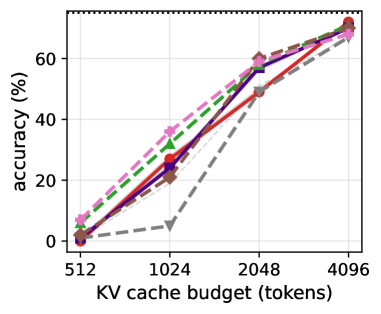
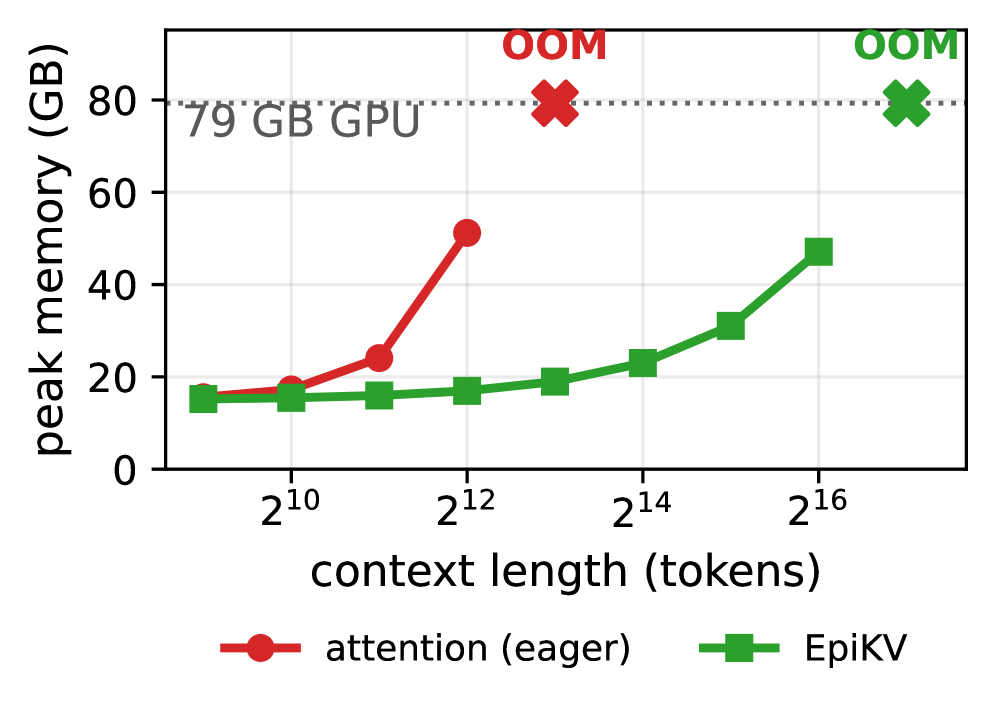
Steven Kolawole and Virginia Smith introduce the epiphany score: a metric derived from how much a token changes the model’s internal representation during the forward pass, rather than how much attention it receives. The key claim is that attention weights are a noisy importance proxy specifically in long reasoning traces — the kind chain-of-thought prompting produces — and that materializing the attention matrix blocks the use of fused kernels like FlashAttention. Their method, EpiKV, requires no training, no classifier, and no custom kernel modifications. At a 4,096-token cache budget, EpiKV hits 72% on MATH-500, matching the strongest attention-based baseline (ThinKV at 71%, H2O at 67%). A lag-normalized variant reaches 37% on AIME-2024 at 8,192 tokens versus the best competing method at 33%, while running at up to 2.8× the speed — and the authors report it scales to a 16× longer feasible context window than attention-based scoring.
Cold read
The benchmark results are narrow: MATH-500 and AIME-2024 are math reasoning tasks, which means the “noisy attention weight” critique and the epiphany score’s edge are validated almost entirely in one domain. Whether this generalizes to code generation, multi-step agentic workflows, or RAG-heavy retrieval tasks is entirely undemonstrated by the abstract. The 2.8× speed figure is plausible but suspiciously clean — speed comparisons are notoriously hardware- and batch-size-dependent, and we have no visibility into the evaluation setup. The AIME-2024 delta (37% vs. 33%) sounds impressive but is four percentage points on a notoriously hard, low-N benchmark where small sample variance can swing results. The method also applies a causal rolling z-score to remove a positional trend, which is a hand-engineered correction — the kind of thing that often degrades gracefully in production when input distributions drift from the eval conditions. “No training required” is a real selling point, but “no training required yet” is often what it becomes once edge cases accumulate.
What it means for you
- Signal maturity: 2/5 — single-paper, single-domain, no third-party replication
- Who gets hurt: Inference infrastructure vendors (Fireworks, Together, Anyscale-tier) selling optimized long-context throughput as a moat — if this holds, the moat shrinks
- What breaks if this is true: The business case for attention-matrix-dependent eviction middleware gets hollowed out; any startup that built proprietary cache management on top of attention scores now has a simpler, faster competitor they can’t easily block with IP
- Why it might not land: Math benchmarks are the single friendliest environment for a method that tracks representational “surprises” — open-domain or instruction-following tasks may show the epiphany score is just as noisy as attention weights in messier distributions
- Watch for: Independent replication on non-math tasks (coding evals, multi-turn agentic AI traces, long-document QA) — that is the specific signal that would move this from “interesting paper” to “deploy this quarter”
Forecast as of 2026-06-27
By Q3 2027, at least one major open-source inference framework (vLLM, SGLang, or equivalent) will have merged an epiphany-score-based eviction option — but it will carry a domain caveat in the docs, because replication attempts on non-reasoning tasks will have shown measurably smaller gains than the 4–5 point deltas reported here.
Source: Epiphany-Aware KV Cache Eviction Without the Attention Matrix — Steven Kolawole, Virginia Smith. https://arxiv.org/abs/2606.26472v1