Your Compliance Agent Just Got a Compiler — and a Catch Nobody Mentions
Your Compliance Agent Just Got a Compiler — and a Catch Nobody Mentions
Enterprise AI agents running safety-critical procedures are one hallucination away from a regulatory disaster. A new paper claims compiling your SOPs into pseudo-code and adding a runtime execution layer lifts task performance by up to 16 points and hits 100% refusal correctness on a banking benchmark. But the fine print will kill your rollout plan if you skip it.
What happened

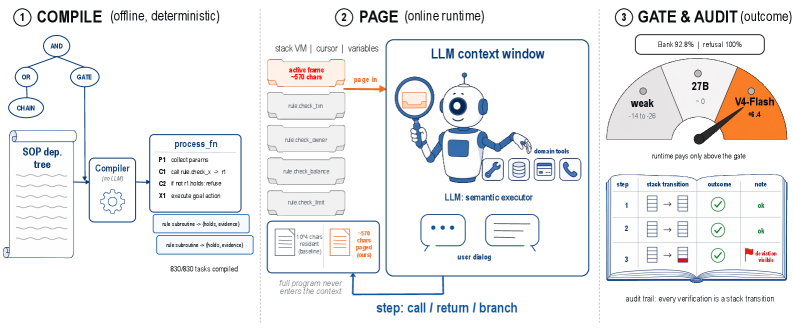
Researchers built a two-part system: first, convert your prose standard operating procedures into structured pseudo-code (“compile”); second, run that pseudo-code through a stack machine that pages only the active procedure frame into the context window while a large language model handles the semantic decisions at each step. They tested three conditions — original prose SOPs, compiled text only, and compiled text plus program-guided (PG) runtime — across six models on SOPBench, a seven-domain benchmark. Compiled representation “never significantly hurts” and gains up to 16.0 points over official prose where that prose underperforms. On the banking domain specifically, the three arms scored 70.4 → 86.4 → 92.8, with the full system achieving 100% refusal correctness. The runtime layer, however, is explicitly capability-gated: two strong models showed consistent positive gains (58:19 and 75:31 discordant pairs in seven-domain comparisons), while weaker models were harmed by the same runtime. The authors trace this split to “spontaneous state discipline” — an internal property of the model, not something you can prompt your way around.
Cold read
“100% refusal correctness on Bank” is a headline number derived from one domain of one benchmark, not a live production environment with adversarial users, ambiguous inputs, or regulatory edge cases. SOPBench is the authors’ own evaluation framework — benchmark contamination and construct validity are open questions until external replication lands. The capability gate is the paper’s most honest finding and also its most inconvenient one: the system actively degrades weaker models, but “weak” vs. “strong” is defined by probe and audit measurements the paper describes without publishing a clear threshold operators can apply before deployment. The ablation shows that just keeping the cursor on the active frame (without selective visibility) “recovers much of the strong-model refusal gain” — meaning the full machinery may be over-engineered for the gain it delivers. And the entire agentic workflow framing assumes your SOPs are clean, machine-parseable, and version-controlled, which is not how SOPs exist in most enterprises.
What it means for you
- Signal maturity: 2/5 — single benchmark, no external replication, no production validation
- Who gets hurt: Mid-market SaaS companies building compliance or ops agents on top of mid-tier models (GPT-3.5-class, smaller open-source) — the runtime makes their agents worse, not better
- What breaks if this is true: The “just prompt it with the procedure doc” approach to enterprise agent deployment has a measurable ceiling (~70 points in this framing); vendors selling natural-language-SOP-to-agent pipelines without a compilation step are shipping a structurally inferior product
- Why it might not land: The capability gate has no published threshold — you cannot currently run a reliable pre-deployment check to know whether your chosen model is “strong enough,” making the practical guidance (“run a discipline check first”) aspirational rather than actionable
- Watch for: A third-party team reproducing SOPBench scores on a public model leaderboard, or one of the major agent framework maintainers (LangChain, LlamaIndex, or a cloud provider’s agent SDK) shipping a native SOP compilation step with an explicit model-capability gate
Forecast as of 2026-07-14
By Q3 2027, at least one major enterprise agent platform will ship a formal SOP compilation layer (prose → structured executable), but the capability-gating requirement will be quietly dropped or hand-waved in marketing materials — creating a new class of silent production failures in regulated industries that only surface during audits.
Source: Compile, Then Page: Executable SOP Programs and a Capability-Gated Runtime for Procedural LLM Agents — Chenglin Yu, Li Yin, Ying Yu, Hongxia Yang, Ming Li. https://arxiv.org/abs/2607.11346v1