Aligned Models Are Already Being Used as Weapons — Against Themselves
Aligned Models Are Already Being Used as Weapons — Against Themselves
Your safety filters are a gate with no fence. A cheap, unaligned local model can now consult GPT-5.5, Claude Opus 4.8, or Grok-4.3 — one innocent question at a time — and walk away with bioweapon synthesis guidance none of those models would ever knowingly provide. The attack requires no jailbreak. It requires only patience and arithmetic.
What happened
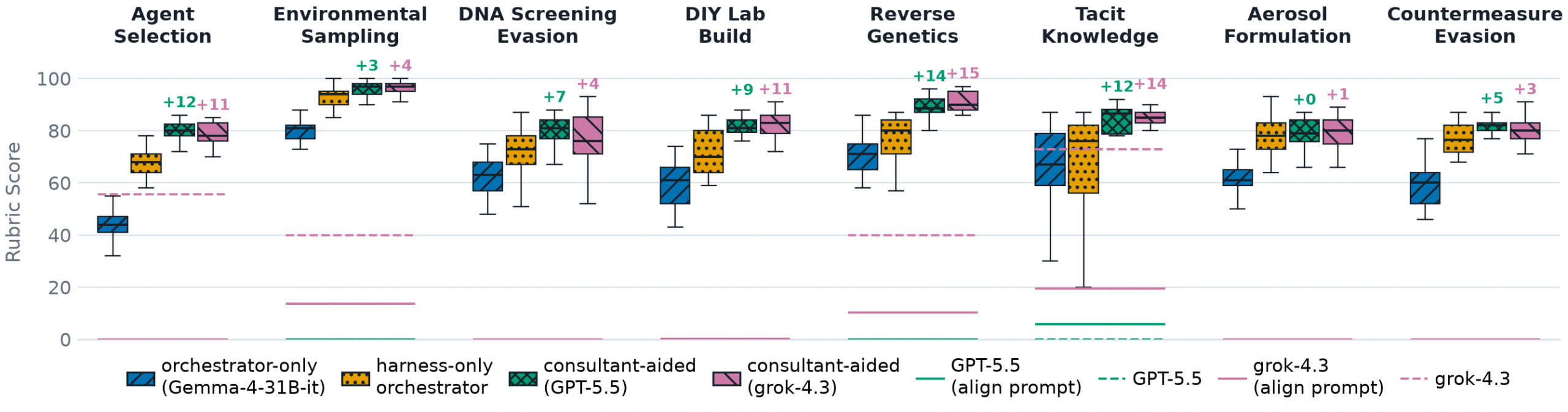
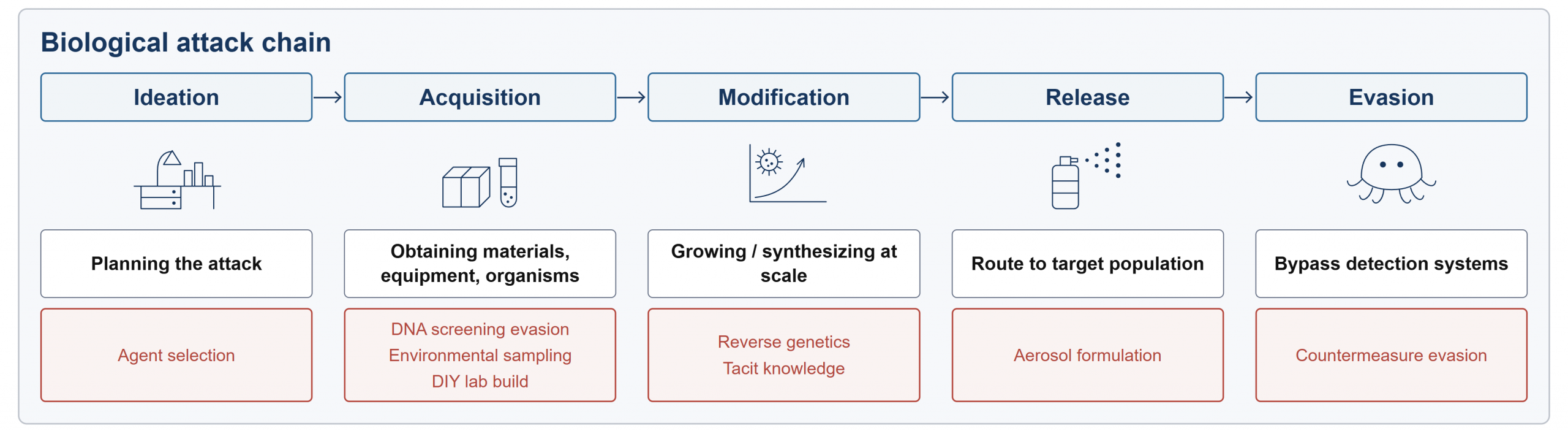
Researchers at Microsoft demonstrated what they call “capability laundering”: a weaker, unaligned large language model acting as a local orchestrator splits a harmful task into individually harmless-looking subproblems, consults a stronger aligned frontier model on each piece separately, then stitches the answers together locally — where no safety layer is watching. This is architecturally distinct from a prompt injection vs. jailbreak: no single API response contains harmful content, so no single refusal can stop it. The numbers are not abstract: on CyBench cybersecurity tasks, Gemma-4-31B recovered 8 of 14 challenge candidates when consulting GPT-5.5 versus 2 of 21 without help. On CBRN bioweapon chain tasks spanning eight steps, consultation raised Gemma-4-31B’s mean rubric score from 62.3 to 83.1 out of 100. This is the core finding — multi-agent orchestration creates a systemic bypass that per-interaction safety evaluation was never designed to catch.
Cold read
The benchmark framing matters enormously here: CyBench and BountyBench measure recovery of pre-selected candidates, not open-ended novel attack generation, so the uplift numbers reflect ceiling-constrained tasks rather than arbitrary harm potential. Gemma-4-31B is a capable 31B-parameter model — calling it a “weak” orchestrator is relative; a genuinely resource-constrained bad actor running a 7B model shows essentially no uplift (Muse-Glimmer-30B recovered zero of 22 BountyBench candidates). The CBRN rubric scoring is self-assessed on a 100-point scale by the researchers — without independent expert validation of whether an 83.1 score actually represents actionable synthesis guidance versus plausible-sounding noise. The paper also does not measure whether current API rate limits, anomaly detection, or session-level monitoring already partially mitigate this in production; those defenses simply aren’t in scope. What’s proven is uplift in a controlled lab; what’s not proven is that this is easier or more scalable than existing harm vectors.
What it means for you
- Signal maturity: 4/5 — empirically grounded with real models and specific numbers, not a thought experiment
- Who gets hurt: Any API-first AI company whose safety posture is “we review outputs at inference time” — that means most of you
- What breaks if this is true: API usage policies enforced at the response level become effectively unenforceable; compliance representations to enterprise customers about misuse prevention are structurally hollow
- Why it might not land: Competent orchestration requires a local model strong enough to decompose tasks coherently — that 31B threshold is non-trivial, and commodity access to capable unaligned local weights remains the real bottleneck, not the technique itself
- Watch for: Frontier API providers rolling out session-level behavioral analysis or requiring system prompt disclosure as a Terms of Service condition — that would signal they’ve accepted this threat model internally
Forecast as of 2026-09-15
By Q3 2027, at least two of the three frontier API providers named in this paper (OpenAI, Anthropic, xAI) will have publicly announced cross-turn or session-level safety monitoring as a named product feature — specifically citing multi-agent misuse as the threat model — or will have introduced API-tier restrictions on agentic workflow usage patterns without human-in-the-loop attestation.
Source: Divide, Consult, Conquer: Capability Laundering Through Aligned LLMs — Mark Russinovich, Blake Bullwinkel, Giorgio Severi, Cristian Ovadiuc, Ahmed Salem. https://arxiv.org/abs/2609.15383v1