Your AI Agent Is Forgetting Things Because Your Memory Store Is Too Far Away
Your AI Agent Is Forgetting Things Because Your Memory Store Is Too Far Away
Every time your agent completes a step, it’s reasoning over stale context — because querying memory across the network is too slow to do it any other way. One paper says the fix costs nothing but an architectural opinion. That’s the pitch. Here’s what the data actually shows.
What happened
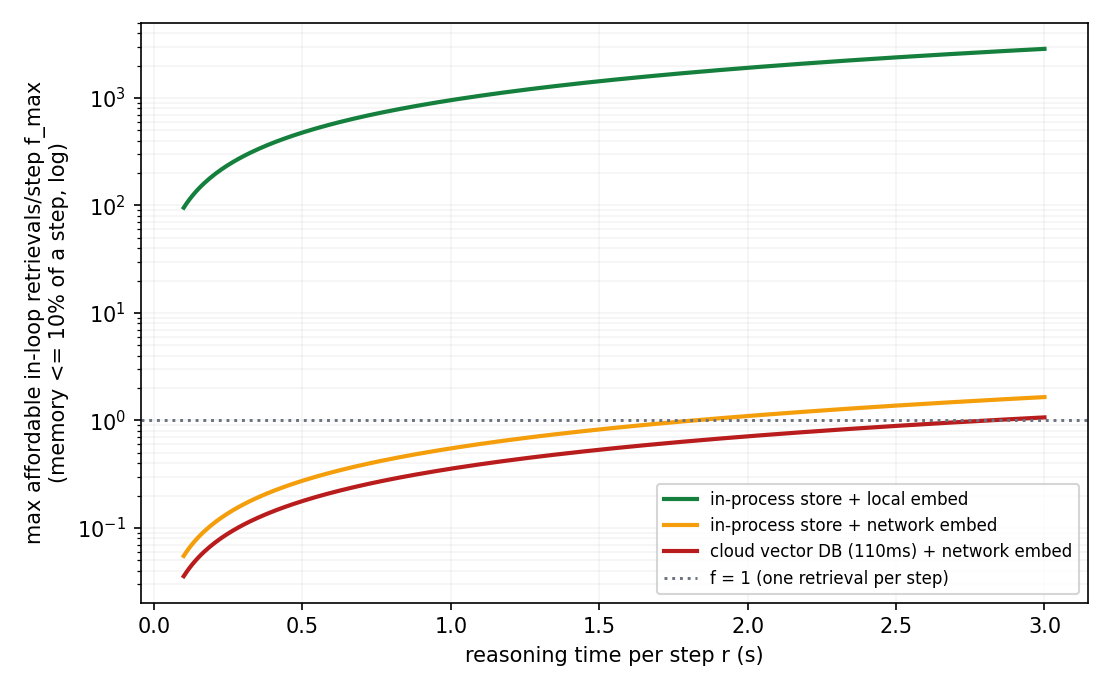
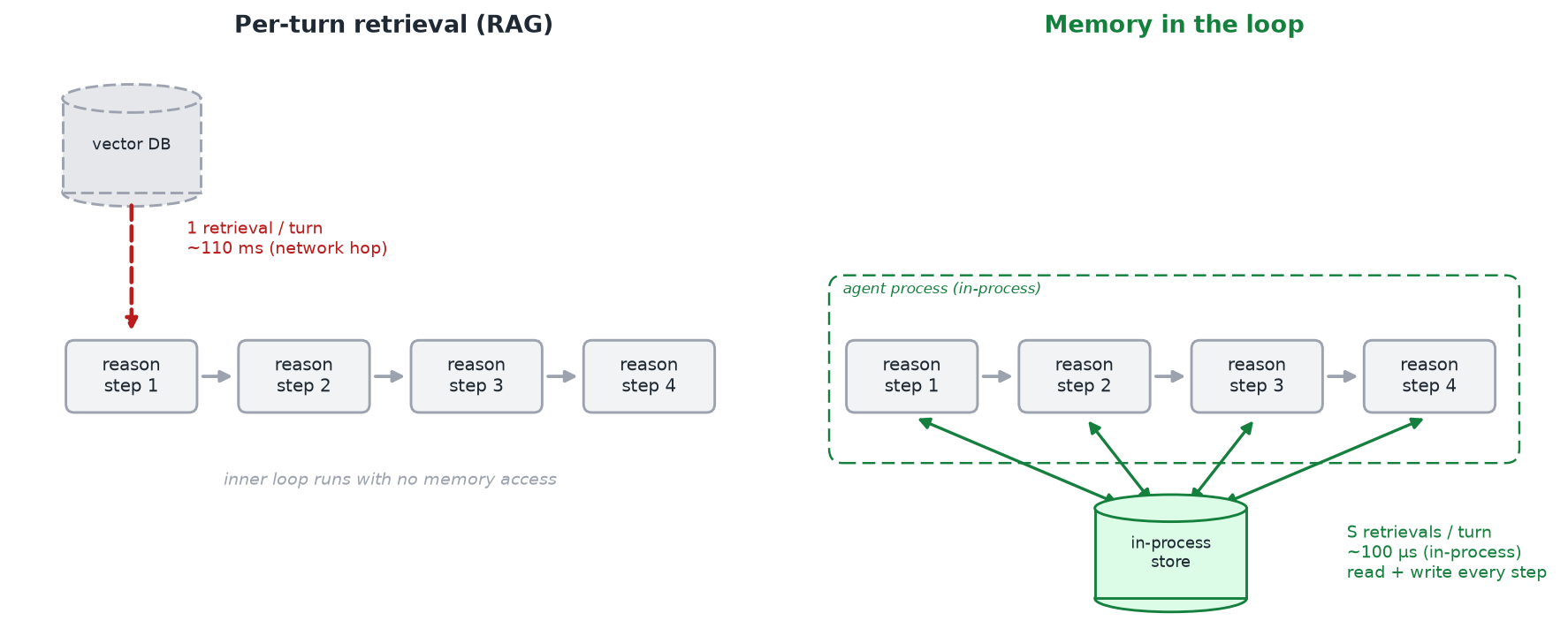
Khan and Lipizzi ran a targeted experiment on where memory lives relative to the agent’s agentic workflow loop, not outside it as a once-per-turn retrieval-augmented generation call, but inside it, read and written on every single step. The core finding: networked memory stores (cloud round-trip ~110ms) cause redundant actions to balloon — 7.2 out of 12 steps were redundant at that latency, versus 0.0 out of 12 when the store answered in ~100 microseconds in-process. That’s three orders of magnitude difference in speed, and it maps almost cleanly onto wasted work (permutation test p=0.0079). On a recall task under a bounded context window, in-loop memory lifted scores from 0/5 to 3.6–4.8/5 across four GPT-5-class models, with store operations clocking in at 80–165 microseconds at p50. The paper also identifies that the real latency villain isn’t the store itself — it’s the embeddings call, which runs 200–400ms over the network; move the embedder local and the whole operation drops to ~40 microseconds.
Cold read
This is a small, controlled experiment: 12-step tasks, 5-item recall tests, a fixed set of GPT-5-class models — not a broad benchmark. The authors’ own results include an inconvenient footnote: a “restate-every-reply” baseline — just instructing the model to repeat key facts each turn — also achieves perfect recall (5/5), at the cost of tokens that grow with working set size. That’s a much simpler solution, and the paper doesn’t conclusively show when the token cost of restating beats the engineering cost of deploying in-process memory. The agent memory vs. context window tradeoff is real, but 244 writes across unspecified runs is a thin empirical base. The extended-mind thesis framing is philosophy, not engineering proof — it’s doing rhetorical work here that the data can’t fully support. The finding that every miss traces to the agent’s read policy, not the store, is actually the most important result, and it points away from infrastructure toward prompt and agent design.
What it means for you
- Signal maturity: 2/5 — interesting directional result; too small and too controlled to operationalize yet
- Who gets hurt: Teams building multi-step agents on managed cloud vector stores (Pinecone, Weaviate SaaS tier) who are paying per-query latency AND per-query cost at high step counts
- What breaks if this is true: The “call the vector DB once per turn” architectural pattern, which is baked into most RAG frameworks and agent SDKs today, becomes a performance antipattern for long-horizon agents
- Why it might not land: The “restate-every-reply” baseline is embarrassingly competitive for short working sets, and most production agent tasks today have short working sets; the in-process store adds ops complexity that founders won’t accept for marginal gains
- Watch for: LangChain, LlamaIndex, or a major cloud provider shipping an “in-process memory” primitive with sub-millisecond SLA claims — that’s the signal that this pattern is graduating from research to infrastructure
Forecast as of 2026-07-09
By Q1 2027, at least one major agent framework (LangChain, LlamaIndex, or equivalent) will ship an in-process or embedded-store memory option with documented sub-millisecond retrieval benchmarks, citing redundant-action reduction as the motivation — but fewer than 20% of production agent deployments will have adopted it, because the token-restatement baseline remains simpler to implement.
Source: Memory in the Loop: In-Process Retrieval as Extended Working Memory for Language Agents — Yusuf Khan, Carlo Lipizzi. https://arxiv.org/abs/2607.05690v1