Your Multimodal AI Agent Is Burning Money Re-Reading the Same Frames Repeatedly
Your Multimodal AI Agent Is Burning Money Re-Reading the Same Frames Repeatedly
Every time your agent scrolls back through a video, a UI screenshot, or a rendered doc, it’s re-encoding from scratch — paying full compute twice for pixels it already saw. A new paper says it has a training-free fix, and the numbers are specific enough to take seriously.
What happened
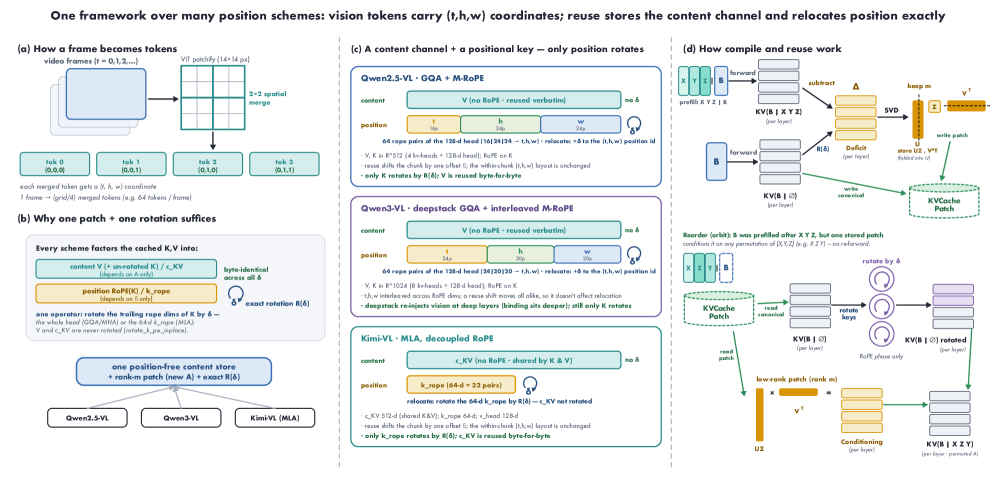
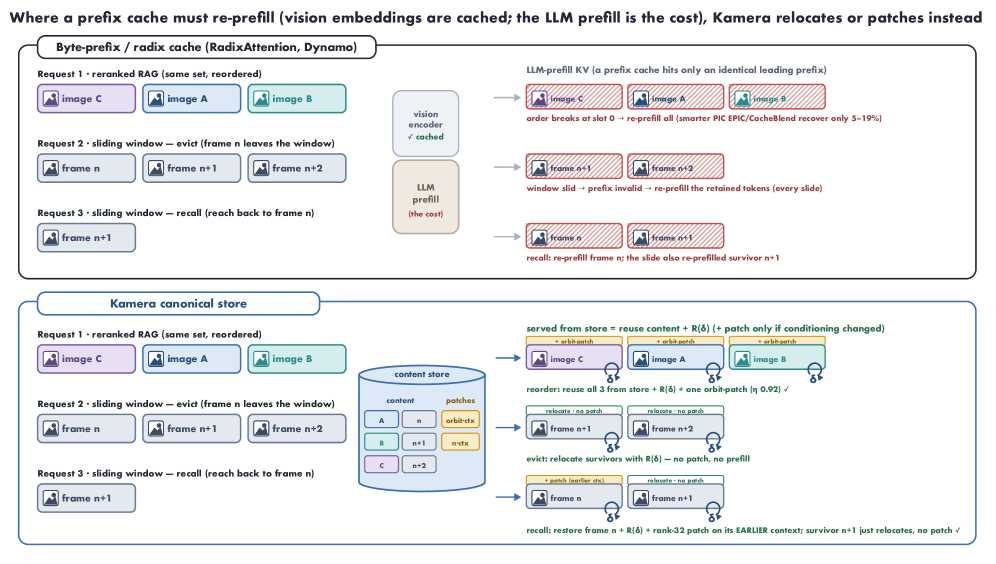
Researchers from FAU Erlangen-Nürnberg identified a concrete, measurable failure in how multimodal agents handle repeated visual context: because standard prefix caches only work at a fixed leading position, any time a cached chunk moves — due to a sliding context window, reordering, or eviction — the system re-encodes from scratch rather than reusing. The team isolated exactly what naive KV reuse loses: not the direct readout of the cached chunk (that’s recovered “exactly and for free” by a standard state-merge), but the cross-chunk conditioning — the influence neighboring chunks have on each other, concentrated in deep transformer layers. This loss is asymmetric and brutal in practice: blind reuse leaves single-hop recall intact while halving multi-hop accuracy. Their fix, Kamera, stores a small low-rank patch alongside each position-free cached chunk, and applies one operator — exact RoPE re-rotation plus the patch — to make the chunk reusable at any position. The system is tested across MLA, GQA, and MHA attention families, six model backbones in a production SGLang kernel, and benchmarks including MM-NIAH and two-page doc-QA, reconstructing re-prefill KV “to within bf16 rounding.”
Cold read
The headline result — recovering “full task accuracy” — is doing a lot of work, and the abstract doesn’t quantify what rank-m means in practice: how big is the patch, and what’s the actual memory overhead versus the KV cache it’s meant to shrink? “Fraction of the KV footprint” is not a number. The benchmark suite (MM-NIAH, two-page doc-QA) is narrow; these are relatively controlled retrieval tasks, not the messy, long-horizon agentic workflows where the real recompute budget gets spent. The claim that the fix is “training-free” is appealing but suspicious — a stored low-rank patch per chunk is itself a form of learned compression, and it’s unclear how the patch is generated without any training signal. Production integration is claimed via SGLang, which is a real signal of engineering seriousness, but six backbones tested in a kernel demo is not the same as six backbones deployed under production load and latency constraints. Benchmark contamination risk is also non-trivial on tasks this specific.
What it means for you
- Signal maturity: 2.5/5 — Technically specific and production-adjacent, but too many unquantified costs to act on yet
- Who gets hurt: Inference infrastructure vendors and cloud AI providers selling multimodal compute by the token — if this works, their recompute revenue shrinks
- What breaks if this is true: The economic case for throwing more GPUs at long-context video and UI agents weakens; the moat shifts from raw inference scale to cache management efficiency
- Why it might not land: Patch generation cost and memory overhead aren’t disclosed; if storing patches per chunk costs more than the recompute they save, the whole arbitrage collapses
- Watch for: SGLang or vLLM merging a Kamera-compatible kernel, or a major inference API provider citing KV reuse rates as a billing-relevant metric
Forecast as of 2026-06-23
By Q4 2026, at least one open-source inference framework (SGLang, vLLM, or equivalent) will ship a position-invariant KV cache feature citing this line of research — but production adoption in multimodal agent stacks will remain under 15% of deployments by end of 2026, gated on the unresolved memory-overhead question.
Source: Kamera: Unified Position-Invariant Multimodal KV Cache for Training-Free Reuse — Bole Ma, Jan Eitzinger, Harald Koestler, Gerhard Wellein. https://arxiv.org/abs/2606.23581v1