Your AI Coding Agents Are Quietly Poisoning the Codebase They Share
Your AI Coding Agents Are Quietly Poisoning the Codebase They Share
You benchmarked the agent. You shipped the agent. You celebrated the merge rate. But the damage isn’t in any single PR — it’s accumulating in your repository right now, invisible to every eval you’re running. A new study of 930,000 agent-authored pull requests says the risk isn’t the agent. It’s the ecosystem your agents are rewriting together.
What happened
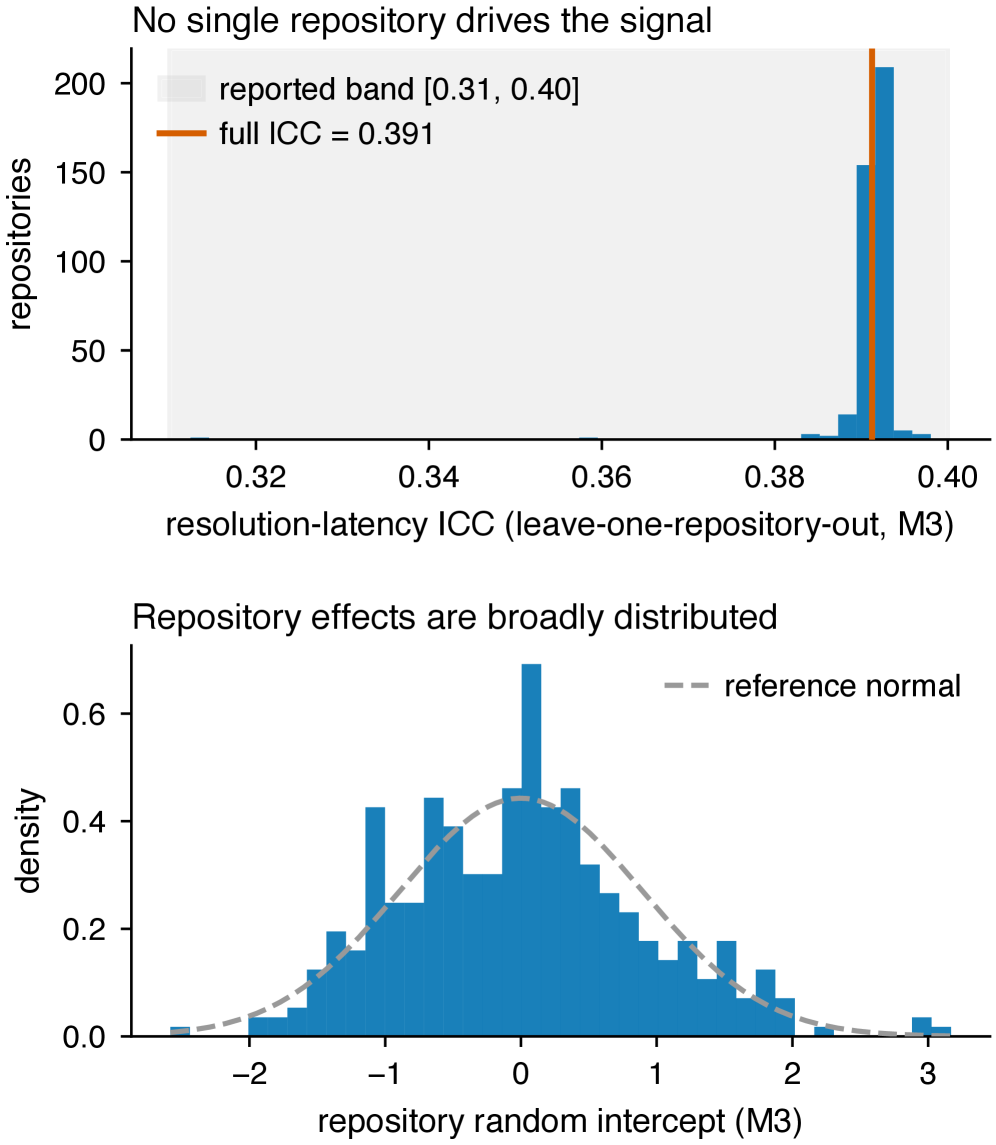
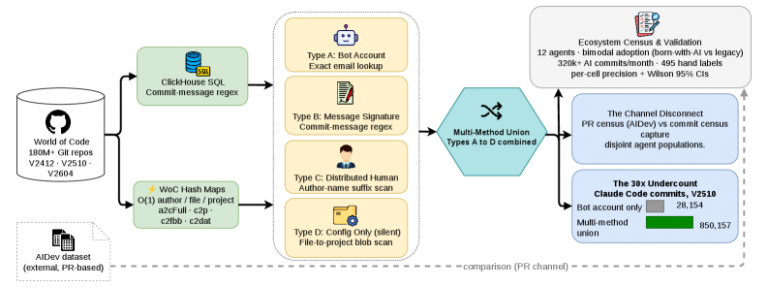
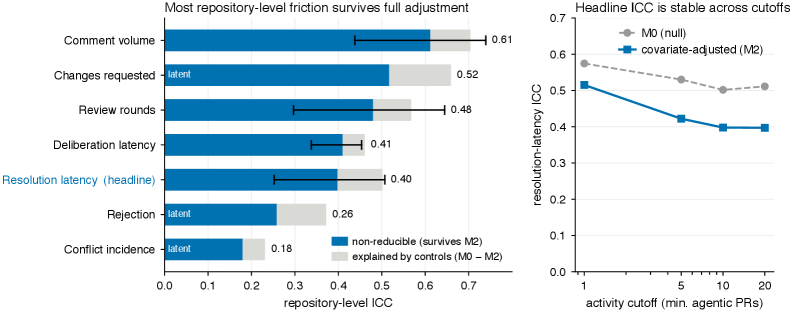
Daniel Russo studied integration friction — the cost of merging a contribution into a codebase that other contributors are simultaneously changing — across more than 930,000 agent-authored pull requests. The core finding: roughly half of the variation in integration friction stays at the repository level after controlling for the individual contribution, its author, its size, and which agent produced it. That repository-level signal survives full statistical controls. Worse, agent-authored contributions concentrate this friction at the repository level roughly twice as much as human contributions do — an intraclass correlation of 0.30 versus 0.16 — and that gap holds after controlling for codebase size, age, task shape, process maturity, and merge path. The implication is that the standard evaluation paradigm for agentic workflows — isolate one agent, run it on a benchmark, measure its output — is measuring the wrong unit of risk. What accumulates in a shared repository is a property of the ecosystem, not any single agent. Standard benchmark contamination concerns aside, even clean per-agent evals tell you almost nothing about what your repo looks like six months from now.
Cold read
This is a correlational study. Russo measures that friction concentrates at the repository level for agent-authored code — he does not establish a causal mechanism for why, nor does he demonstrate that any specific intervention reduces the effect. The dataset is large (930K PRs), but we don’t know the distribution across repository types, languages, team sizes, or agent vendors — a skew toward particular ecosystems could inflate or deflate the ICC numbers significantly. “Integration friction” is a defined construct, not a universally agreed metric; different operationalizations could yield different ICC ratios. The 0.30 vs. 0.16 ICC gap sounds alarming but both numbers are in the low-to-moderate range — most friction still lives outside the repository level, meaning per-agent improvements are not meaningless, just incomplete. And the paper argues for ecosystem-level governance without specifying what that governance looks like in practice, which is where the hard work actually begins.
What it means for you
- Signal maturity: 3/5 — Large dataset, real effect, but no intervention evidence and no causal chain yet
- Who gets hurt: Platform engineering teams and CTOs who bought “just run more agents in parallel” as a scaling strategy — their repos are the petri dish
- What breaks if this is true: Per-agent SLAs and per-agent evals become contractually and operationally misleading; any vendor selling you an agent on isolated benchmark scores is selling you the wrong unit of analysis
- Why it might not land: Repository-level governance tooling barely exists; organizations will default to what they can measure (per-agent evals) because ecosystem-level measurement requires instrumentation they don’t have
- Watch for: Enterprise dev-platform vendors (GitHub, Linear, Atlassian) shipping repository-health dashboards that explicitly segment human vs. agent contribution friction — that’s the commercial signal that this finding has crossed from paper to product
Forecast as of 2026-06-29
By Q4 2027, at least two major enterprise dev-platform vendors will ship a native “agent contribution health” metric distinguishing repository-level friction from per-agent output quality — if this paper’s framing is right, the demand signal from platform engineers will be impossible to ignore. If no such product ships by then, the finding stayed academic.
Source: Govern the Repository, Not the Agent: Measuring Ecosystem-Level Risk in AI-Native Software — Daniel Russo. https://arxiv.org/abs/2606.28235v1