Your Frozen LLM Just Got a 128K Context Window for 80% Less Compute
Your Frozen LLM Just Got a 128K Context Window for 80% Less Compute
The GPU memory bill for long-context inference is the silent killer of AI product margins. A new modular add-on claims to slash both compute and peak GPU memory by ~80% at 128K tokens — without touching your existing model weights. That’s either a paradigm shift or a very convincing magic trick.
What happened
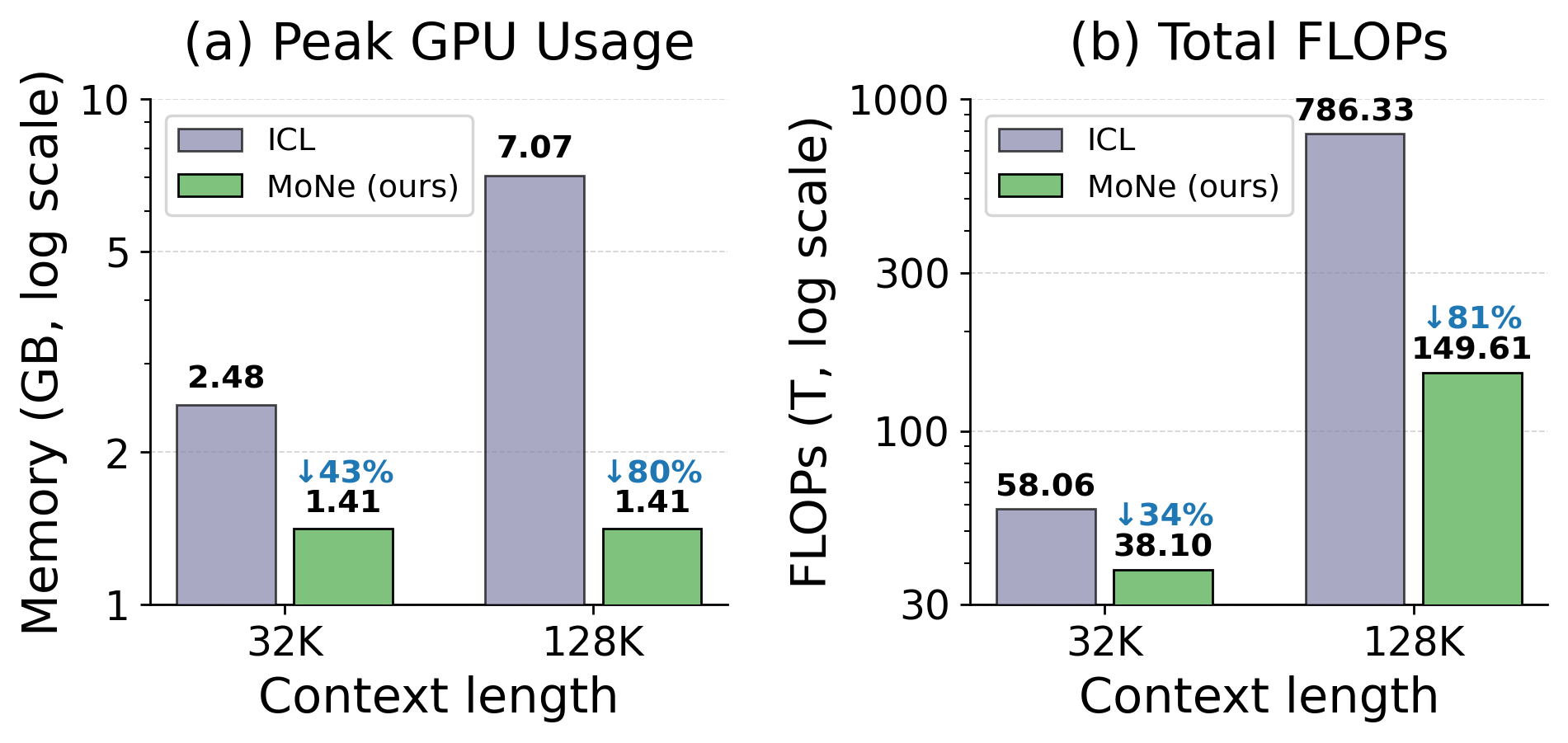
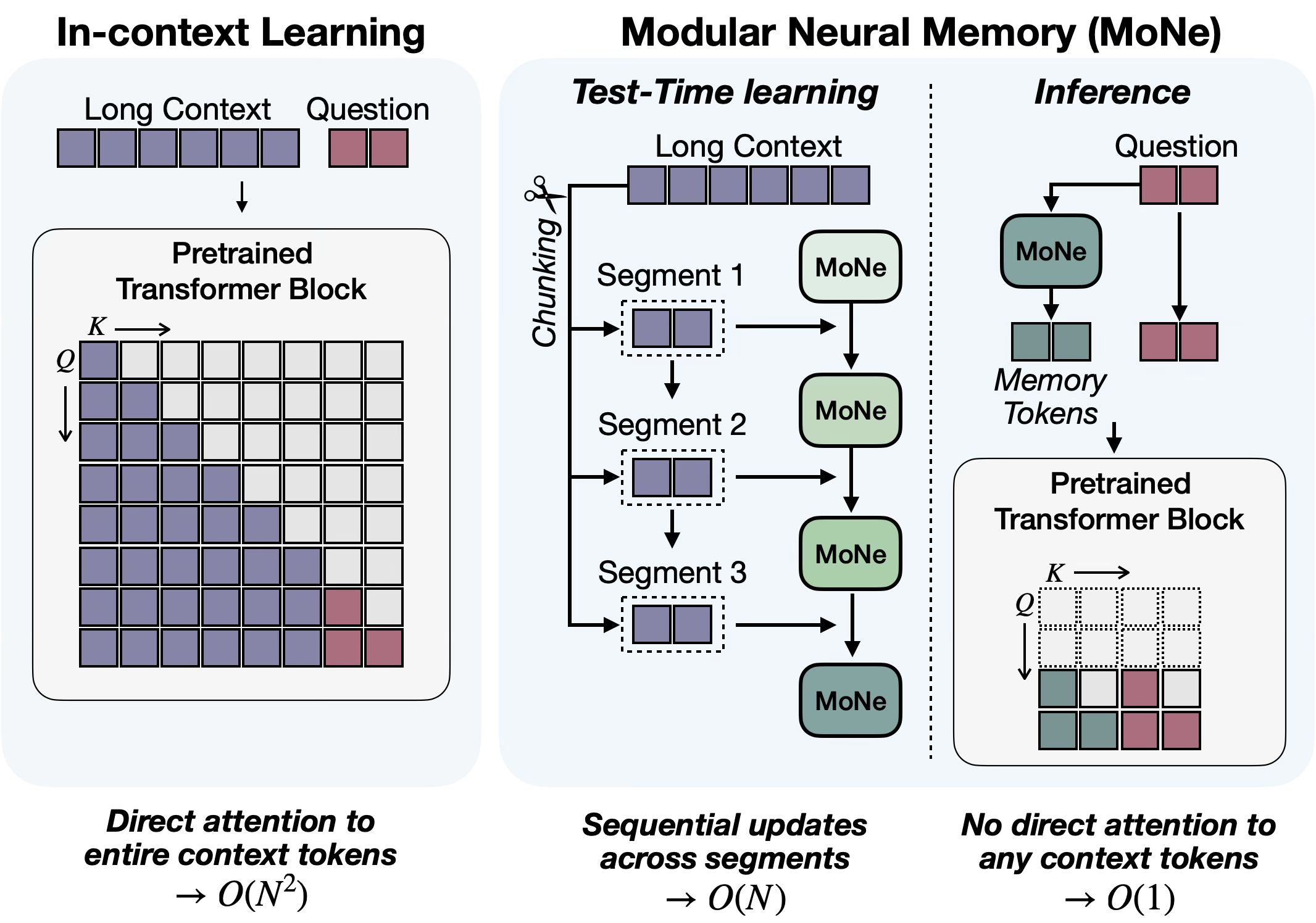
Researchers from Samsung and collaborators introduced MoNe, a lightweight neural memory module that bolts onto any frozen pretrained Transformer — no retraining required. It works in two phases: during a preprocessing pass, it reads the context in fixed-size segments and encodes that information into fast-weight neural memory networks via test-time learning with layer-localized gradient updates. At actual query time, the memory generates keys and values from the query tokens alone, with zero re-reading of context tokens. The architectural consequence is significant on paper: preprocessing scales as O(N) in context length, but query cost is O(1), and peak GPU memory does not grow with context size. At 128K tokens, the authors report approximately 80% reduction in both compute and peak GPU memory versus standard in-context learning, with only 6.4% parameter overhead added to the backbone. MoNe also claims strong performance on needle-in-a-haystack and word extraction benchmarks from the RULER suite — tasks where vanilla long-context window inference reportedly degrades sharply — and generalizes to context lengths beyond the backbone’s native window without fine-tuning the backbone itself. Think of it as a form of agent memory vs. context window arbitrage: offload the retrieval burden to learned weights rather than live attention.
Cold read
The 80% compute and memory reduction is measured against standard ICL (full attention over the whole context) — the most expensive possible baseline, not a tuned alternative like sliding-window attention, sparse attention, or retrieval-augmented generation. The abstract does not disclose accuracy numbers on those RULER benchmarks, only that performance is “strong” and that ICL “degrades sharply” — this is qualitative, not quantitative, and you should treat it with suspicion until you see the actual delta. Test-time learning via gradient updates introduces a preprocessing step that has its own latency and memory footprint during the encoding phase; the abstract is silent on how long that phase takes, which matters enormously for real-time or low-latency applications. The claim of generalization “far beyond the backbone’s native window” is extraordinary — benchmark contamination and distributional mismatch between training and test-time contexts are well-known failure modes that the abstract doesn’t address. Finally, “frozen pretrained Transformer” plug-and-play claims have a long history of working well in lab conditions and poorly in production, where quantization, custom CUDA kernels, and serving infrastructure complicate clean module attachment.
What it means for you
- Signal maturity: 2/5 — Abstract-stage results, no open weights, no independent replication yet
- Who gets hurt: Inference infrastructure startups and cloud providers whose pricing models depend on context-length-proportional GPU consumption; also RAG vendors whose value prop is “we solve the long-context cost problem”
- What breaks if this is true: The economic case for chunked RAG pipelines weakens considerably — if you can load 128K tokens into a memory module at 80% lower cost than full attention, the complexity tax of retrieval pipelines becomes harder to justify for many use cases
- Why it might not land: The preprocessing gradient pass is a hidden cost the abstract doesn’t quantify; for streaming or interactive applications where context accumulates incrementally, the two-phase design may be architecturally awkward or prohibitively slow to re-encode
- Watch for: Third-party benchmarks comparing MoNe against sparse-attention or RAG baselines on the same tasks, with explicit latency and throughput numbers — that’s the test that will either validate or deflate this
Forecast as of 2026-08-19
By Q2 2027, at least one major open-source inference framework (vLLM, SGLang, or equivalent) will have experimented with MoNe-style modular memory, but production adoption will remain niche — limited to offline batch processing use cases where preprocessing latency is acceptable — because the two-phase design will prove too inflexible for the dominant real-time inference workloads.
Source: MoNe: Modular Neural Memory for Efficient Long Context Inference — Wonguk Cho, Kyubyung Chae, Tribhuvanesh Orekondy, Sunghyun Park, Hyoungwoo Park, Jeongho Kim, Arash Behboodi, Kyuwoong Hwang, Sungrack Yun. https://arxiv.org/abs/2608.17616v1