Your Cloud Vector DB Is Leaking Every Query Your Users Ever Asked
Your Cloud Vector DB Is Leaking Every Query Your Users Ever Asked
Every time your RAG pipeline hits an outsourced vector index, you’re handing a stranger the keys to your corpus and your customers’ intent. At scale, that’s not a privacy footnote — it’s a liability. A new cryptographic system claims to fix it without making you wait three minutes per search.
What happened
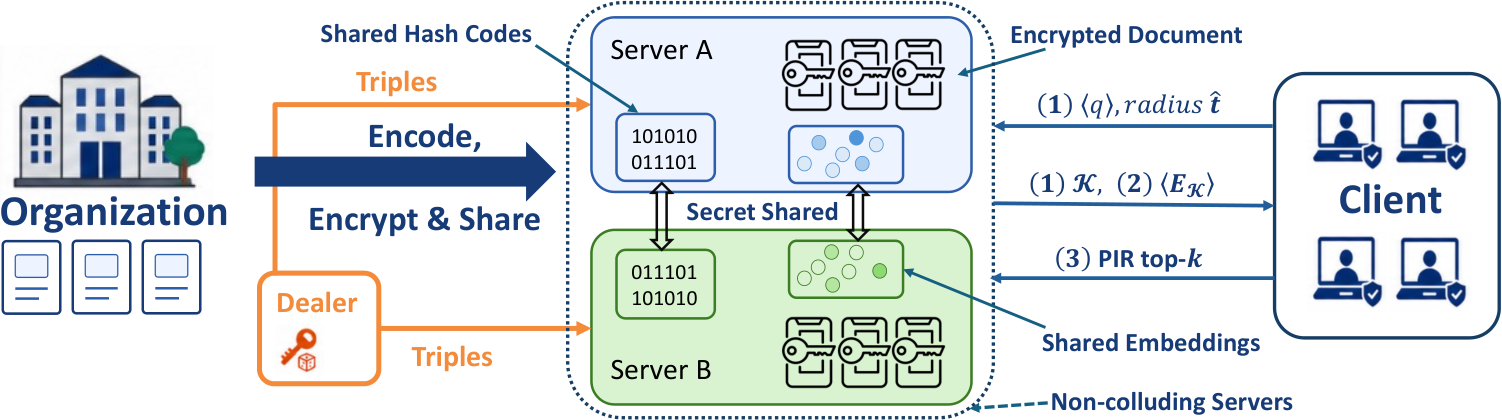
Researchers built Spruce, a system for running retrieval-augmented generation vector search over outsourced indexes without revealing the query or the corpus to the cloud host. The core problem is brutal: naive cryptographic protection of embeddings at million-document scale costs ~90 GB of communication per query and takes minutes. Even the best prior work still ran 10–22 seconds per query — unusable in production. Spruce sidesteps this by replacing full-precision embedding comparisons with binary code Hamming-distance computation under two-server multi-party computation (MPC), then reranking only a small candidate set. Across four real corpora ranging from 383K to 5.42M documents, full private scans complete in 0.21–2.97 seconds at 10 Gbps inter-server bandwidth — 4.8–6.7× faster than the closest prior system measured. A “private pruning” mode cuts that further to 0.06–1.09 seconds with 13.1–22.9× speedups, while retaining 93.9%–97.3% of full-float retrieval quality (NDCG). On the largest corpus, combining pruning with a local “dealer” node improves sustained throughput by 31.5× at 1 Gbps. The median candidate sets passed to reranking are tiny: just 382–1,952 documents out of millions, which is where retrieval precision and recall either holds or collapses.
Cold read
The 10 Gbps inter-server bandwidth assumption is doing enormous work here. Enterprise cloud deployments rarely guarantee that between independently operated servers, and the 1 Gbps numbers — while still impressive — represent a significantly harder deployment story. The two-server MPC model requires that your two servers are non-colluding, which means contractual and operational guarantees, not just cryptographic ones; if both servers are in AWS us-east-1 under the same account manager, you’ve bought theater. The quality retention numbers (93.9%–97.3% NDCG) sound good but are measured against the authors’ own binary-code pipeline, not necessarily against the raw retrieval quality your current unencrypted system delivers — the baseline matters enormously and the abstract doesn’t fully clarify this chain. There is also no latency data for the reranking step that follows candidate selection; total end-to-end query latency in a live RAG system will be higher than the headline numbers suggest. Finally, “four corpora” is a thin evaluation surface for a claim of production readiness.
What it means for you
- Signal maturity: 2/5 — Novel and genuinely fast for its class, but the infrastructure assumptions are lab-grade
- Who gets hurt: Vector database vendors (Pinecone, Weaviate, Qdrant) selling “just trust us” outsourced index hosting to regulated-industry customers — healthcare, legal, finance
- What breaks if this is true: The implicit SaaS bargain that “you outsource the search, we see your data” becomes legally and technically avoidable, which is bad for any vendor whose moat depends on corpus lock-in
- Why it might not land: Two-server non-collusion is operationally hard to certify at scale; compliance teams will want audited guarantees that cryptographers and lawyers haven’t agreed on yet
- Watch for: A managed “privacy-preserving RAG” offering from a major cloud provider that absorbs this or similar MPC-over-embeddings work — that’s the signal this crossed from research to product pressure
Forecast as of 2026-09-05
By Q3 2027, at least one enterprise vector database vendor will announce a private/confidential retrieval feature citing MPC or equivalent cryptographic techniques — but it will require co-located or explicitly partnered dual-server infrastructure, confirming that the non-collusion assumption remains the binding constraint preventing mainstream adoption.
Source: Spruce: Scalable Private Outsourced Retrieval Using Compact Embeddings — Peichun Hua, Yunming Xiao. https://arxiv.org/abs/2609.03376v1