Switching AI Models Mid-Task Is Quietly Bleeding Your Agent Budget
Switching AI Models Mid-Task Is Quietly Bleeding Your Agent Budget
You built a clever cost-optimization playbook: start cheap, escalate when stuck, downshift when the hard work is done. Turns out the model switch itself is a hidden tax that erases most of the quality gain you were chasing. The “smart routing” strategy your team is proud of may be costing you more than running expensive models from the start.
What happened

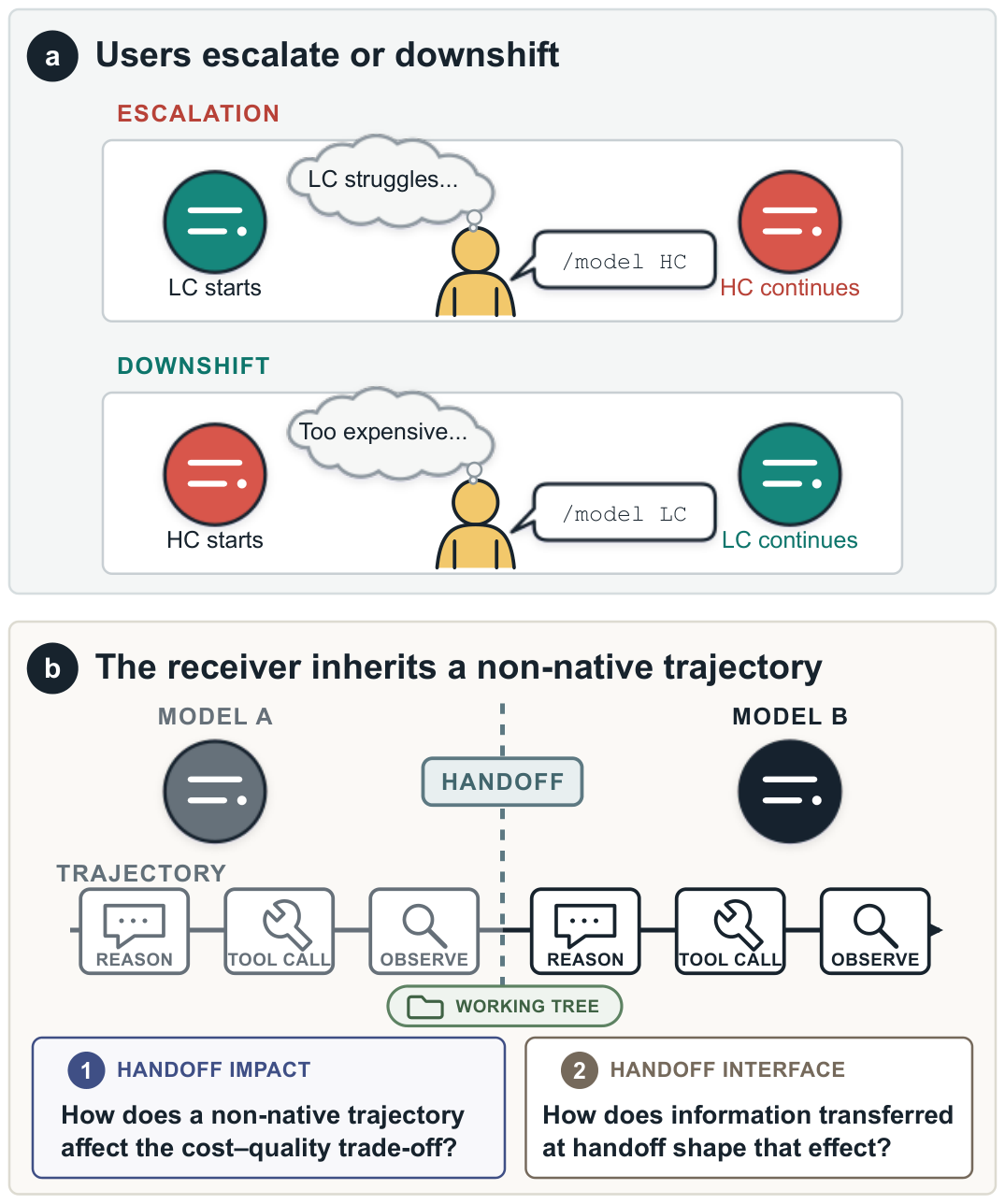
Researchers at (presumably) Anthropic and related labs studied what happens when agentic workflows hand off mid-run between a low-cost/low-capability (LC) model and a high-cost/high-capability (HC) model — covering both escalation (LC→HC) and downshift (HC→LC) across Claude and GPT model families. The task domain was coding agents running long multi-step jobs: dozens of model calls, tool uses, and code edits. The central finding is brutal: full-trajectory escalation recovers less than half of the LC-to-HC quality gap while still incurring a substantial cost premium. They tested three handoff interfaces — passing the full context window of the prior model’s trajectory, compacting it, or stripping it entirely and preserving only repository state — and found the preferred interface flips depending on direction. For escalation, reducing the LC trajectory actually improves quality; for downshift, removing the HC trajectory hurts quality. In other words, the cheap model’s messy reasoning trail actively poisons the expensive model’s ability to take over, but the expensive model’s reasoning trail is genuinely useful to the cheaper successor.
Cold read
This study covers one domain — coding agents — and results from coding benchmarks are notoriously hard to generalize to retrieval-heavy, customer-facing, or reasoning-diverse multi-agent orchestration setups. The paper doesn’t appear to report statistical significance intervals or the size of the benchmark suites used, so “less than half the quality gap” is a headline number without published error bars. The finding that stripping context helps escalation quality is genuinely interesting but could be an artifact of benchmark contamination — HC models may simply perform better on clean-slate starts because their pretraining already covers these coding scenarios. The study tests only two model families (Claude and GPT); whether this generalizes to open-weight models or fine-tuned domain specialists is entirely untested. And “substantial cost premium” for escalation is described qualitatively, not quantified precisely in the abstract — founders should not assume they know the magnitude until they read the full paper.
What it means for you
- Signal maturity: 3/5 — Real phenomenon, real numbers, narrow domain
- Who gets hurt: Any startup running tiered-model cost optimization in coding copilots, dev tools, or CI/CD agents — your routing logic may be delivering worse outcomes at higher costs than you’ve measured
- What breaks if this is true: The entire “smart escalation” architecture sold by agent orchestration platforms — if escalation only recovers <50% of the quality gap, the business case for dynamic model routing collapses unless you’re willing to cold-start the HC model from scratch every time
- Why it might not land: Most real-world agent runs are shorter and less state-heavy than the long coding trajectories studied here; in shorter contexts the handoff tax may be negligible
- Watch for: Anthropic or OpenAI releasing native handoff APIs or “trajectory summarization” features that attempt to solve the compaction problem — that would confirm the industry is taking this seriously at the platform level
Forecast as of 2026-08-26
By Q2 2027, at least two major agent orchestration platforms (e.g., LangChain, CrewAI, or a hyperscaler-native offering) will ship an explicit “clean-handoff” or “cold-escalation” mode as a documented best practice, directly citing the problem this paper identifies — or internal replications of it — as the motivation.
Source: The Handoff Tax: Continuing Non-Native Trajectories in LLM Agents — Roy Ganz, Mor Shpigel Nacson, Adi Kalyanpur, Ron Litman. https://arxiv.org/abs/2608.24358v1