Your AI Agent Is Bleeding Tokens on Skills It Doesn’t Need
Your AI Agent Is Bleeding Tokens on Skills It Doesn’t Need
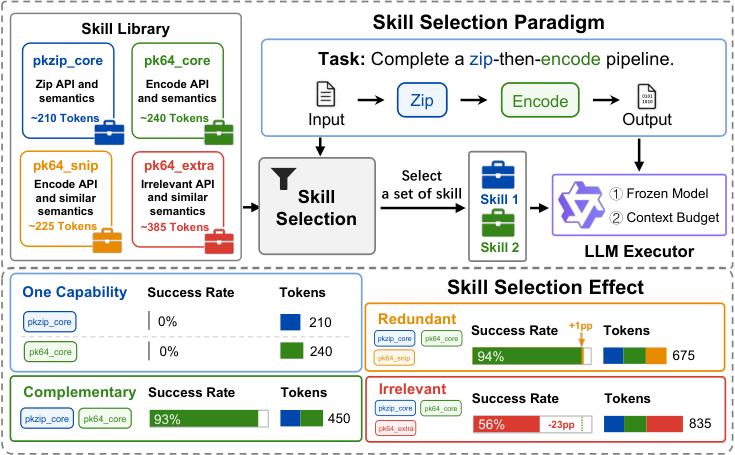
Every agent you’re running right now picks skills the dumb way — grab the top-k most “relevant” ones and stuff them in. A new paper says that wastes tokens, degrades performance, and has zero quality guarantee. They built something better, and the gap is not small.
What happened
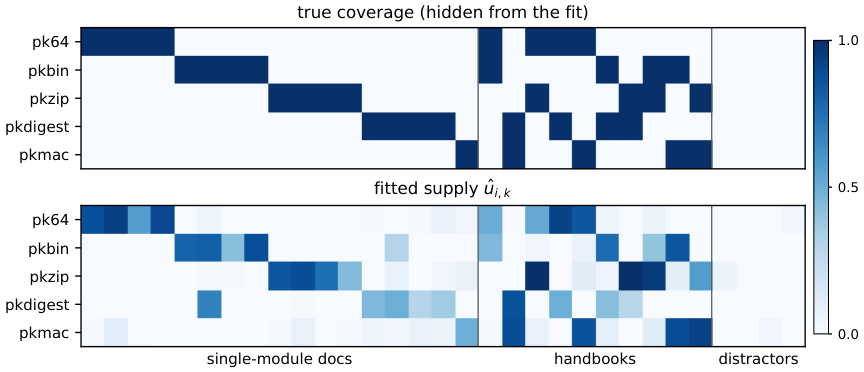
Researchers from Tsinghua modeled skill selection for LLM agents as a formal optimization problem — something nobody had apparently bothered to do with provable guarantees before. The setup: you have a library of reusable skill documents, a hard context window token budget, and you need to pick a skill set that maximizes task benefit while penalizing redundancy and cost. They framed the benefit function as monotone submodular (diminishing returns as you add more skills), then built a polynomial-time algorithm called Best Prefix Selection (BPS) with a proven bicriteria approximation ratio of (1−1/e, 1) — meaning the benefit coefficient is provably optimal for polynomial-time algorithms. On a benchmark-contamination-controlled variant of BigCodeBench, BPS hit 0.73 task success versus 0.20–0.52 for all released baselines — including specialized skill routers, text retrievers, and letting the executor pick its own skills — while using 28% fewer tokens than the strongest competing router. That’s not a marginal win; that’s existing tools operating near the floor of their range.
Cold read
The battlefield is BigCodeBench, one domain, one contamination-control variant — not a diverse sweep of agentic workflows across enterprise use cases. The submodular benefit formulation is theoretically elegant but requires you to actually model how skill sets interact with task outcomes, which in practice means you need data to calibrate that function — the paper doesn’t dwell on how painful that calibration is in production. The baselines scored 0.20–0.52, which is a wide spread; the weaker ones look like straw men against a 0.73 result. Provable approximation guarantees from combinatorial optimization sound reassuring, but they guarantee proximity to the optimum of your model of the problem — if your submodular benefit function is miscalibrated, the guarantee is meaningless in deployment. Finally, “polynomial-time” covers a lot of ground; whether BPS is fast enough to run per-query at scale versus offline is not addressed in the abstract.
What it means for you
- Signal maturity: 2/5 — single-domain academic result, no production validation
- Who gets hurt: Vendors selling skill-routing middleware for RAG-style agent platforms — this paper frames their core product as a solved optimization problem with a better answer
- What breaks if this is true: The “just embed-and-retrieve top-k skills” architecture that most agent frameworks ship by default becomes a competitive liability on both cost and performance
- Why it might not land: Calibrating the submodular benefit function requires task-specific outcome data that most operators don’t have cleanly labeled; the approach may be theoretically superior but operationally heavy
- Watch for: An open-source BPS implementation benchmarked on multi-domain agent evals (SWE-bench, AgentBench) with latency numbers — that’s the moment this moves from paper to threat
Forecast as of 2026-08-21
By Q2 2027, at least one major agent framework (LangChain, LlamaIndex, or a top-5 funded agent startup) will ship a submodular-aware skill selection module citing this line of work — but fewer than half of production agent deployments will have adopted it, because the calibration burden will slow uptake more than the performance gap accelerates it.
Source: Optimal Skill Selection for LLM Agents with Provable Bicriteria Guarantees — Yu Chen, Ruishuo Chen, Xun Wang, Zhuoran Li, Longbo Huang. https://arxiv.org/abs/2608.19993v1