Your AI Paper Reviewer Just Changed Its Mind — Without Telling You
Your AI Paper Reviewer Just Changed Its Mind — Without Telling You
Two versions of the same model. Same papers. Accept rate drops 52 percentage points overnight. No paper moved up — only down. If you’re using LLM scores to gate anything that matters, you are measuring a moving target that moves in one direction.
What happened
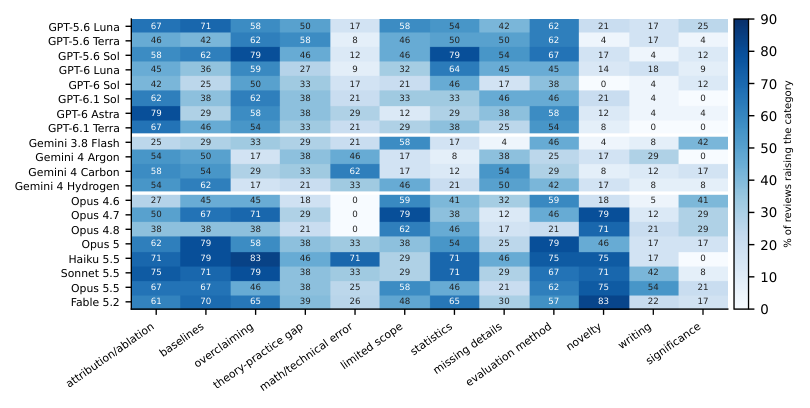
Researcher Jizhou Guo audited twenty frontier models from OpenAI, Google, and Anthropic on live ICLR 2027 submissions, with tests pre-registered before decisions were announced. Between an earlier and later version of Claude Opus, the share of papers landing on the accept side fell by 52 percentage points across 183 randomly drawn submissions; the same gap for Gemini was 53 points across 60 submissions. Across six further paired comparisons, the swing ranged from 43 to 79 points — and in every single case, the direction was one-way: no paper moved up. When score-stripped critiques were swapped between versions, the later critiques alone dragged the accept share down by 35 points for Opus and 51 for Gemini, even under a third-party scorer. This is a textbook LLM-as-judge validity problem: the “judge” is not a stable instrument. Making it worse, Opus 4.6 accepted all 11 decided papers it claimed to recognize — classic benchmark contamination — and Claude Opus 5.5 correctly named the first author of 27 decided ICLR 2026 papers from titles alone with zero errors, confirming training-set leakage into retrospective evaluations. Meanwhile, all twenty models squeezed their scores into a range of 2–3 in 473 of 475 reviews, versus humans who spread across the range in 60 of 72 reviews: the LLMs are also catastrophically range-compressed. The one genuinely encouraging number: on 99–119 submissions, model self-estimated percentiles correlated with two human reviewers more strongly than a third human reviewer did (point estimates 0.17–0.21), though the 95% confidence intervals run from -0.04 to +0.42 — wide enough to drive a truck through.
Cold read
The confidence intervals on that “models beat human reviewers” finding are so wide they are functionally uninformative — the paper is admirably honest about this, but it will not stop people citing the point estimate in pitch decks. The study covers ICLR 2027 submissions still under review, meaning ground-truth validation against actual accept/reject decisions is promised for December 16, 2026 but absent from this paper; without it, we don’t know whether the stricter later models are more or less accurate than the lenient earlier ones. The contamination finding — that Opus 5.5 names true first authors from titles alone — demonstrates the models have memorized decided papers, but the paper cannot quantify how much this inflates accept rates on training-adjacent work versus genuinely novel submissions. The score compression finding (2 or 3 in 473 of 475 reviews) suggests these models are useless as discriminative rankers, but the paper doesn’t test whether prompt engineering or temperature changes could recover spread. Single-author study, single venue, single submission cycle: the drift pattern is alarming but the generalization to your domain is unproven.
What it means for you
- Signal maturity: 2/5 — real phenomenon, missing ground truth validation until December
- Who gets hurt: Any team using LLM-as-judge pipelines with version-pinned score thresholds — content moderation, grant screening, hiring filters, automated QA gates
- What breaks if this is true: Any threshold you set against one model version is miscalibrated the moment your provider silently upgrades — your “70th percentile” cutoff is now selecting a completely different population
- Why it might not land: The drift might be ICLR-specific; academic paper evaluation may be an unusually sensitive domain where model fine-tuning shifts affect judgment more than, say, customer support scoring
- Watch for: The December 16, 2026 release of this paper’s validation against actual ICLR 2027 decisions — that is the moment this goes from “alarming pattern” to “proven instrument failure” or gets quietly revised downward
Forecast as of 2026-11-17
When the ICLR 2027 decisions drop in December 2026, the later (stricter) model versions will show higher correlation with actual accept/reject outcomes than the earlier lenient versions — the pessimistic drift reflects calibration improvement, not degradation — but the threshold instability finding will hold, and at least two major evaluation benchmark leaderboards will add model-version pinning requirements by Q2 2027.
Source: Same Papers, Different Verdicts: Tracing Version Drift in LLM Peer Review — Jizhou Guo. https://arxiv.org/abs/2611.20608v1