Your AI Agent Is Running Live in Prod — No One Can Test It
Your AI Agent Is Running Live in Prod — No One Can Test It
You’ve shipped an LLM agent into a core business process. Congratulations. You also have no reliable way to know when it fails, why it failed, or whether your fix actually worked. A new paper from the research community just put that uncomfortable fact in writing.
What happened
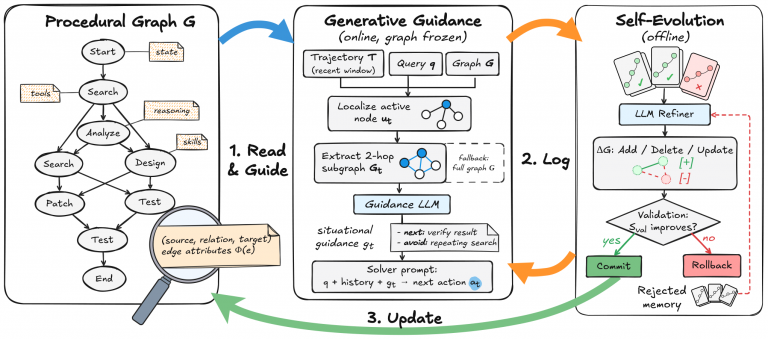
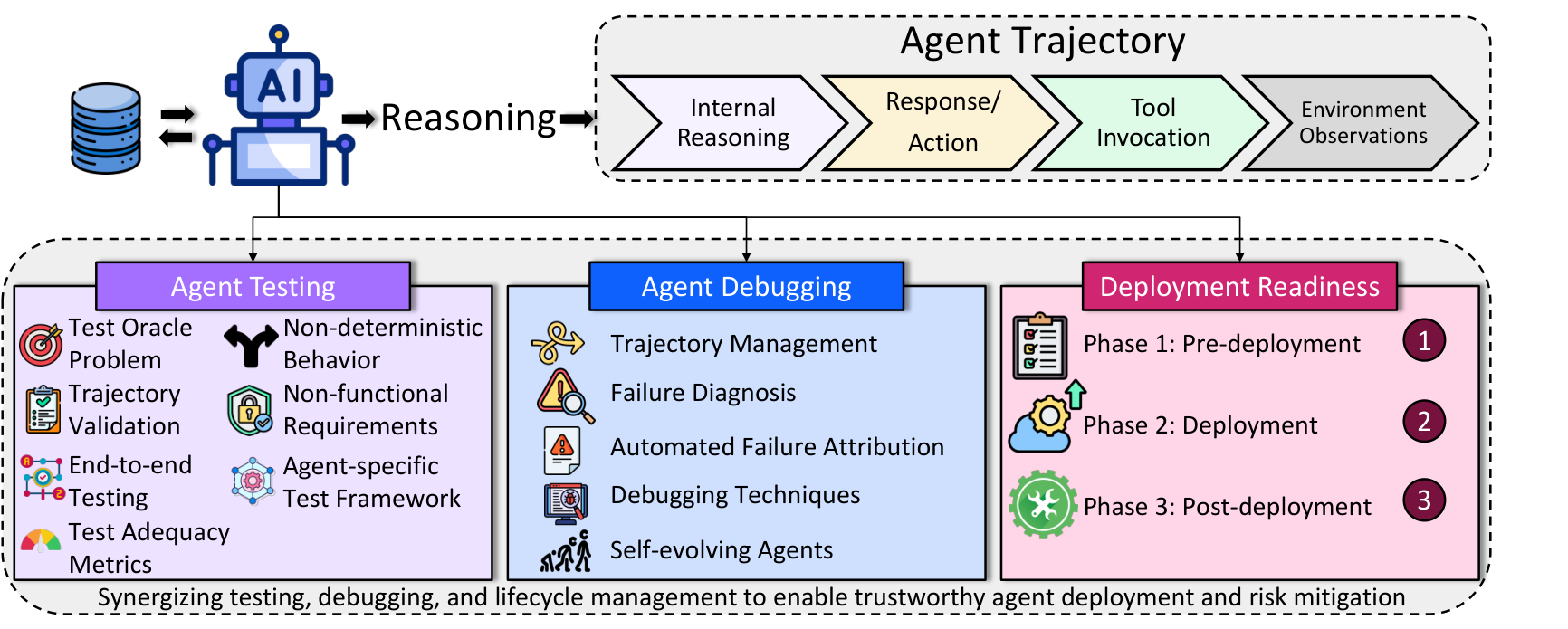
Researchers Huo, Pan, and Roychoudhury argue that the safety case for deployed agentic AI rests almost entirely on trajectories — the recorded sequences of reasoning steps, tool invocations, and environmental observations that an agent produces as it runs. Their core claim: most agent failures are only visible in the trajectory, not in the final output alone. The paper frames agent testing and debugging as a largely unsolved research program, identifying four compounding problems: the oracle problem (you often don’t know what the correct trajectory looks like), non-determinism (same prompt, different run, different trajectory), trajectory validation (how do you check a multi-step chain of tool calls?), and the total absence of formal adequacy metrics — no one has defined what “enough testing” even means for an agentic workflow. They also flag automated failure attribution and agent self-evolution as open, unsolved debugging problems. The paper closes with a deployment-readiness checklist covering the full lifecycle — a sign the authors intend this as a practitioner artifact, not just theory.
Cold read
This is a position paper, not an empirical study. There are no benchmark results, no failure-rate numbers, no controlled experiments — the abstract contains zero quantitative findings. The authors identify real problems, but “we argue” and “we advocate” are doing heavy lifting where data should be. The trajectory-as-ground-truth framing is intuitive but circular: if you can’t define the oracle for the output, recording the steps doesn’t solve the oracle problem, it relocates it. The proposed “deployment-readiness checklist” is the kind of artifact that sounds useful in a slide deck and gathers dust in a repo. And “self-evolving agents” as a reliability solution is, charitably, a research aspiration — the paper itself lists it as an open problem, which is the academic equivalent of “we have no idea yet.” Founders should read this as a diagnosis, not a prescription.
What it means for you
- Signal maturity: 2/5 — position paper with no experimental validation, every key metric labeled an open problem
- Who gets hurt: Any team that has deployed an agentic workflow into a compliance-sensitive process (finance, legal, healthcare ops) without trajectory logging in place — you’re flying blind and this paper explains exactly why
- What breaks if this is true: The standard QA playbook — unit tests, integration tests, acceptance criteria — is structurally insufficient for agent deployment, meaning your engineering velocity on agent features is quietly accumulating unquantified liability
- Why it might not land: Testing infrastructure for agents requires trajectory capture, storage, replay, and oracle definition — all at once, before any metric exists to tell you when you’re done; the tooling cost is high enough that most startups will skip it and bet on LGTM
- Watch for: A credible open-source agent testing harness that implements trajectory-based adequacy metrics with real benchmark numbers — that paper is the one that changes procurement conversations
Forecast as of 2026-08-18
By Q2 2027, at least one high-profile agentic deployment failure — attributable to an undetected trajectory-level error — will become a public incident significant enough to trigger regulatory or legal scrutiny; this paper will be retroactively cited as having predicted the exact failure class, but no widely adopted testing standard will yet exist.
Source: Towards Risk-free AI Agent Deployment — Yintong Huo, Rangeet Pan, Abhik Roychoudhury. https://arxiv.org/abs/2608.16411v1