Your RAG Stack Is Lying to You — and It Sounds Very Confident
Your RAG Stack Is Lying to You — and It Sounds Very Confident
Every retrieval-augmented generation product built in the last two years may share the same silent defect: the model reads your retrieved documents and then mostly ignores them. A new paper puts a number on the problem — and claims to have mostly fixed it.
What happened
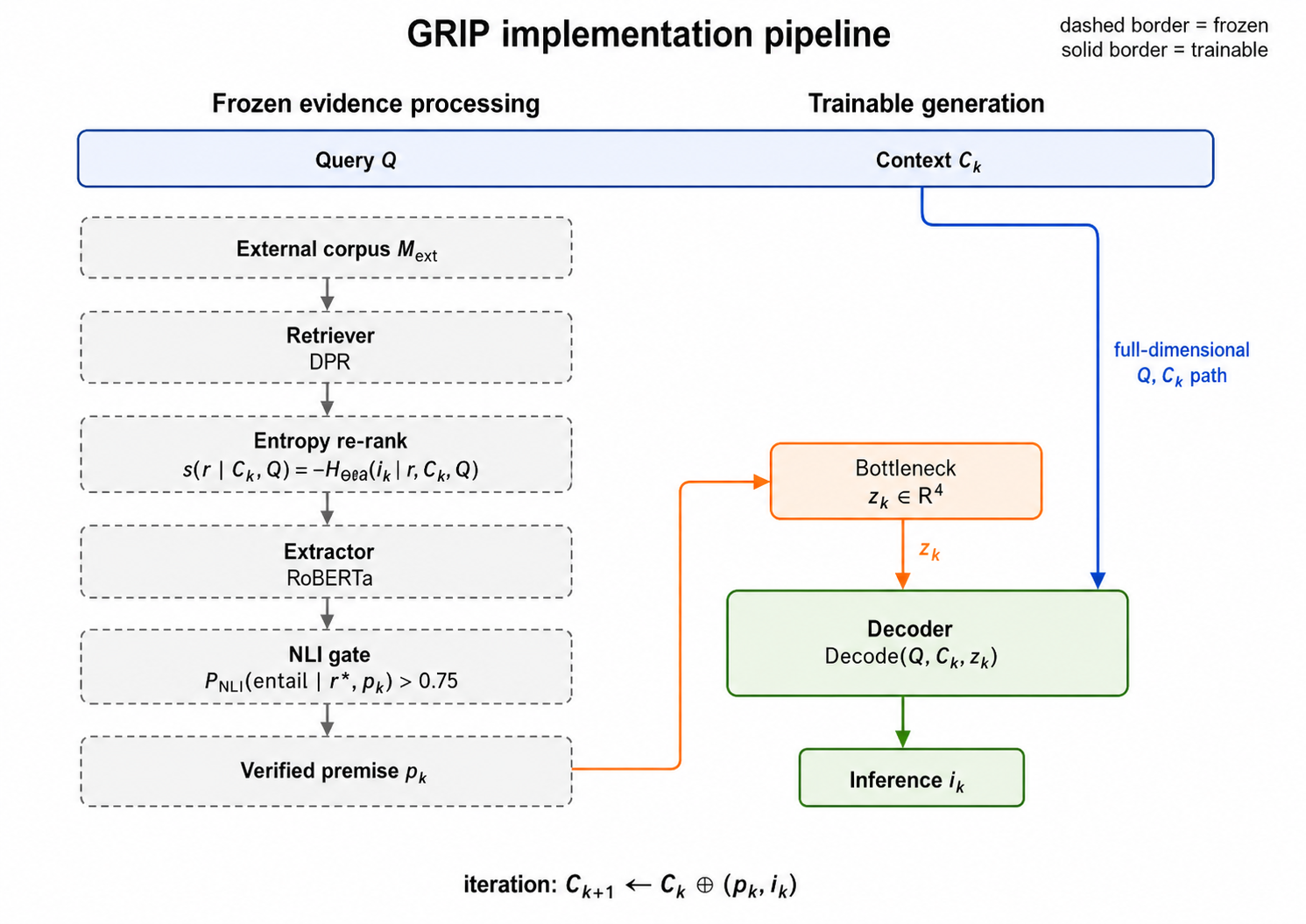
Researcher Lirui Teng identifies a failure mode called query dominance: in high-capacity RAG encoders, the query so thoroughly saturates the model’s latent state that retrieved evidence becomes functionally irrelevant. The proposed fix is GRIP (Grounded Reasoning via Information-Restricted Premises), which enforces a structural imbalance — the decoder retains full-dimensional access to the query while retrieved evidence is forced through a severe stochastic bottleneck, compelling that channel to carry only what the query cannot already supply. Tested across five reasoning benchmarks against “strong iterative baselines,” GRIP cuts a query–latent mutual-information diagnostic from 14.8 bits down to 0.47 bits — roughly a 30× reduction — and reports a 73% reduction in hallucination. Residual-alignment analysis confirms the bottleneck output occupies subspaces that are geometrically less aligned with the query than baseline representations, which is the architectural explanation for why retrieval starts pulling its weight. If you care about faithfulness vs. groundedness, this paper is speaking your language — it is operationalizing a distinction that most RAG pipelines treat as a vibe.
Cold read
Five benchmarks are not five independent real-world deployments — the domains, chunk sizes, and retrieval strategies used matter enormously and are not described in the abstract. The 73% hallucination reduction is striking, but “hallucination” is a contested measurement; the abstract does not specify whether this is model-graded, human-graded, or string-match-based, and LLM-as-judge evaluations have their own reliability problems. The mutual-information diagnostic (14.8 → 0.47 bits) is an elegant internal metric, but it is not a user-facing accuracy number — low query–evidence MI tells you the architecture is doing something different, not that the difference is always beneficial. The stochastic bottleneck may hurt in retrieval-heavy tasks where the query should dominate evidence selection, e.g., when a user’s intent is highly specific and the retrieved passage is directly on point. Finally, this is a single-author preprint with no independent replication yet — the track record on this class of architectural claim is mixed.
What it means for you
- Signal maturity: 2/5 — single preprint, no ablations or deployment results visible in the abstract
- Who gets hurt: Founders selling RAG-based knowledge products (internal search, document Q&A, compliance assistants) who have been measuring retrieval precision but not evidence utilization
- What breaks if this is true: “We use RAG so we don’t hallucinate” is not a defensible claim; query dominance is a structural flaw in the encoder architecture, not fixable by better chunking or prompt engineering
- Why it might not land: The bottleneck is stochastic and architectural — grafting this onto existing LLM inference pipelines (OpenAI, Anthropic, Gemini APIs) is not straightforward; it requires model-level access most founders don’t have
- Watch for: A replication by a multi-institution group, or adoption in an open-source RAG framework (LlamaIndex, LangChain) within the next two quarters — that is when this becomes an operator-actionable finding
Forecast as of 2026-08-18
By Q2 2027, at least one major open-source RAG framework will have merged a capacity-asymmetry or evidence-bottleneck mechanism into its default architecture, citing GRIP or a direct successor — but the hallucination reduction in production deployments will be reported at under 40%, not the paper’s 73%, due to retrieval noise and domain mismatch.
Source: GRIP: Grounded Reasoning via Information-Restricted Premises — Lirui Teng. https://arxiv.org/abs/2608.16776v1