Your AI Agent Is Quietly Rotting — And No One Is Watching
Your AI Agent Is Quietly Rotting — And No One Is Watching
Every production AI agent you’ve shipped is accumulating silent failures in its knowledge bases, tool descriptions, and system prompts — and you’re probably debugging them by hand, one log file at a time. A new paper claims it can automate that entire diagnostic loop. Before you forward this to your engineering team, read the fine print.
What happened
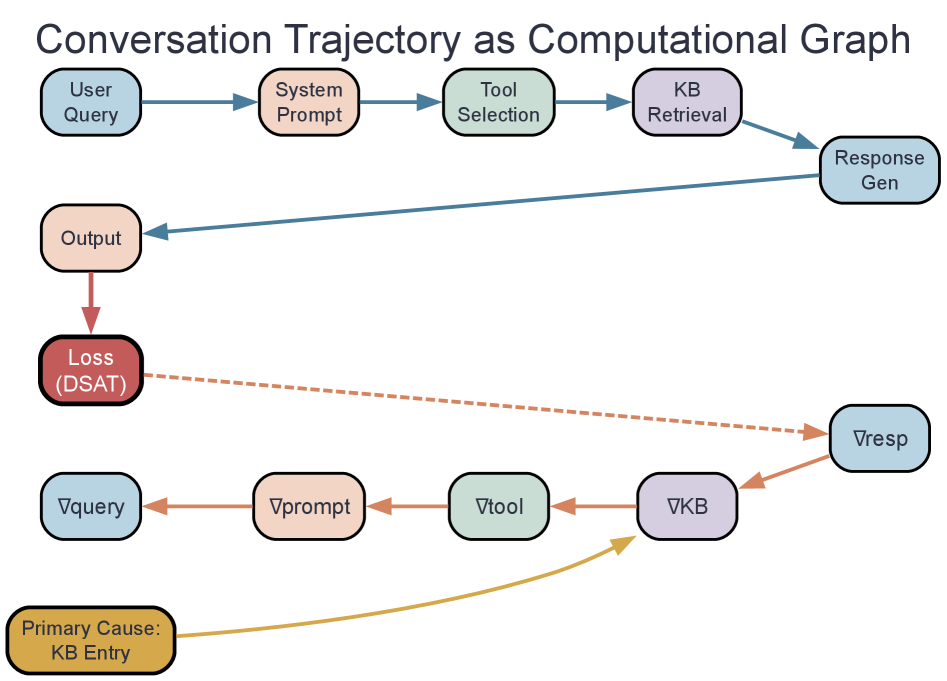
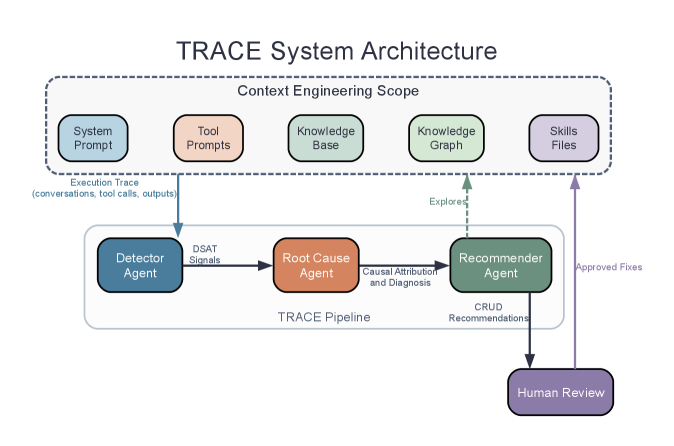
Researchers from TRACE built an automated feedback system that reads historical agentic workflow execution logs — “trajectories” — and uses implicit dissatisfaction signals (user corrections, rephrasing, abandonment) to diagnose and fix broken context sources without requiring any explicit user feedback collection. The core idea is that your agents’ conversation histories already contain the error signal; you’re just not mining it. Rather than retraining models, TRACE operates entirely on the context layer: system prompts, knowledge bases, tool descriptions, and procedural skills. The system uses what the authors call “multi-component causal attribution” — an extension of textual gradients — to assign blame across heterogeneous context sources rather than treating the whole thing as a monolithic prompt. On a benchmark of 60 dissatisfaction traces across three complexity tiers (up to 16 execution nodes), TRACE achieved 72.7% root cause attribution accuracy and 82% end-to-end fix effectiveness. A sub-component called “exploratory verification” — where the agent actively reads context sources to distinguish gaps (requiring CREATE) from stale content (requiring UPDATE) — hit 96% operation-type accuracy.
Cold read
The benchmark is 60 traces. Sixty. Built by the same team that built the system, using a synthetic simulation methodology they designed themselves, with a six-category fault taxonomy they authored — a setup that creates serious benchmark contamination risk even if unintentional. The 82% fix effectiveness number sounds compelling until you ask: effective at what, measured how, by whom? There are no independent real-production datasets here; the paper explicitly cites the “absence of open datasets for context debugging” as a gap they’re trying to address with their own benchmark, which is exactly the kind circular validation that should make you nervous. The 72.7% attribution rate also means roughly one in four root causes is misdiagnosed — in a system designed to autonomously modify your production knowledge bases and prompts, a 27% miss rate is not a rounding error; it’s a liability. Complexity is also capped at 16 execution nodes, which is modest for any serious multi-step agent operating in a real enterprise environment.
What it means for you
- Signal maturity: 2/5 — promising framing, toy-scale validation
- Who gets hurt: Founders shipping production AI agents who read “82% fix effectiveness” and hand this to an intern to implement against live knowledge bases
- What breaks if this is true: The market for manual prompt engineering consultants and agent observability tools collapses; the value shifts entirely to automated context-layer maintenance pipelines
- Why it might not land: Implicit dissatisfaction signals (rephrasing, abandonment) are notoriously noisy in real products — users rephrase for dozens of reasons unrelated to agent failure, and a system trained to read those signals will generate false positives that corrupt working context sources
- Watch for: An independent team reproducing the attribution accuracy numbers on a real-production agent dataset with more than a few hundred traces — that’s the signal that this moves from clever paper to deployable infrastructure
Forecast as of 2026-08-12
By Q3 2027, at least one agent observability startup (Langfuse, Braintrust, or a direct competitor) will ship a commercial feature explicitly based on trajectory-mining for context attribution — but independent benchmarks on real production data will show attribution accuracy well below the 72.7% reported here, likely under 60%.
Source: TRACE: TRajectory Attribution for Automated Context Engineering — Yikai Zhao, Pradeep Kumar Misra, Saurabh Pandey. https://arxiv.org/abs/2608.09153v1