The “Privacy Layer” You’re Paying For Is Basically Open
The “Privacy Layer” You’re Paying For Is Basically Open
Startups are routing sensitive customer prompts through cloud LLM APIs and paying for obfuscation middleware to keep that data private. A new attack recovers the original tokens with 73.5% accuracy. That middleware is not a moat. It may not even be a lock.
What happened
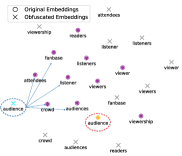
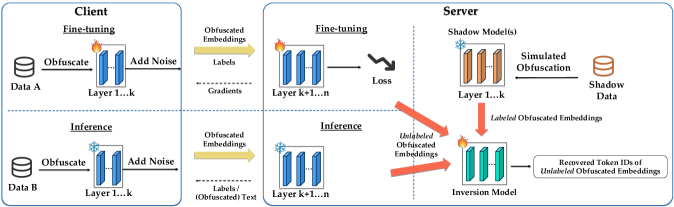
Researchers built DeepInvert, a semi-supervised attack that reconstructs original text tokens from embeddings that have already been run through obfuscation defenses — the lightweight, non-cryptographic privacy layers that services like ObfusLM, SentinelLMs, TextObfuscator, and DPNR offer as alternatives to full encryption. The core finding: obfuscated representations still retain exploitable semantic structure, and DeepInvert harvests it by combining supervised training on a small labeled “shadow” dataset with an unsupervised consistency objective over unlabeled target embeddings. Against ObfusLM specifically, DeepInvert hits 73.5% top-1 token recovery — compared to 26.2% for the previous best attack, nearly tripling inversion accuracy. The attack was tested across nine defenses, five tasks, and four model architectures, and outperformed prior methods on most. The paper also identifies a structural trap: any obfuscation scheme that preserves enough signal to keep the model useful also preserves enough structure to be inverted. Utility and privacy are, in most cases, fundamentally in tension here — and tokenization-level reconstruction is the proof.
Cold read
73.5% token recovery sounds devastating, but token-level accuracy is not the same as full prompt hacking or document reconstruction — recovering 7 in 10 tokens from a legal contract is very bad, recovering them scrambled or out of context may be less actionable than the headline implies. The attack requires access to obfuscated embeddings directly, which means an adversary needs to be positioned somewhere between the client and the cloud API — that’s a real threat model for cloud providers themselves, but not a trivial one for most external attackers. The paper tests on encoder-based and autoregressive architectures, but the specific model families and the real-world API configurations tested are not detailed in the abstract, so generalizability to production deployments is unverified. The one partial reprieve the authors grant — “on simpler classification tasks, some DP-based defenses can maintain both” utility and privacy — suggests that if your use case is narrow enough, you’re not automatically exposed. But most enterprise system prompt and RAG pipelines are nowhere near that narrow.
What it means for you
- Signal maturity: 4/5 — specific numbers, multi-architecture testing, and a named attack beat a named defense class convincingly
- Who gets hurt: Any SaaS company routing PII, legal text, medical records, or proprietary business logic through a cloud LLM API behind an obfuscation middleware vendor
- What breaks if this is true: The compliance and sales narrative that “we obfuscate your data before it leaves your network” is not a defensible privacy claim — and any enterprise customer who accepted that as a GDPR or HIPAA control has a problem
- Why it might not land: Real-world attackers need access to the obfuscated embedding stream, not just the API endpoint; insider-threat and supply-chain threat models are real but limited in scope
- Watch for: Obfuscation middleware vendors quietly updating their documentation to downgrade privacy guarantees, or a GDPR enforcement action citing embedding-layer attacks as evidence that non-cryptographic protections are inadequate
Forecast as of 2026-08-06
By Q2 2027, at least one major obfuscation-based LLM privacy vendor will either publicly deprecate their core defense mechanism in favor of cryptographic alternatives, or face documented regulatory scrutiny citing embedding inversion research — the math in this paper is too clean and the threat model too concrete for the compliance community to ignore.
Source: DeepInvert: Semi-Supervised Embedding Inversion Against Obfuscated Language Models — Zhicong Huang, Cheng Hong, Tao Wei. https://arxiv.org/abs/2608.04477v1