Your AI Memory Layer Is Secretly Bottlenecking Every Request
Your AI Memory Layer Is Secretly Bottlenecking Every Request
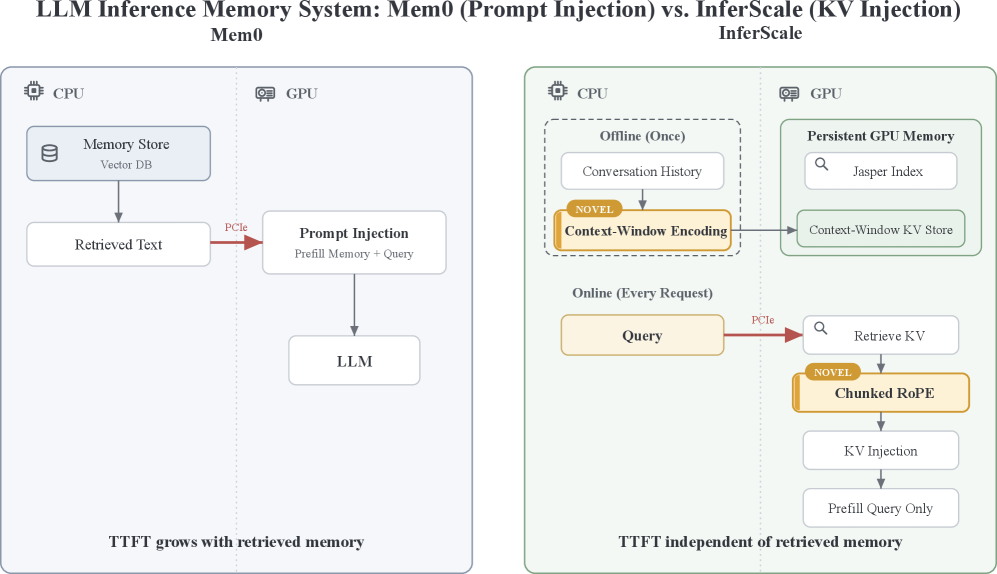
Every time your app injects a user’s memory profile into a prompt, your GPU re-reads the entire thing from scratch — even if it saw those same facts ten seconds ago. A new paper says that’s not just wasteful, it’s architecturally broken. And the fix cuts first-token latency by up to 79%.
What happened
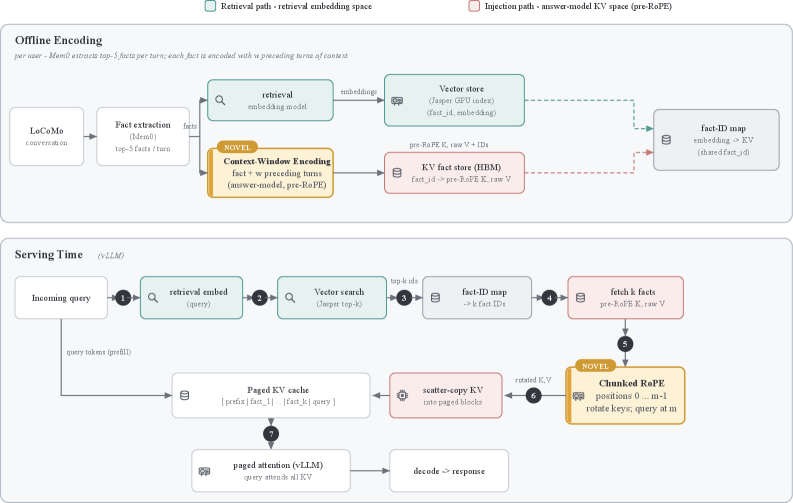
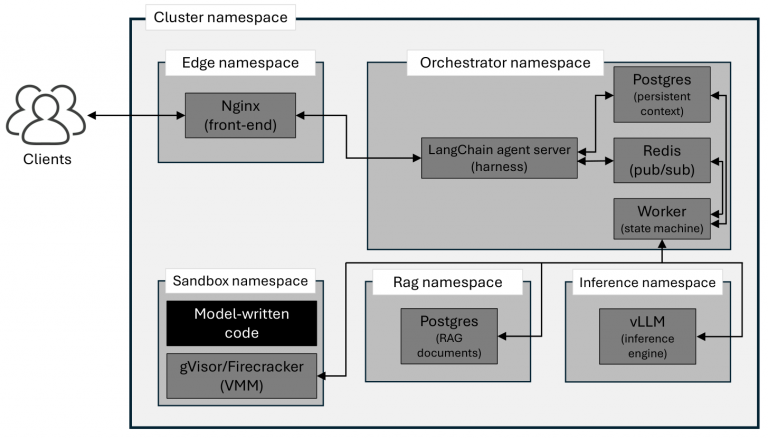
Researchers at InferScale built a GPU-native memory system that attacks a specific, painful inefficiency in personalized LLM serving: the fact that RAG-style memory injection forces a full prefill computation every single request, even when the retrieved memory facts are identical to what was injected moments before. Their system precomputes KV cache representations for individual memory facts, stores them on-GPU alongside semantic embeddings, and surgically injects them into vLLM’s paged cache at serving time — no engine rewrite, no fine-tuning required. The hard technical problem is rotary position embeddings (RoPE), which bake positional information into keys at encoding time, making pre-cached KV states position-dependent; they solve this with “Chunked RoPE,” storing keys pre-rotation and applying positions at injection. The numbers on LoCoMo across three open-weight models are concrete: at k=50 retrieved facts, TTFT drops 72–79% (3.6–4.8× faster), throughput under concurrent load improves 3.7–4.5×, and the accuracy cost relative to Mem0 with full recomputation is 60.3% vs. 63.3% — a 3-point quality penalty. The agent memory vs. context window tradeoff that has plagued production memory systems like Mem0, MemGPT, and Zep is the explicit target here.
Cold read
Three points matter before you budget engineering time on this. First, the 3-point accuracy gap (60.3% vs. 63.3%) sounds small but is measured on LoCoMo, a single long-conversation benchmark — there is no evidence this gap stays small on domain-specific tasks where cross-fact reasoning is critical, and independently encoded memory facts by design miss cross-fact context. Second, the entire system requires GPU-resident KV storage for every memory fact per user; at scale, the GPU memory cost of maintaining pre-cached KV states across large user bases is not analyzed in the abstract, and for most startups with thousands of users, this could easily invert the economics. Third, the vLLM KV-connector interface is the integration point — this is a specific, moving-target dependency, and any vLLM version change or migration to a different inference backend (TGI, SGLang, proprietary) breaks the implementation entirely. The throughput gains are measured under concurrent load, which is the right test, but “concurrent load” conditions and hardware specs are not disclosed in the abstract, making replication risk non-trivial.
What it means for you
- Signal maturity: 2/5 — Single benchmark, no production deployment data, GPU memory cost unaddressed
- Who gets hurt: Memory-layer startups (Mem0, Zep, any wrapper selling “persistent user context”) whose core value prop is retrieval quality, not serving efficiency — this reframes the competition toward infrastructure
- What breaks if this is true: The assumption that TTFT scales with retrieved context size becomes false, which collapses the main argument for keeping retrieval budgets small and forces a rethink of memory product architecture
- Why it might not land: GPU-resident per-user KV caches are memory-expensive at scale; most startups cannot afford to keep millions of users’ memory facts hot on GPU, making this an enterprise/high-margin use case only
- Watch for: vLLM merging native KV-injection APIs into its core release, or a major cloud inference provider (Fireworks, Together, Anyscale) shipping a managed version — that’s when this stops being a research artifact
Forecast as of 2026-07-31
By Q2 2027, at least one major managed inference provider will ship a production feature explicitly marketing KV-cache-based memory injection (whether InferScale-derived or independently built), but fewer than 20% of AI startups using memory layers will have migrated to it due to GPU memory cost constraints at their user scale.
Source: InferScale: GPU-Native KV Injection for Personalized LLM Serving — Peter Li, Prashant Pandey. https://arxiv.org/abs/2607.27090v1