Your Agent Is Drowning in Its Own Memory and Bleeding You Dry
Your Agent Is Drowning in Its Own Memory and Bleeding You Dry
Every turn your production agent runs, its token bill compounds. Not linearly — quadratically. Meanwhile it forgets things it saw three conversations ago and confidently hallucinates the rest. One researcher says he’s named the fix. That’s the hype. Here’s the cold read.
What happened
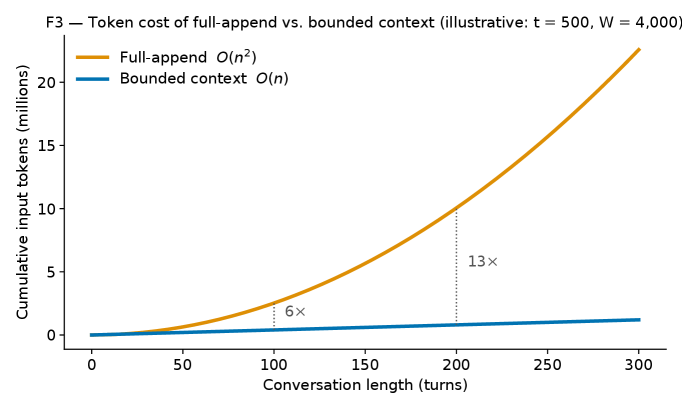
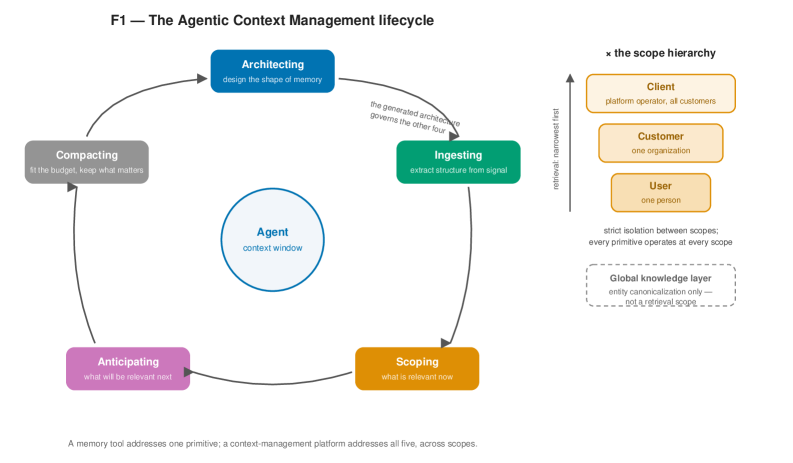
Gaurav Dadhich argues that production agentic workflows don’t fail because the model can’t reason — they fail because the context window becomes a garbage heap: accumulating conversation histories, bloated tool definitions, and runaway tool outputs. The incumbent framing treats this as a retrieval-augmented generation problem — store stuff, fetch it back. Dadhich argues that framing is too narrow and proposes a discipline he calls Agentic Context Management (ACM), decomposed into five primitives: architecting, ingesting, scoping, anticipating, and compacting & consolidation. The economic claim is the sharpest part: naive context accumulation grows token cost quadratically with conversation length; crude summarization trades that down to linear cost but introduces what the paper calls an “accuracy cliff”; only “validated compaction” achieves linear cost with preserved fidelity. A reference implementation called Maximem Synap reportedly scores 92% on LongMemEval and 93.2% on LoCoMo under a specific configuration. The paper also flags that in real production, this operates not over a single user but across an organizational scope hierarchy — a distinction most agent memory vs. context window discussions ignore entirely.
Cold read
The headline benchmark numbers — 92% and 93.2% — are attached to a specific, author-chosen configuration described in Section 6, with no independent replication and no ablation published in the abstract. That’s a vendor demo dressed in paper clothing, not a peer-reviewed result. The “quadratic cost” framing is real math, but the claim that “validated compaction” preserves fidelity at linear cost is the entire bet — and the abstract provides no error bars, no comparison baseline, and no definition of what “validated” means operationally. The paper openly admits that existing benchmarks don’t capture latency, token efficiency, or “context-rot resistance,” which means Maximem Synap is being graded on a test the author helped design while acknowledging the real test doesn’t exist yet. Benchmark contamination risk is non-trivial when a commercial implementation reports its own scores on public evals. Finally, “organizational scope hierarchy” sounds important but is asserted, not demonstrated — there’s no data on multi-tenant degradation or cross-user privacy boundaries.
What it means for you
- Signal maturity: 2/5 — one author, one commercial implementation, self-reported benchmarks, no peer review
- Who gets hurt: Teams building long-horizon customer-facing agents (support, sales, copilots) who are currently duct-taping RAG onto a context overflow problem and watching costs spike mid-contract
- What breaks if this is true: The assumption that smarter retrieval alone solves agent amnesia — your RAG pipeline is necessary but not sufficient, and you may be paying quadratic token costs while thinking you have a storage problem
- Why it might not land: “Validated compaction” is doing enormous load-bearing work here. If compaction introduces subtle factual drift, you’ve traded a cost problem for a hallucination problem that’s harder to detect and more dangerous at enterprise scale
- Watch for: Independent replication of LongMemEval/LoCoMo scores by a non-affiliated lab, or a major agent framework (LangGraph, CrewAI, AutoGen) shipping a native context lifecycle primitive — that would confirm the problem framing is real even if this solution isn’t
Forecast as of 2026-07-24
By Q1 2027, at least two of the major open-source agent orchestration frameworks will ship an explicit “context lifecycle” abstraction (distinct from plain memory/RAG), validating the problem framing in this paper — but Maximem Synap specifically will not be the implementation they adopt.
Source: Agentic Context Management: Solving Agent Memory and Cost by Treating Them as Lifecycle and Architecture Problems — Gaurav Dadhich. https://arxiv.org/abs/2607.21503v1