Your AI Agent Is Leaking Customer Data Right Now. Here’s the Fix Nobody Ships.
Your AI Agent Is Leaking Customer Data Right Now. Here’s the Fix Nobody Ships.
Agentic systems—the ones your team is rushing to production—have a structural data leakage problem baked into their architecture. Researchers just built a pre-deployment pipeline that claims to eliminate it. Before you forward this to your CTO with a smiley face, read the cold part.
What happened
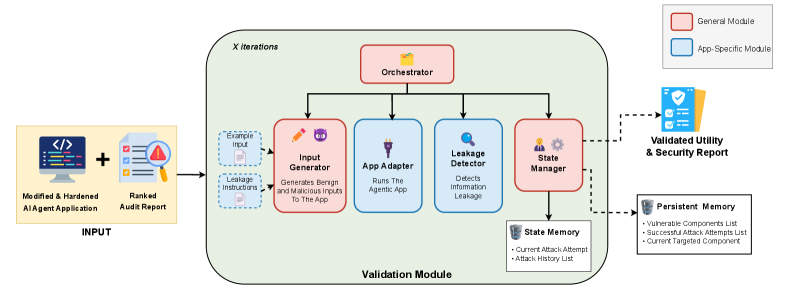
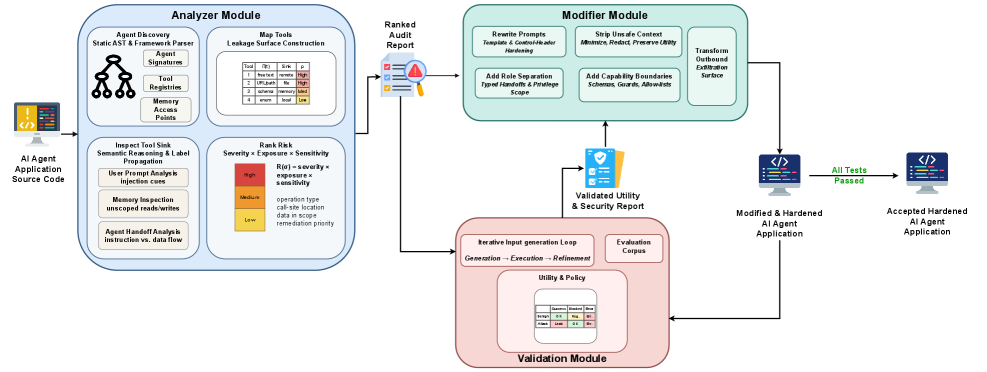
A team from Ben-Gurion University built an automated pipeline that scans agentic workflows for data leakage risks before deployment, patches the vulnerabilities, then validates the patches under adversarial conditions. The system targets multi-agent orchestration environments specifically—the messy, multi-codebase setups where enforcing security controls consistently is a known nightmare. The hardening techniques are deliberately low-drama: schema tightening, boundary sanitization, allowlist-based tool gating, and least-privilege checks on tool invocations. On the validation side, the pipeline auto-generates attack inputs mimicking jailbreaks and prompt injection attacks alongside benign variants to confirm you haven’t broken normal behavior. Tested across five real-world agentic applications plus the AgentDojo benchmark, the pipeline achieved 100% leakage elimination against basic jailbreak and instruction-override attacks, and a 91% reduction under “stress-induced manipulation”—without requiring continuous runtime policy enforcement.
Cold read
Five real-world applications is a thin evidence base for a “solved problem” headline—we don’t know their complexity, industry, or how representative they are of the multi-agent systems your company actually runs. The 100% result is against basic jailbreaks; the 91% figure under “stress-induced manipulation” is the honest number and it means roughly 1-in-10 sophisticated attacks still leaks data, which in a regulated industry (healthcare, finance, legal) is a compliance event, not a rounding error. The pipeline analyzes system prompts, tool interfaces, and invocation code—but real-world agentic apps accumulate tool integrations fast, and a static pre-deployment scan is structurally blind to tools added post-deployment or emergent behaviors from in-context learning at runtime. The paper does not report false-positive rates on the benign validation set at scale, so we don’t know how often the hardening breaks legitimate functionality in more complex workflows. There’s also a classic benchmark contamination concern: AgentDojo’s attack patterns are published, which means a pipeline trained to pass it may not generalize to novel attack vectors your adversaries will actually use in six months.
What it means for you
- Signal maturity: 2/5 — Promising architecture, insufficient breadth of validation
- Who gets hurt: B2B SaaS founders shipping AI agents that touch customer data, PII, or internal tooling; any team that skipped a security design review because “we’ll add guardrails later”
- What breaks if this is true: Runtime monitoring vendors (the “add a proxy in front of your LLM” category) lose their primary sales argument if pre-deployment hardening becomes commoditized
- Why it might not land: The pipeline requires access to prompt templates, tool interfaces, and invocation code—a static analysis assumption that falls apart in dynamic, plugin-heavy agent architectures or when third-party tools are opaque black boxes
- Watch for: Enterprise buyers in regulated verticals (HIPAA, SOC 2, GDPR) adding pre-deployment agent security scans to vendor security questionnaires—that’s the signal this approach is crossing from research into procurement requirements
Forecast as of 2026-07-22
By Q1 2027, at least two commercial agentic security vendors (or existing SAST players like Snyk/Semgrep) will ship a product explicitly framing pre-deployment agent hardening as a category—but enterprise adoption will remain below 15% of agentic deployments because most teams still don’t have the structured prompt templates and tool inventories the pipeline requires as inputs.
Source: Data Leakage Prevention in Agentic Applications via Preemptive Hardening — Akansha Shukla, Emily Bellov, Parth Atulbhai Gandhi, Yuval Elovici, Asaf Shabtai. https://arxiv.org/abs/2607.18847v1