Your AI Agent Is Losing Its Mind Mid-Task—Here’s the Receipt
Your AI Agent Is Losing Its Mind Mid-Task—Here’s the Receipt
Multi-hop reasoning agents don’t fail because they’re stupid. They fail because they forget what they already know, bury early discoveries under new retrievals, and then keep digging anyway. A single-author paper just put a number on this problem—and it’s bigger than the vendors will tell you.
What happened
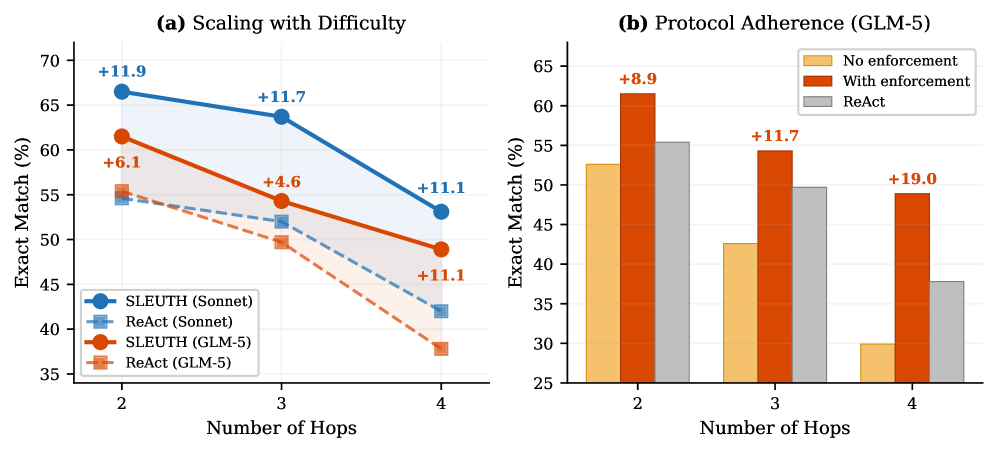
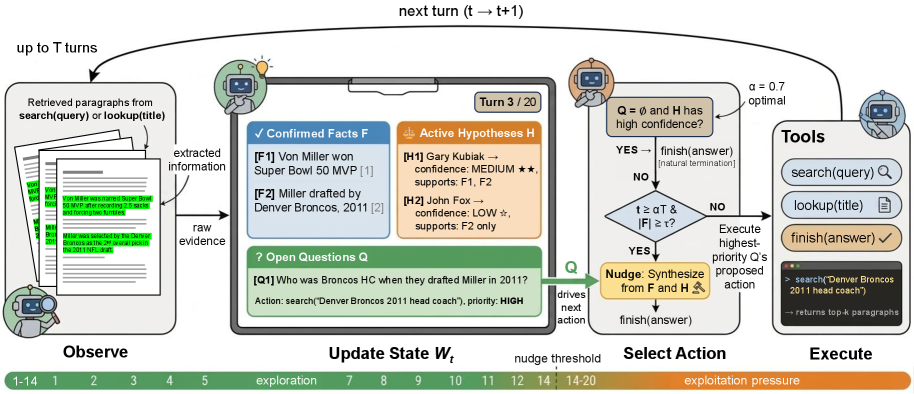
Ning Liu identifies a specific failure mode called context dilution: as an agentic workflow accumulates tool calls and retrieved results, the agent’s actual investigative state—what’s confirmed, what’s suspected, what’s still open—gets swamped inside an ever-growing context window, making early discoveries effectively invisible. The proposed fix is SLEUTH, a structured epistemic working memory that forces the agent to maintain three explicit buckets at every step: Confirmed Facts (source-grounded), Active Hypotheses (evidence-ranked), and Open Questions (action-driving). Tested across five multi-hop benchmarks against five baselines, SLEUTH gains +5 points on HotpotQA and +11 points on 4-hop chains—with the gap growing as difficulty increases. The paper also isolates a secondary pathology it calls the evidence sufficiency problem: agents often already have the answer but keep burning their compute budget on redundant verification. A lightweight commitment trigger stops this waste—but only if the agent is already running structured state; the same trigger bolted onto an unstructured agent produces zero improvement. Most striking for cost-conscious founders: enforcing the structured protocol on a weaker model recovers up to +19 points on the hardest problems, directly challenging the assumption that more capable (read: more expensive) models are the fix for agent memory vs. context window degradation.
Cold read
This is a single-author preprint, not yet peer-reviewed, and five benchmarks—however standard—are not the same as your production environment. The +11 and +19 point gains are real numbers, but benchmark performance on HotpotQA and similar datasets has a well-documented benchmark contamination problem: these sets are old enough that model training data almost certainly touched them. The “weaker model + structured protocol beats stronger model unstructured” claim is the most commercially interesting finding, but the paper doesn’t specify which models were compared or by how much they differ in cost—making it impossible to calculate actual ROI from the abstract alone. SLEUTH’s structured state also adds latency and token overhead at every reasoning step; the paper doesn’t report what that costs. Finally, multi-hop QA benchmarks are a clean, well-scoped problem class—the leap to messy, open-ended enterprise agent tasks (ambiguous goals, unreliable tools, shifting user intent) is not proven here.
What it means for you
- Signal maturity: 2/5 — promising single-author preprint, no peer review, no production validation
- Who gets hurt: Founders who bought enterprise RAG or agentic research tools on the promise that a bigger/newer model would fix multi-step reliability; they may be spending on the wrong lever
- What breaks if this is true: The “just upgrade to the next model tier” upsell from AI infrastructure vendors weakens considerably—memory architecture, not model size, becomes the defensible differentiator
- Why it might not land: The structured memory overhead may be prohibitive in latency-sensitive applications, and real-world agent tasks rarely have the clean, verifiable answer structure that makes this protocol easy to enforce
- Watch for: Any major agent framework (LangGraph, CrewAI, AutoGen) shipping an explicit epistemic state layer—structured memory moving from research into default scaffolding would be the confirmation signal
Forecast as of 2026-07-15
By Q2 2027, at least two of the top four open-source agent orchestration frameworks will ship a native “working memory” or equivalent structured-state module as a first-class feature—not a plugin—directly citing the class of research SLEUTH represents; if that doesn’t happen, the finding stays academic.
Source: Track, Rank, Crack: Epistemic Working Memory Scales Multi-Hop Reasoning in Language Agents — Ning Liu. https://arxiv.org/abs/2607.12267v1