Your AI Judge Panel Is Confidently Wrong and You Don’t Know It
Your AI Judge Panel Is Confidently Wrong and You Don’t Know It
You built a multi-model evaluation pipeline because surely five models agreeing means something. It does — just not what you think. The most consistent frontier models are also the most dangerously overconfident, and this paper has the receipts.
What happened
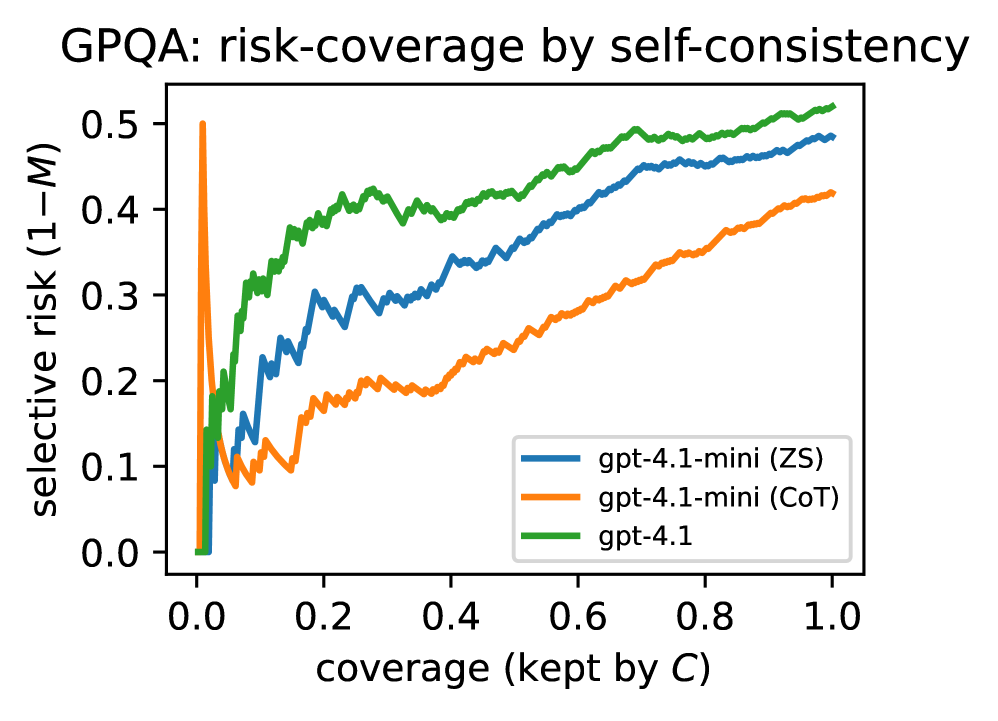
A single-author study ran 53 model configurations, drawing 50 samples each across overlapping cases on two hard benchmarks (GPQA Diamond and AIME), totalling 265,000 samples. The core question: does agreement — either a model agreeing with itself across runs, or multiple models agreeing with each other — actually predict correctness? The short answer is weakly, conditionally, and badly at the frontier. Agreement correlated with accuracy at only ρ = 0.20–0.59 depending on regime, and the worst outcome was the most alarming: the most consistent frontier model hit agreement ≥ 0.8 on 77% of GPQA cases — and 48% of those high-confidence answers were wrong. This is the LLM-as-judge problem in quantified form: when you replace human evaluation with model consensus, you inherit the shared biases, memorized heuristics, and position priors baked into every model in the panel. A cross-provider check on three Claude tiers showed the same pattern — confident errors recurred across providers above a baseline null, meaning this isn’t a single-vendor artifact. The data and per-run answer distributions are publicly released, which is more than most papers of this kind offer.
Cold read
This is a benchmarks-only study (GPQA Diamond, AIME) — structured, closed-answer, relatively short tasks. The finding that agreement is a weak signal may be more optimistic than the real-world case for open-ended generation, summarization, or long-form reasoning where ground truth is fuzzier and hallucination is harder to detect. The 53 “runners” are not 53 independent models — the overlap in training data, RLHF pipelines, and benchmark contamination across frontier providers means correlated failure is structurally guaranteed, and this paper measures it rather than solves it. The ρ = 0.20–0.59 range is wide enough to paper over a lot: the lower bound is essentially noise, and the upper bound is only achieved in the “unsaturated mid-tier” regime that most enterprise deployments are actively trying to move away from. Also worth noting: majority-correctness as the deployment label assumes you have ground truth to validate against — which is precisely what you’re using LLM judges to avoid having to produce.
What it means for you
- Signal maturity: 2/5 — agreement is a real but weak and regime-sensitive proxy, not a confidence score you can ship
- Who gets hurt: any team running automated eval pipelines where model consensus gates deployment decisions, content moderation, or QA in production
- What breaks if this is true: your “ensemble judge” setup gives a false floor of certainty — high agreement scores get interpreted as validation when 48% of them may be wrong, eroding the feedback loop that your whole eval infrastructure depends on
- Why it might not land: most operators using LLM-as-judge panels don’t have GPQA-style ground truth to benchmark against, so they can’t observe this failure mode — the problem stays invisible until something visibly breaks downstream
- Watch for: evaluation tooling vendors (Braintrust, Patronus, Confident AI) explicitly qualifying or capping confidence scores derived from model agreement — that’s the market signal this research has hit practitioners
Forecast as of 2026-07-10
By Q1 2027, at least two major eval-infrastructure vendors will publicly document or deprecate “cross-model agreement as confidence” as a primary quality signal, citing correlated failure modes — a direct response to findings like this becoming standard practitioner knowledge. If that doesn’t happen, the research stayed in academia and the industry kept shipping broken eval loops.
Source: When LLMs Agree, Are They Right? Auditing Self-Consistency and Cross-Model Agreement as Confidence Signals — Kaihua Ding. https://arxiv.org/abs/2607.08065v1