Your Model Choice Is a Rounding Error. Your Orchestration Layer Is Not.
Your Model Choice Is a Rounding Error. Your Orchestration Layer Is Not.
You’ve been optimizing the wrong thing. Every quarter spent agonizing over Claude vs. Gemini vs. GPT is a distraction if your orchestration layer is hemorrhaging tokens on replayed context and failed turns. A new paper claims the harness around your model moves costs more than the entire model menu does — and they have numbers.
What happened
![Figure 2: The two-zone prompt. A byte-stable prefix (tool-schema catalog, stable system prompt, append-only transcript) carries up to four provider cache breakpoints [C1–C4]; everything that changes p](https://readpriors.com/wp-content/uploads/2026/07/arxiv_2607.06906_2.png)
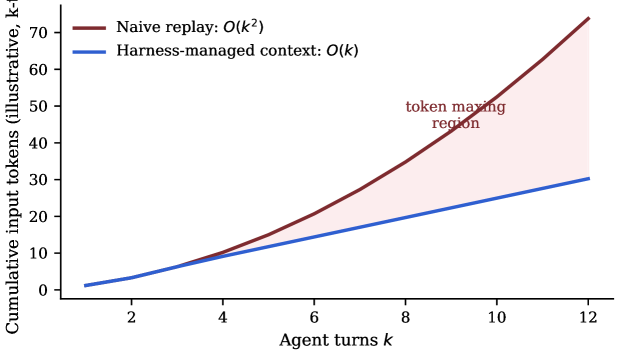
Researchers from Writer ran a controlled experiment designed to isolate one variable almost nobody isolates: the orchestration layer, not the model. They locked 22 evaluation tasks, froze six foundation models (Claude Sonnet 4.6, Gemini 3.1, Gemini Flash 3.5, Qwen 3.6, GLM 5.1, Palmyra X6), and swapped only the orchestration harness — a conventional production loop against Writer’s own Agent Harness. The results, held across all six models: blended cost per task dropped 41% ($0.21 → $0.12), median wall-clock time fell 44% (48s → 27s), and tokens per task shrank 38% (14,200 → 8,800). Task-completion quality held roughly flat (0.78 → 0.81, which the authors themselves flag as directional at this sample size). The paper introduces a concept called “harness leverage” — the finding that quality gains correlate almost perfectly with a model’s baseline capability (r=0.99, n=6), meaning a stronger model extracts more quality upside from a better agentic workflow, while efficiency gains are model-invariant. Quality per dollar rose 82%; task-completions per million tokens jumped from 54.9 to 92.0. The authors argue the root pathology is “token maxing” — organizations buying capability with volume (longer chain-of-thought traces, wider tool payloads, bloated replayed context windows) while falling per-token prices mask the rising total spend.
Cold read
The most important sentence in this paper is buried: “task-completion quality at parity (0.78 → 0.81, directional at this sample size).” Twenty-two tasks is a toy benchmark — you cannot draw robust quality conclusions from n=22, and the authors know it. More critically, one of the two harnesses being compared is built by the same organization publishing the paper; Writer is evaluating Writer’s own product, which is a conflict of interest that no amount of methodological rigor fully neutralizes. The “model-invariant efficiency” claim is intriguing but tested on six models across one workload type — enterprise agentic tasks are wildly heterogeneous, and a harness optimized for one task distribution may actively hurt another. The r=0.99 correlation on harness leverage is computed on n=6 data points, which is statistically meaningless as a standalone finding — six points will almost always fit a line. Finally, the paper formalizes “token economics at the orchestration layer” as a framework, but the mechanisms described (cache-shape discipline, failure-spend governance) are architectural choices, not laws — competitors can copy them, eroding any moat the paper implies.
What it means for you
- Signal maturity: 2/5 — Real effect, but self-serving measurement on a thin benchmark
- Who gets hurt: Infrastructure teams at mid-market SaaS companies who sunk engineering cycles into model-switching logic and benchmark comparisons while their orchestration layer leaks tokens on every retry loop
- What breaks if this is true: The “just upgrade the model” playbook becomes a cop-out; AI infra vendors selling model-routing layers without orchestration efficiency face a harder pitch
- Why it might not land: Orchestration is deeply workload-specific — the harness that wins on 22 Writer-selected tasks may underperform on customer support queues, code generation pipelines, or multimodal workflows; generalization is unproven
- Watch for: Third-party replications of the harness-swap experiment on public benchmarks (GAIA, SWE-bench) with disclosed task sets; if the 35–40% cost delta holds there, this is real infrastructure alpha
Forecast as of 2026-07-09
By Q1 2027, at least two major multi-agent orchestration platform vendors (e.g., LangChain, CrewAI, or a hyperscaler’s agent SDK) will publish competing benchmarks explicitly framing orchestration efficiency in token-economics terms, validating or refuting the 38–41% delta range on larger task sets — if Writer’s numbers hold up at scale, “harness efficiency” becomes a standard procurement metric; if they don’t replicate, this paper will be remembered as a well-produced product brief dressed as research.
Source: The Harness Effect: How Orchestration Design Sets the Token Economics of Enterprise Agentic AI — Muayad Sayed Ali, Aliaksandra Novik, Anji Boddupally, Artem Yavorskyi, Chris Nickerson, Daniel Rica, Emily DuGranrut, Felix Leung, Garrett Prince, Grace Barnett, Heath Robinson, Hosain Al Ahmad, Jesse Resnick, Juan Carlos Farah, Jyothi Swaroop Meruga, Leonid Kuznetsov, Luke Gorham, Marie Schmoll, Michael Paciullo, Saumya Das, Sharath Sheripally, Tommy Griscom, Mykyta Osadchyi, Neha Mantri, Nick Westrum, Olivia Benowitz, Parikshith Kulkarni, Radik Chernyshov, Rakshith Vasudev, Rohith Nadimpally, Vikas Gangadevi, Waseem AlShikh. https://arxiv.org/abs/2607.06906v1