Your AI Agent Is a Permanent Money Pit — Here’s One Exit
Your AI Agent Is a Permanent Money Pit — Here’s One Exit
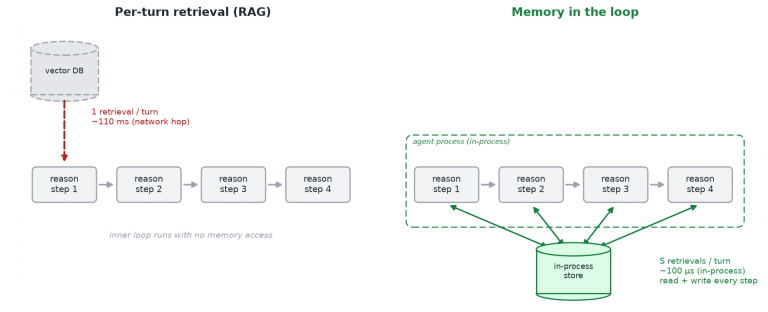
Every month your agentic workflow runs in production, you’re paying full LLM inference costs to re-solve problems you already solved last month. One AIOps team claims they cut per-incident agent costs by 70% by systematically retiring their agents. That’s not a research fantasy — they ran it on tens of thousands of real incidents.
What happened
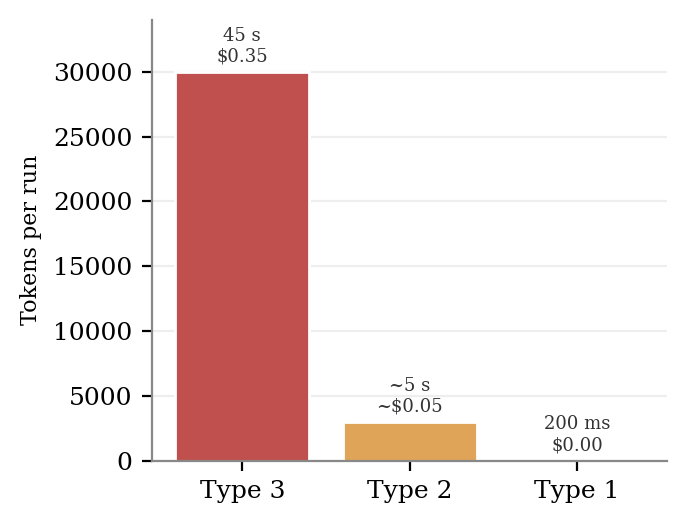
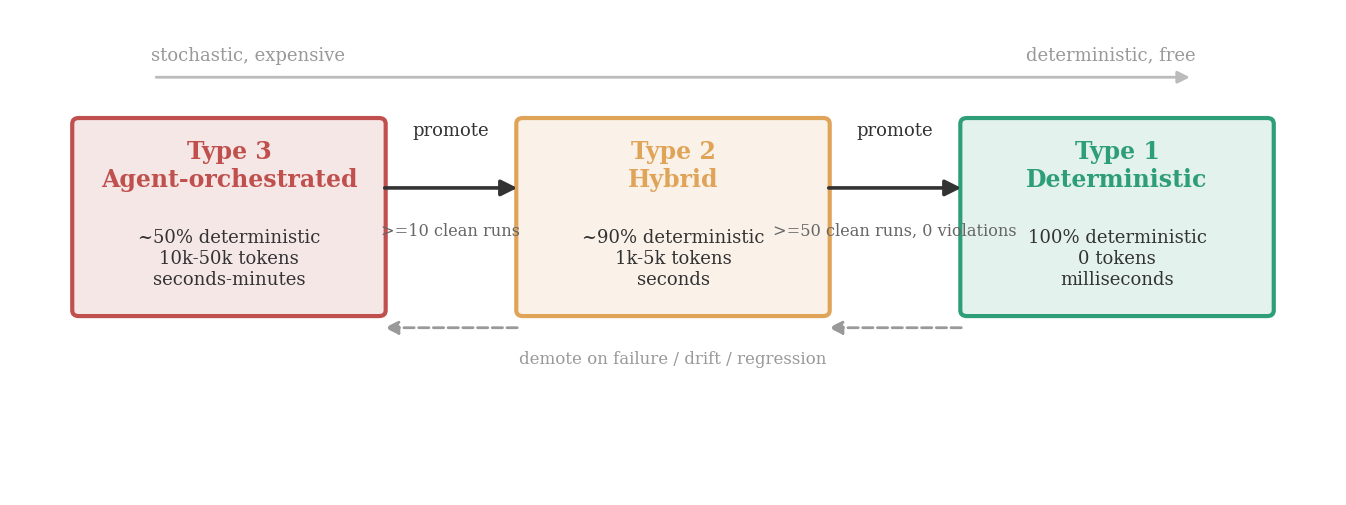
Arun Malik, working on a production cloud networking AIOps system, published a framework called “progressive crystallization” — the idea that AI agents should be treated as explorers, not permanent workers. The system defines three execution tiers: fully agent-orchestrated, hybrid, and fully deterministic workflows. An evidence-based promotion mechanism watches for agent behaviors that get repeatedly validated, then converts them into hardcoded deterministic workflows — no LLM inference required. Demotion runs the other way: if a crystallized workflow regresses, it gets kicked back to agent-mode. Over eight months on a system processing tens of thousands of incidents per month, deterministic execution climbed from 0% to 45%, per-incident agent costs dropped more than 70% despite incident volume doubling, and the authors report improved reproducibility and auditability as safety gains. The paper also presents a full economic model, trace extraction methodology, and a taxonomy of promotion/demotion criteria.
Cold read
This is a single-deployment case study from a single author — there is no comparison group, no independent replication, and the system (cloud networking AIOps) is one of the most structured, pattern-repetitive domains that exists. The 45% deterministic rate sounds impressive until you ask: what’s the incident distribution? If half your incidents are the same five reboot-and-ping workflows, crystallizing them is table stakes, not a breakthrough. The 70% cost reduction is stated as a result but the paper’s economic model, promotion criteria, and threat-to-validity section are self-reported — there is no external audit. Multi-agent orchestration in messier, higher-variance domains (sales, customer success, open-ended coding) will almost certainly crystallize at far lower rates, making the economics much weaker. The safety claim — “greater reproducibility and auditability” — is directionally true but introduces a new risk: a crystallized workflow that was validated on old incident patterns can become confidently wrong when the environment changes.
What it means for you
- Signal maturity: 3/5 — Real production numbers, but single-site, self-reported, narrow domain
- Who gets hurt: AI infrastructure vendors and agent platform companies whose pricing model depends on you running full LLM inference on every call, forever
- What breaks if this is true: The “agents as a service” SaaS model collapses for high-volume repetitive workflows; customers migrate cost off the platform as patterns crystallize
- Why it might not land: Most founders are not running AIOps at tens-of-thousands-of-incidents-per-month scale; below that volume, the engineering overhead of building promotion/demotion pipelines exceeds the savings
- Watch for: A second independent team publishing crystallization rates and cost curves from a different domain — that’s the signal this generalizes
Forecast as of 2026-07-09
By Q2 2027, at least two enterprise AIOps or IT-automation vendors (e.g., PagerDuty, ServiceNow, Datadog) will ship a named feature that automates workflow promotion from agent to deterministic execution, citing cost reduction as the primary value prop — but the published crystallization rates in general-purpose agent platforms will remain below 30%, confirming this is a domain-specificity story, not a universal architecture shift.
Source: Progressive Crystallization: Turning Agent Exploration into Deterministic, Lower-Cost Workflows in Production — Arun Malik. https://arxiv.org/abs/2607.07052v1