Your GPU Bill Is a Math Problem You’re Too Lazy to Solve
Your GPU Bill Is a Math Problem You’re Too Lazy to Solve
Every founder building on LLMs is leaving money on the floor—not because the hardware is wrong, but because your team is guessing. One researcher just published a blueprint that turns LLM serving configuration from a dark art into arithmetic. The uncomfortable implication: if you’re grid-searching, you’ve already failed.
What happened
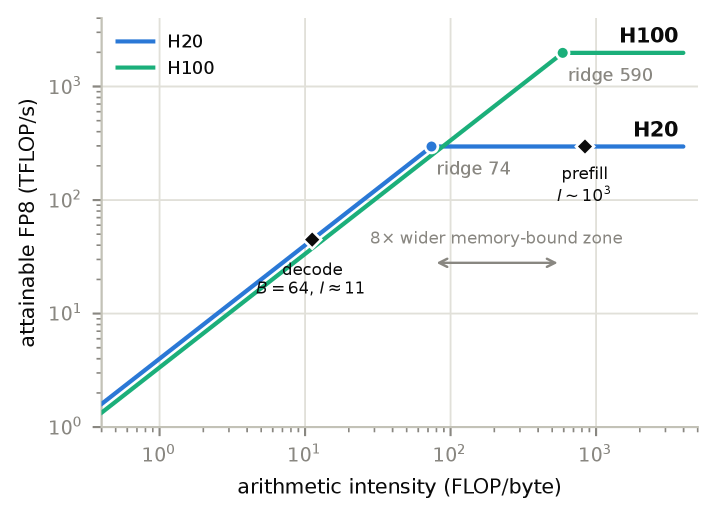
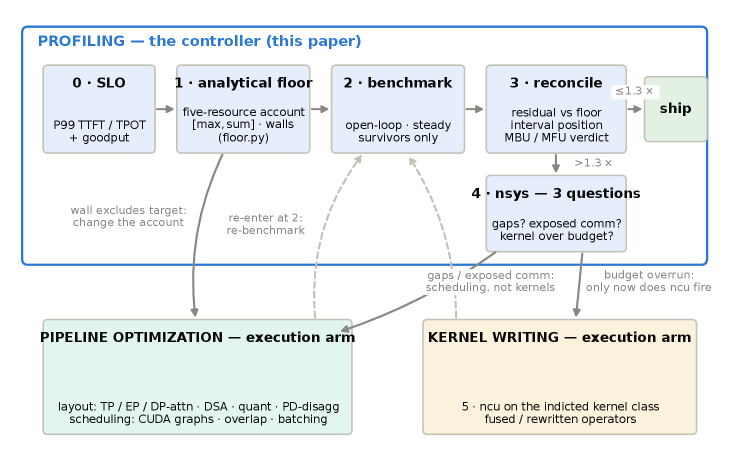
Yihua Liu argues that the standard playbook for LLM serving optimization—benchmark lots of configurations, fire up a heavy profiler when latency targets are missed—is backwards and expensive. The paper proposes Floor First, a triage workflow that models each decode step as a five-dimensional resource vector: HBM bytes, FLOPs, network bytes, network messages, and KV capacity. From these, you compute an optimistic floor (the max across resources) and a pessimistic ceiling (the sum); where your actual measurement lands inside that [max, sum] interval tells you how well your system overlaps work before you open a profiler. Profilers only escalate on residuals above a stated threshold. As a concrete case study, the method analyzes a DeepSeek-V3.2-style 671B MoE model on 16 NVIDIA H20 GPUs—a chip with a ridge point of ~74 FLOP/byte versus ~590 for H100—making it an extreme decode-oriented part. The floors reveal that TP16 decoding is KV-capacity-limited to roughly 70 concurrent 8K requests, that an EP16+DP-attention layout yields an order-of-magnitude higher capacity wall (~644 vs ~70 concurrent requests), and that single-stream latency still favors tensor parallelism by 2.4×. The layout choice, the paper argues, is a computable function of your operating point—which explains why production deployments on identical hardware have shipped opposite attention layouts and both been “right.” The workflow is designed to be compositional and ships as a zero-dependency calculator plus an agentic workflow skill for automated optimization loops.
Cold read
This is a single-author paper with a single case study—one model architecture (DeepSeek-V3.2-style MoE) on one hardware configuration (16× H20). The floor/ceiling framework is analytically clean, but the paper does not demonstrate empirically that real-world measurements consistently fall inside the predicted [max, sum] intervals across diverse workloads, attention variants, or hardware generations. The “zero-dependency calculator” is a tool claim, not a validated product; there’s no ablation showing it saves meaningful engineering time versus ad-hoc estimation or that the threshold-based profiler escalation actually catches the right residuals in practice. The compositional module-declaration model sounds elegant but assumes you can cleanly characterize new attention or state-space variants in the five-dimensional resource space—a non-trivial lift for teams without deep systems expertise. And the entire framework is still an estimation layer: it tells you where to look, not what the answer is, so operators with weak hardware intuition may misread the floors and draw wrong conclusions.
What it means for you
- Signal maturity: 2/5 — analytically rigorous, empirically thin; no production validation across diverse workloads
- Who gets hurt: ML platform teams at Series A–C companies doing naive benchmark sweeps to pick serving configurations; they’re paying for compute time to answer questions that are, per this paper, just arithmetic
- What breaks if this is true: The $200K/month GPU cluster your infra team “optimized” via grid search may be running the wrong attention layout for your actual traffic distribution—and a back-of-envelope calculation would have caught it
- Why it might not land: Most founders and even most ML engineers don’t have the hardware intuition to correctly populate the five-dimensional resource vector; the framework is only as good as your input assumptions, and bad priors produce confident wrong floors
- Watch for: Adoption of this framework (or something like it) in mainstream serving stacks—vLLM, SGLang, TensorRT-LLM—as a built-in pre-profiling estimation pass; that’s the signal it has legs beyond a whitepaper
Forecast as of 2026-07-08
By Q2 2027, at least one major open-source LLM serving framework will ship a lightweight pre-profiling estimation layer—whether derived from this paper or independently developed—making floor/ceiling resource analysis a standard step before benchmarking; if none does, this work will remain a practitioner curiosity cited in literature but not operationalized.
Source: Think Before You Grid-Search: Floor-First Triage for LLM Serving — Yihua Liu. https://arxiv.org/abs/2607.05876v1