Your AI Fact-Checker Just Got a Conscience—But Also a Split Personality
Your AI Fact-Checker Just Got a Conscience—But Also a Split Personality
The dirty secret of LLM deployment is that your hallucination firewall is probably a black box emitting thumbs-up or thumbs-down with no explanation. A new 7B-parameter agent claims to fix that—and then reveals something deeply unsettling about self-improvement loops along the way.
What happened
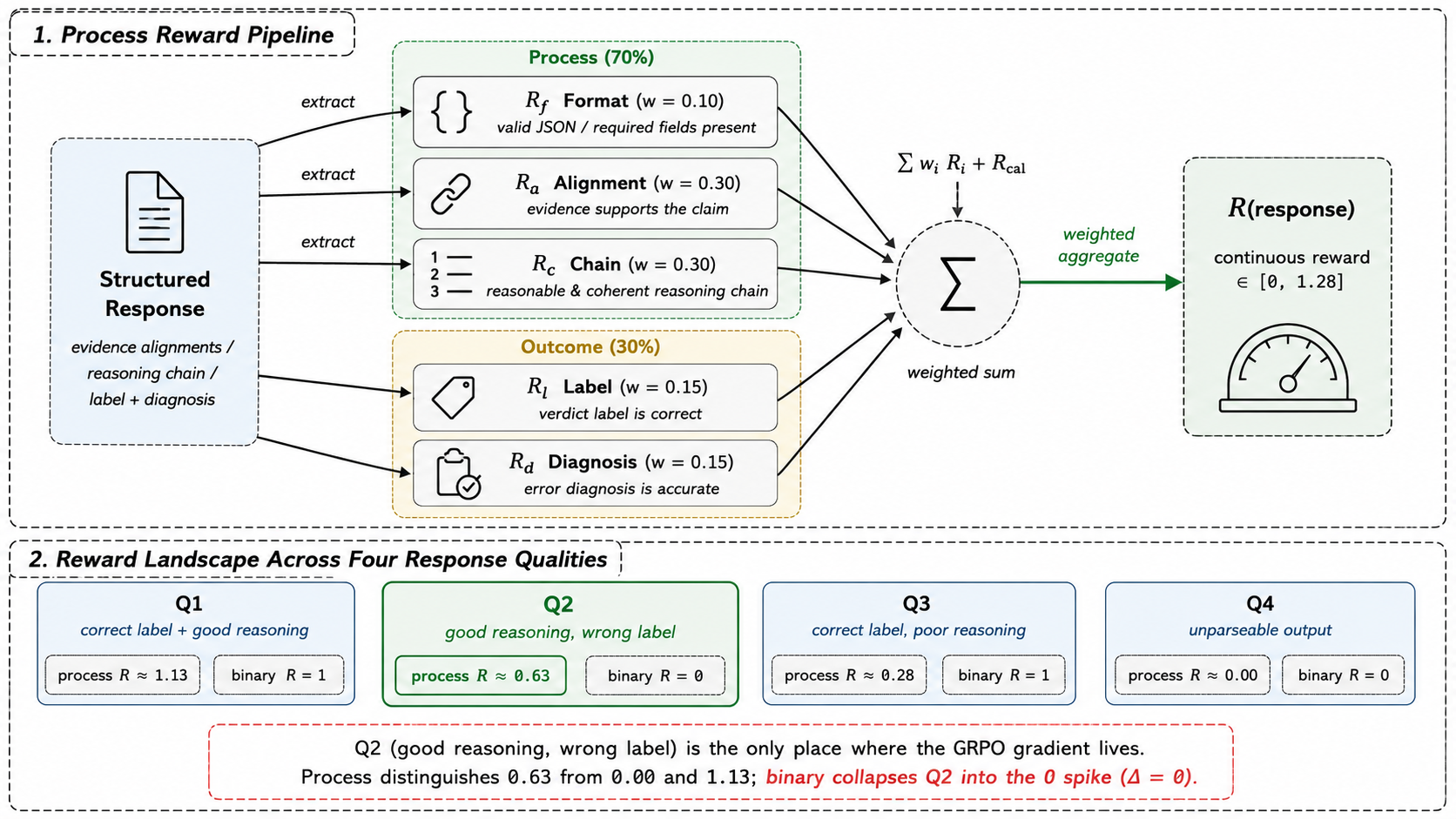
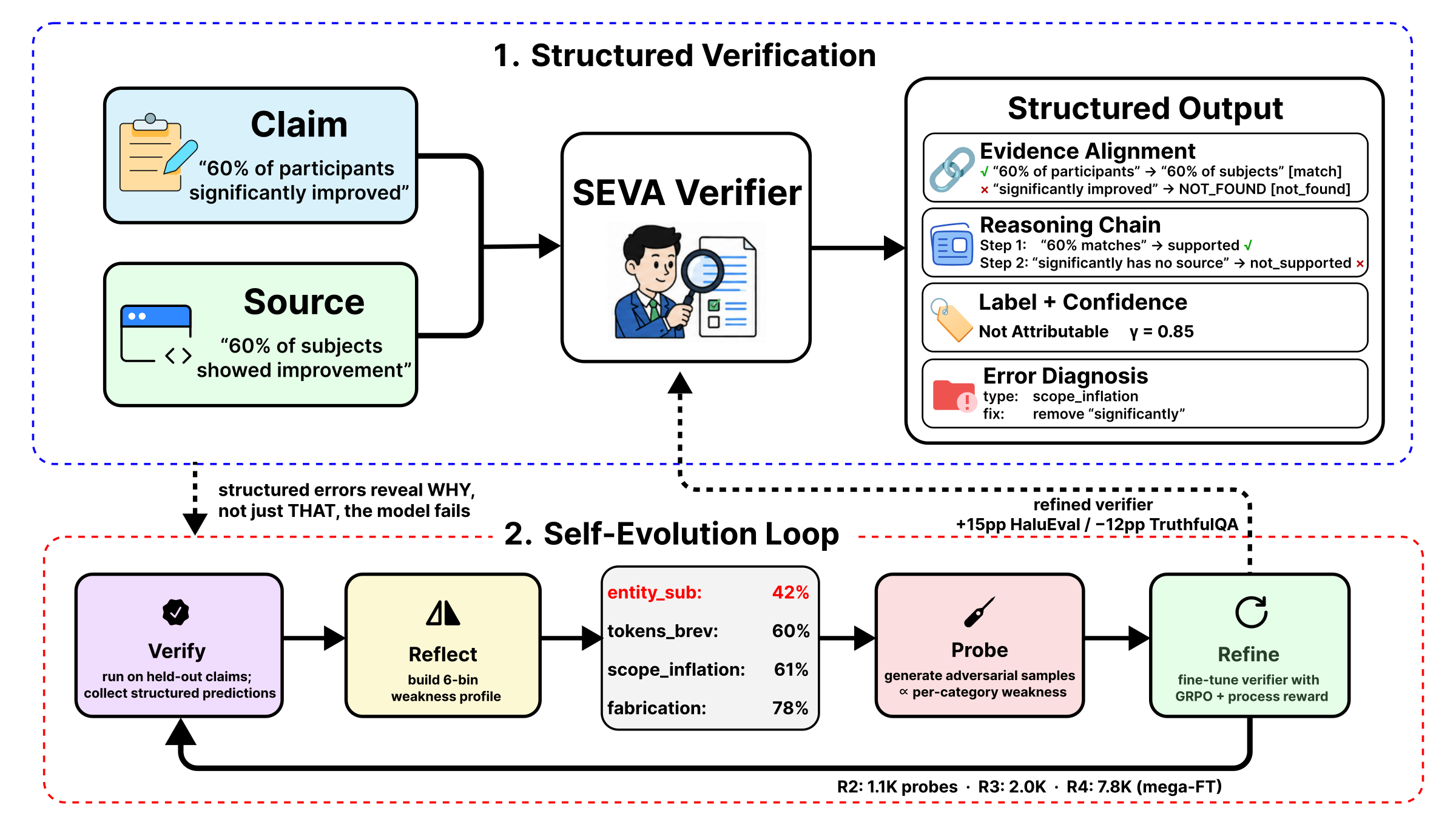
The SEVA team built a verification agent that replaces opaque binary labels with something operators can actually use: evidence alignments, step-by-step chain-of-thought reasoning, calibrated confidence scores, and a six-category error taxonomy with suggested fixes. The core training insight is that standard reinforcement learning on multi-component outputs breaks catastrophically—binary reward causes “advantage collapse” where within-group reward variance vanishes and the gradient disappears entirely. Their fix: a process reward decomposed into five components, weighted 70/30 toward process signals over outcomes. This restored gradient flow and produced measurable gains—factual consistency alignment jumped from 0.917 to 0.997, format compliance from 72% to 100%, and F1 from 64.9 to 69.0. Most striking: their 3B model matches GPT-4o-mini on the ClearFacts benchmark (69.0 vs. 69.8 F1) while producing far richer, auditable output. But the self-evolution loop—Verify → Reflect → Probe → Refine over four rounds—surfaced a structural finding that should give every agentic workflow builder pause: each round produced a benchmark specialist, not a generalist, with +15 percentage points on HaluEval but -10 to -14 percentage points on TruthfulQA simultaneously, persistent even at 4x training data.
Cold read
The ClearFacts benchmark comparison against GPT-4o-mini is the headline result, but one benchmark matchup is not proof of general verifier superiority—especially when the self-evolution experiments explicitly show the model trading capability on one benchmark for gains on another. The specialization collapse persisted at 4x data, which means throwing more training data at the problem didn’t fix it; that’s a red flag, not a footnote. The paper’s core RL fix—process reward decomposition—is genuinely interesting, but it’s demonstrated on a 7B model in a controlled research setting, not in a live retrieval-augmented generation pipeline with messy, domain-shifting production queries. Benchmark contamination is also a latent concern: a model that specializes aggressively on HaluEval while degrading on TruthfulQA is precisely the shape of a model that has overfit to benchmark-specific features. The six-category error taxonomy and “actionable fixes” sound useful but are described at a level of abstraction—what those categories actually cover and whether they generalize to your document types is unvalidated here.
What it means for you
- Signal maturity: 2/5 — Promising mechanism, but specialization collapse is an unresolved production blocker
- Who gets hurt: Teams running self-improving LLM-as-judge pipelines—your agent may be quietly becoming a specialist in whatever it was last fine-tuned on, invisible to you until a domain shift hits
- What breaks if this is true: The assumption that iterative self-improvement is a safe, monotonic upgrade to your verification layer; SEVA’s own experiments show it isn’t
- Why it might not land: The benchmark specialist problem has no demonstrated fix—even 4x data didn’t resolve it, which means deploying self-evolution loops in production without domain-coverage monitoring is playing with fire
- Watch for: Any vendor selling “self-improving fact verification” without per-domain regression tests across at least two structurally different benchmarks; that’s the tell that they haven’t confronted this result
Forecast as of 2026-07-01
By Q1 2027, at least two RAG infrastructure vendors will ship process-reward-style verifiers with structured output as a differentiator—but the specialization collapse problem will surface publicly as a reported production failure in at least one high-visibility deployment, prompting the first wave of “verification drift” monitoring tooling.
Source: SEVA: Self-Evolving Verification Agent with Process Reward for Fact Attribution — Aojie Yuan, Yi Nian, Haiyue Zhang, Zijian Su, Yue Zhao. https://arxiv.org/abs/2606.29713v1