Your AI Agent’s Memory Bill Just Got a 75% Discount — Maybe
Your AI Agent’s Memory Bill Just Got a 75% Discount — Maybe
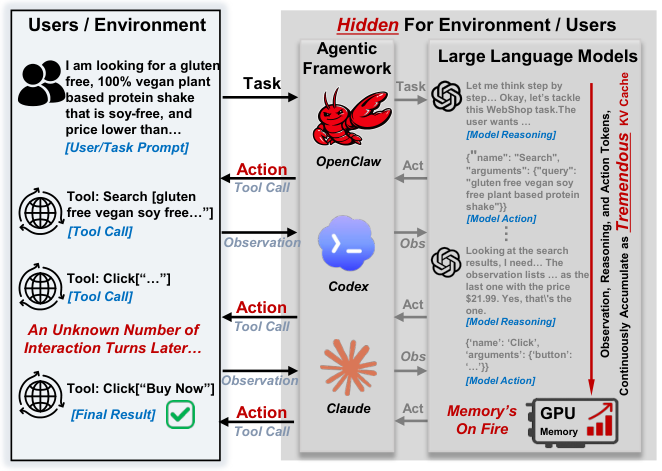
Agentic AI is eating your GPU budget one reasoning loop at a time, and nobody warned you how fast KV cache bloat compounds across a 50-step task. A team just published a framework claiming 4× throughput and 98% accuracy at a quarter of the memory. Before you forward this to your infrastructure lead, let’s read the fine print.
What happened
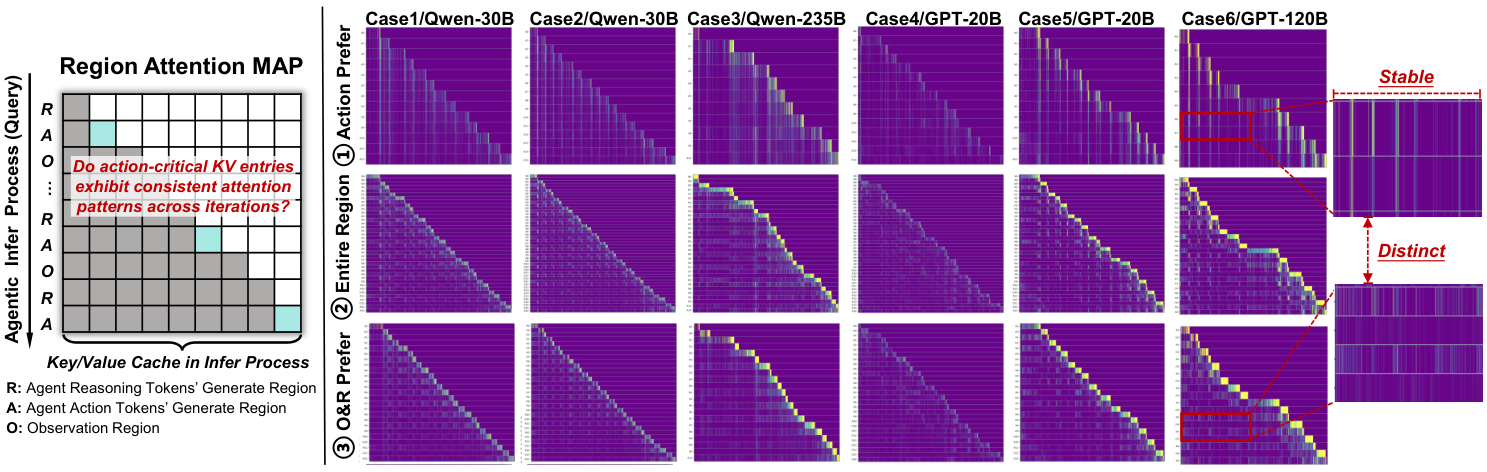
Researchers at seven institutions built ActKV, a KV cache compression system designed specifically for agentic workflows — the observe-reason-act loops that define modern AI agents. The core insight: existing compression methods treat all tokens as roughly equal, but in an agentic AI loop, what actually matters is the quality of the action the model emits, not the quality of its intermediate reasoning prose. ActKV therefore evicts KV entries based on their contribution to action generation, not overall output fidelity. It adds a confidence-driven budget allocator that dynamically adjusts how much memory to spend based on how certain the model is about its next action, and it standardizes everything into paged memory primitives with custom GPU kernels. On “long-trace tasks,” the system retained 98.53% of full-cache accuracy while consuming only 25.98% of peak KV memory, and achieved 3.97× token throughput and 3.58× task throughput versus the full-cache baseline. The agent memory vs. context window problem is real and expensive; these are the most aggressive efficiency numbers published against it to date.
Cold read
The 98.53% accuracy figure is doing enormous work here, and the abstract does not tell you what “long-trace tasks” means: which benchmarks, which agent frameworks, which base models, how many steps constitute a “long” trace. Accuracy at 25% memory budget on a curated benchmark and accuracy on your messy production agentic workflow are very different claims — the gap between the two is where startup budgets disappear. The “stable action access patterns” assumption in the eviction policy is the load-bearing wall of this whole architecture: if your agent’s tasks are heterogeneous or your action space is wide, those patterns may not be stable at all, and the eviction logic degrades from smart to arbitrary. The confidence-driven budget allocator sounds elegant, but LLM confidence (typically derived from token probabilities) is a notoriously unreliable signal — hallucination research has spent three years demonstrating that high-confidence outputs are frequently wrong. Throughput numbers also typically assume controlled serving conditions; multi-tenant, variable-load production environments routinely cut benchmark throughput gains by 30–60%.
What it means for you
- Signal maturity: 2/5 — paper-stage results on unspecified benchmarks with no third-party replication
- Who gets hurt: Inference infrastructure vendors (Together, Fireworks, Anyscale) and any startup whose differentiation is “we run agents cheaper” — this compresses their moat if ActKV or a derivative ships in a major serving stack
- What breaks if this is true: The business case for throwing more H100s at agentic latency problems weakens significantly; CapEx-heavy scaling strategies for agent orchestration layers need re-examination
- Why it might not land: The “stable action access pattern” assumption almost certainly breaks on open-ended, tool-rich agents (browser agents, coding agents with large repos); the system may also require model-specific tuning that eliminates the claimed ease of integration
- Watch for: A production integration into vLLM, SGLang, or a major inference API within 6 months — that would be the real signal that the kernel primitives work outside a lab
Forecast as of 2026-09-28
By Q3 2027, at least one major open-source inference framework (vLLM or SGLang) will have merged an action-oriented KV eviction strategy inspired by this line of work — but real-world throughput gains in production agentic deployments will be reported at 1.5–2.5×, not the 4× headline figure.
Source: ActKV: Efficient LLM Agents through Action-Guided KV Cache Management — Zihan Wang, Cheng Tang, Lei Gong, Chao Wang, Wenqi Lou, Teng Wang, Xuehai Zhou. https://arxiv.org/abs/2609.31395v1