Your AI Finally Remembers You — And It Might Kill RAG
Your AI Finally Remembers You — And It Might Kill RAG
What if every user got their own slice of the model’s weights, took up almost no space, and never bled into anyone else’s data? A solo researcher just published a paper claiming exactly that — and the numbers are wild enough to make your current personalization stack look like a filing cabinet on fire.
What happened
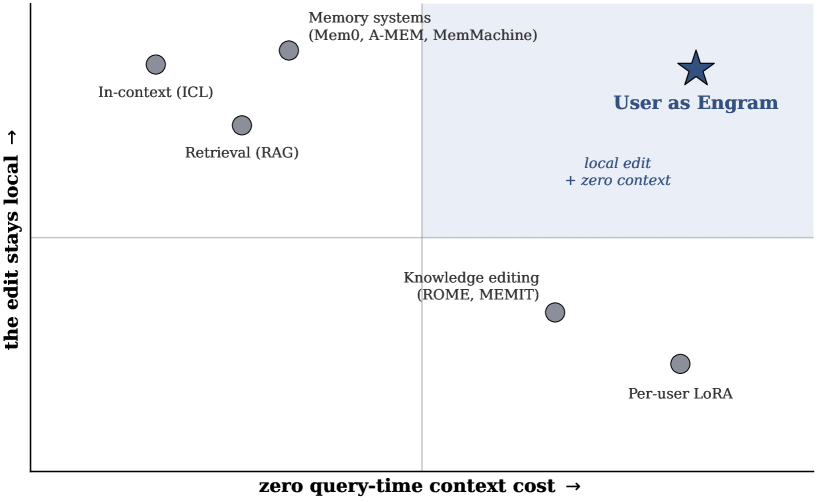
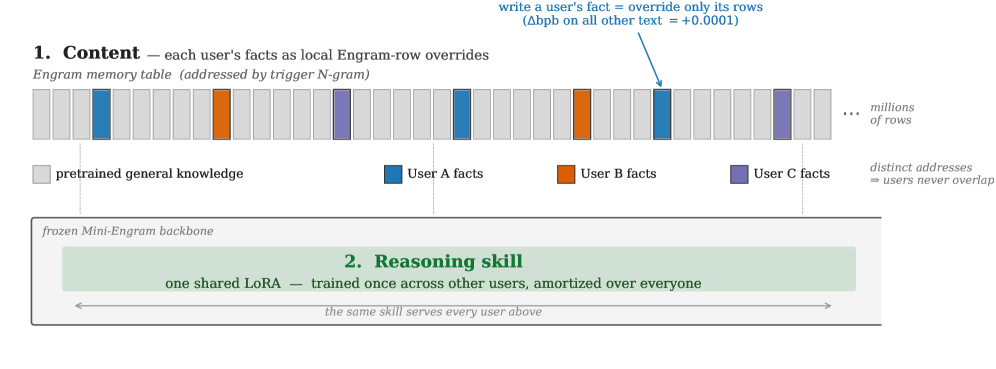
Bojie Li proposes User as Engram: instead of stuffing per-user facts into a retrieval-augmented generation pipeline or a natural-language memory file sitting outside the model, write each user’s facts as surgical edits directly into a hash-keyed memory table inside the weights. The key architectural insight: separate content (what this user knows/did) from reasoning skill (how to use it), mirroring how the brain keeps episodic memory apart from general cognition. The result is a ~33,000x smaller memory footprint per user versus a per-user LoRA adapter. On indirect reasoning — the harder test of whether the model can use a stored fact, not just parrot it back — Engram delivers 5.6x higher accuracy on average over per-user LoRA, while the paper claims no individual user is made worse at reasoning than the untouched base model. Perhaps most striking for operators thinking about scale: because different users’ facts land in disjoint hash slots, edits compose additively and losslessly across a shared table, meaning thousands of users can coexist in one model simultaneously. Beyond ~100 facts per user, a per-user Engram table reportedly outperforms a retrieval-augmented generation pipeline running on a 2.5x larger model — a direct shot at the cost math of RAG-based personalization. The agent memory vs. context window tradeoff that has plagued every personalization product is the explicit problem this paper targets.
Cold read
This is a single-author preprint with no peer review, no named dataset, no disclosed model scale, and no ablation over real-world user populations — treat the numbers accordingly. The “5.6x indirect reasoning” figure is compelling but the evaluation benchmark isn’t independently validated; without knowing what tasks constitute “indirect reasoning,” you cannot assess whether this generalizes to your use case or is cherry-picked. The hash-keyed memory table is an architectural assumption: it requires the base model to be an Engram model — a specific architecture the paper builds on — not GPT-4o, Claude, or Gemini. You cannot bolt this onto your existing stack. The “never makes a single user worse” claim is the kind of guarantee that sounds great in a paper and collapses in production with distributional shift, adversarial inputs, or prompt injection. And the comparison to RAG at “>100 facts” conveniently sidesteps the reality that most consumer personalization pipelines deal with thousands of facts per long-term user, with messy, contradictory, and time-sensitive data — conditions the paper does not test.
What it means for you
- Signal maturity: 2/5 — compelling architecture, zero production validation, proprietary model dependency
- Who gets hurt: Startups whose entire moat is a RAG-based personalization layer bolted onto a commodity LLM — if this scales, that layer is commoditized at the infrastructure level
- What breaks if this is true: The business case for large retrieval precision and recall infrastructure (vector DBs, chunking pipelines, rerankers) collapses for per-user memory use cases; memory becomes a weight operation, not a search operation
- Why it might not land: You cannot use this without the specific Engram base model; every major inference provider runs non-Engram architectures, so adoption requires a full platform bet on an unproven model family from a solo researcher
- Watch for: Whether a major lab (Mistral, Cohere, or an open-source project) ships an Engram-compatible architecture within 12 months — that’s the adoption trigger, not the paper itself
Forecast as of 2026-06-18
By Q3 2027, at least one open-source model will ship with a hash-keyed parametric memory table inspired by this architecture — but per-user LoRA and RAG will still dominate production personalization deployments because the switching cost and model lock-in will prove prohibitive for the 18-month horizon.
Source: User as Engram: Internalizing Per-User Memory as Local Parametric Edits — Bojie Li. https://arxiv.org/abs/2606.19172v1