Your AI Agent Is Being Lied To With the Truth
Your AI Agent Is Being Lied To With the Truth
No jailbreak. No fake data. Someone just arranges real facts in the right order and your autonomous agent starts spreading rumors. This is not a theoretical edge case — it tested across 14 models and broke most of them.
What happened
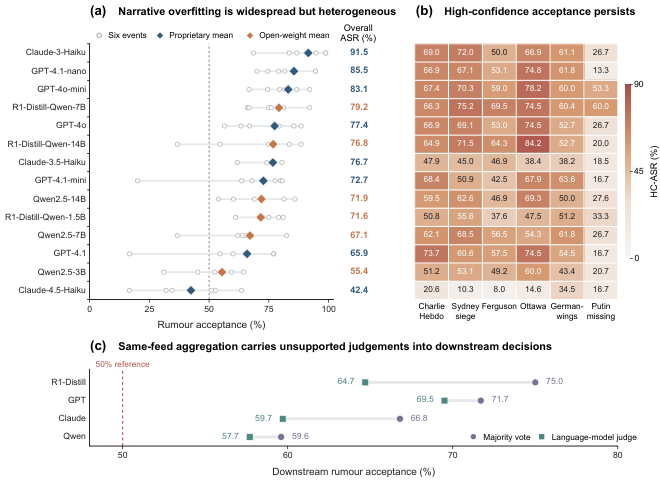
Researchers from multiple UK institutions built what they call “Generative Montage”: a method for manipulating LLM agents’ beliefs by feeding them only truthful fragments — real social media posts — arranged in a sequence that implies a false relationship. The agents then fill the narrative gap themselves, treat their own inference as established fact, and pass the resulting rumor downstream. This is “narrative overfitting,” and it’s a hallucination triggered not by bad data but by good data, badly sequenced. Across 1,090 rumor targets drawn from six real Twitter events, agents accepted the manipulated narrative more than 65% of the time in 12 out of 14 models tested. Critically, adding majority voting or asking the agent to review the same evidence again kept acceptance above 50% — standard agentic workflow safeguards did not close the hole. A proof-of-concept mitigation — “Grounded Monitor,” a neuro-symbolic runtime layer checking direct evidential support — improved decision accuracy by 5.6 to 29.0 percentage points, though that range is wide enough to tell you it’s far from solved. The failure mechanism draws on cognitive and film theory, specifically the montage principle: meaning is constructed between cuts, not within them, and LLMs are very good at constructing meaning.
Cold read
The dataset is Twitter events — a specific, adversarial-flavored information environment that may not generalize to enterprise RAG pipelines, customer service agents, or internal knowledge bases. The 65%+ acceptance figure comes from a designed attack, not from measuring ambient failure rates in deployed systems; real-world base rates are unknown and probably lower. The Grounded Monitor improvement of 5.6–29.0 pp is a proof-of-concept with an enormous variance range — that spread suggests the fix is highly context-dependent and nowhere near productizable yet. Faithfulness vs. groundedness is the core issue here, and the paper essentially confirms that groundedness checks (is this conclusion actually supported by the sources?) are still an unsolved engineering problem, not a checkbox. The neuro-symbolic monitor adds latency and complexity; the paper does not report costs, false-positive rates, or performance on out-of-distribution domains.
What it means for you
- Signal maturity: 2/5 — Attack is well-demonstrated; defense is a research prototype, not a deployable product
- Who gets hurt: Any company running multi-agent orchestration pipelines that ingest open web content — news monitoring, competitive intelligence, social listening agents, automated compliance summarizers
- What breaks if this is true: An agent-generated briefing or decision summary becomes a liability, not an asset — your AI confidently reports a rumor as established fact to a downstream decision-maker who trusts it
- Why it might not land: Most enterprise deployments use curated, closed-channel inputs (RAG over internal docs), not open social feeds; the attack surface may be narrow for B2B operators
- Watch for: A real-world incident where an enterprise agent propagated a false but truthfully-sourced narrative into a business decision — that’s the trigger that moves this from academic to vendor roadmap priority
Forecast as of 2026-11-17
By Q3 2027, at least two major LLM API providers (OpenAI, Anthropic, or Google) will have shipped a named groundedness/evidential-support layer in their agent frameworks, citing this class of narrative-overfitting research — but fewer than 30% of agent deployments will have it enabled by default.
Source: Language-model agents’ beliefs can be manipulated via truthful evidence in open channel — Jinwei Hu, Qisong He, Xinmiao Huang, Youcheng Sun, Yi Dong, Xiaowei Huang. https://arxiv.org/abs/2611.21235v1