Your Agentic AI Just Got a 0% Hallucination Rate — On 157 Medical Tools
Your Agentic AI Just Got a 0% Hallucination Rate — On 157 Medical Tools
Healthcare AI just got its most credible “no cloud, no hallucinations” claim yet. A compiler-based approach clocked zero invented content across thousands of tool calls — while your LLM agents were fabricating inputs 1-in-5 times. If that number is real, it guts the core argument for LLM-based clinical automation.
What happened
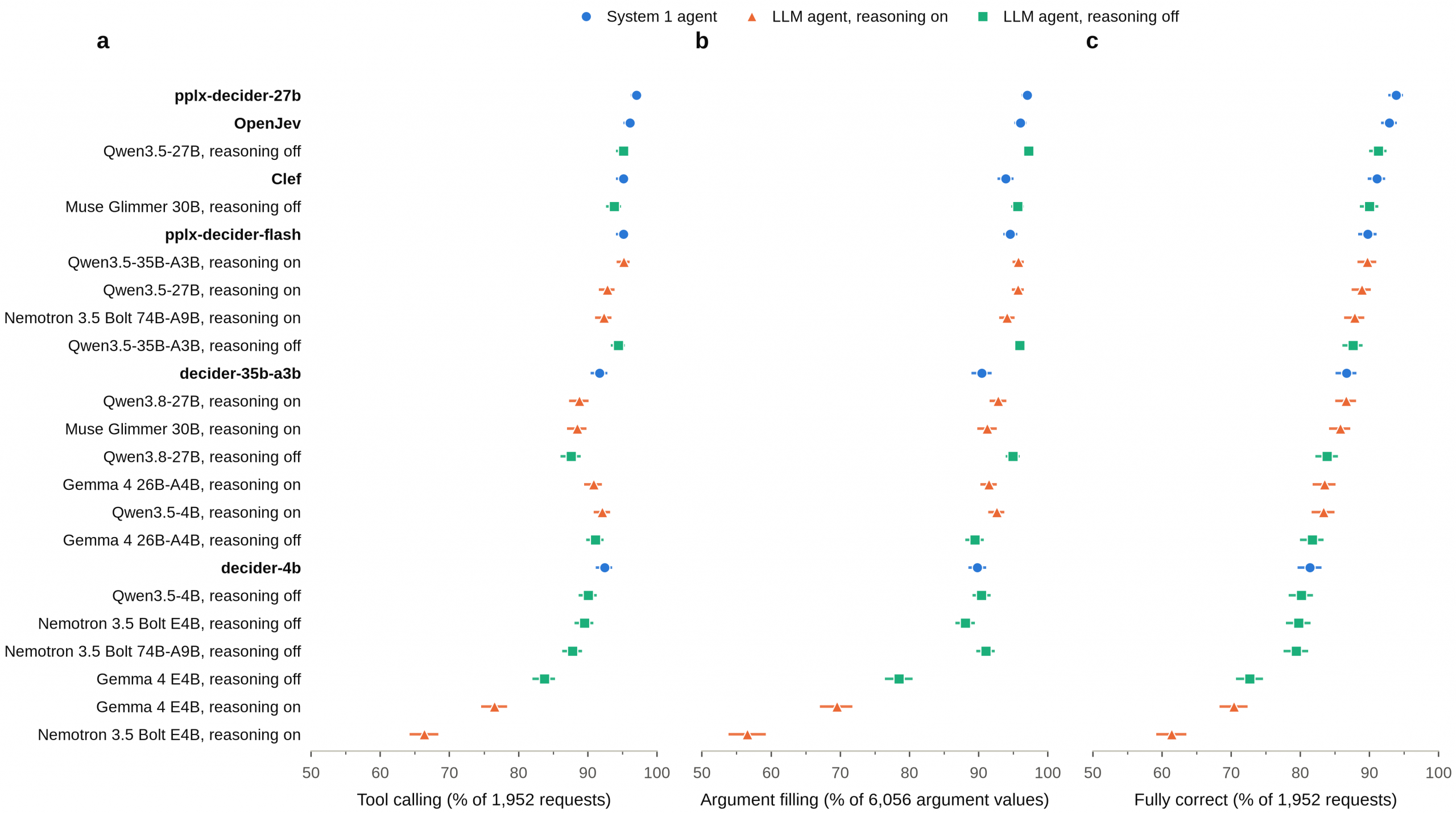
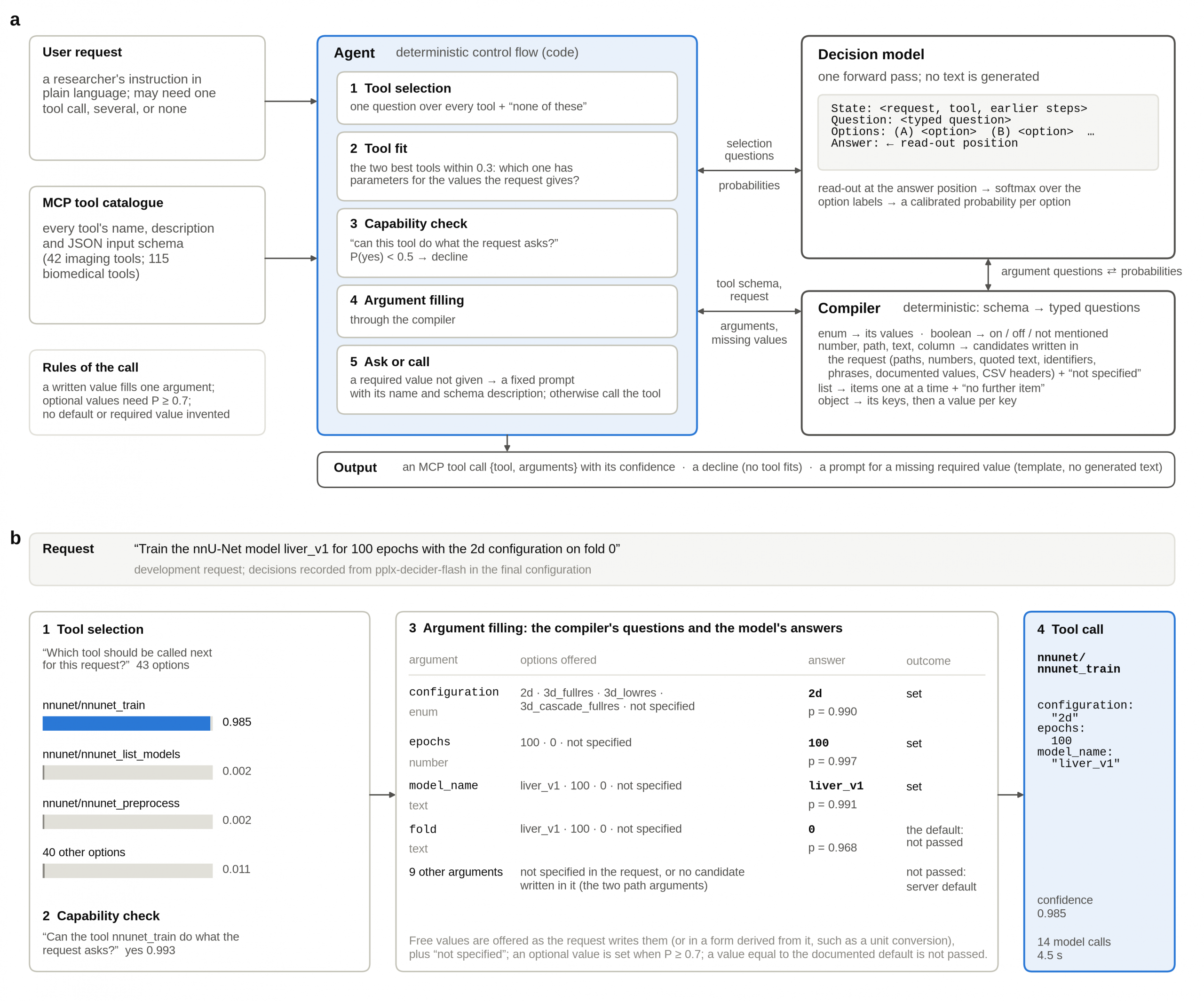
Tzanis and Klontzas identified a specific, nasty failure mode in agentic AI pipelines: when a local large language model hallucinates a single argument value in a tool call, that invented value propagates through every downstream step — an error multiplier, not just a one-off mistake. Their fix is architectural: a deterministic compiler converts each tool’s schema plus the user request into multiple-choice questions, then a one-pass decision model selects answers from the options presented. No text generation, no confabulation surface. Tested against 1,952 requests across 157 biomedical tools, the best System 1 agent achieved 97.0% correct tool selection and 97.0% correct argument fill — beating the best of 18 local LLM-agent configurations (95.2% tool selection). The headline stat: zero invented content in any System 1 call, versus 5.5–19.7% of calls containing fabricated values across all LLM baselines. The tool use problem is reframed as a classification problem, and the code is open-source.
Cold read
The benchmark is 157 biomedical tools — a narrow, structured domain where schemas are well-defined and requests map cleanly to options. Real-world agentic deployments involve ambiguous requests, overlapping tool capabilities, and schemas that evolve; the multiple-choice framing may degrade badly when no option is a good fit. The 97.0% vs. 95.2% gap over the best LLM baseline sounds dramatic, but that’s roughly 35 more correct calls out of 1,952 — meaningful in clinical contexts, but not a category-killing margin at the headline level. The zero-hallucination claim is structurally guaranteed by design (you can’t invent what isn’t a choice), which is elegant — but it also means the system can only fill values already present in the request or schema; any value requiring inference or lookup simply can’t be generated. That’s a hard constraint, not a free lunch. Finally, benchmark contamination risk is unaddressed: we don’t know how representative these 1,952 requests are of the actual distribution of clinical queries operators will face.
What it means for you
- Signal maturity: 3/5 — Rigorous narrow benchmark, zero production validation
- Who gets hurt: Vendors selling cloud-LLM clinical automation on a “we handle HIPAA” promise — this paper arms their on-prem competitors
- What breaks if this is true: The moat of frontier LLM providers in regulated healthcare collapses; a small local model with a smart compiler beats GPT-4-class agents on the only metric that matters for compliance
- Why it might not land: The multiple-choice constraint is a ceiling, not just a floor — any task requiring synthesized or inferred argument values is out of scope by design, limiting real-world utility to well-structured, schema-complete workflows
- Watch for: A health-tech operator citing this paper when renegotiating a cloud AI contract, or an FDA/EMA guidance document referencing deterministic tool-call methods as a compliance pathway
Forecast as of 2026-11-17
By Q3 2027, at least one HIPAA-scoped clinical AI platform will publicly ship a compiler-based, non-generative tool-calling layer citing this architecture — but the approach will remain confined to structured biomedical tool domains and will not displace LLM agents in open-ended clinical workflows.
Source: System 1 agents: a method for local, reliable and fast agentic AI — Eleftherios Tzanis, Michail E. Klontzas. https://arxiv.org/abs/2611.21053v1