Your AI Agent Keeps Failing Mid-Task. This Paper Claims to Fix It.
Your AI Agent Keeps Failing Mid-Task. This Paper Claims to Fix It.
LLM agents break in production constantly — wrong tool calls, looping actions, reasoning that goes nowhere. A Stanford team says they’ve built a “failure memory” layer that makes agents learn from their own mistakes in real time, without retraining. That’s a big claim. Let’s look at what they actually showed.
What happened
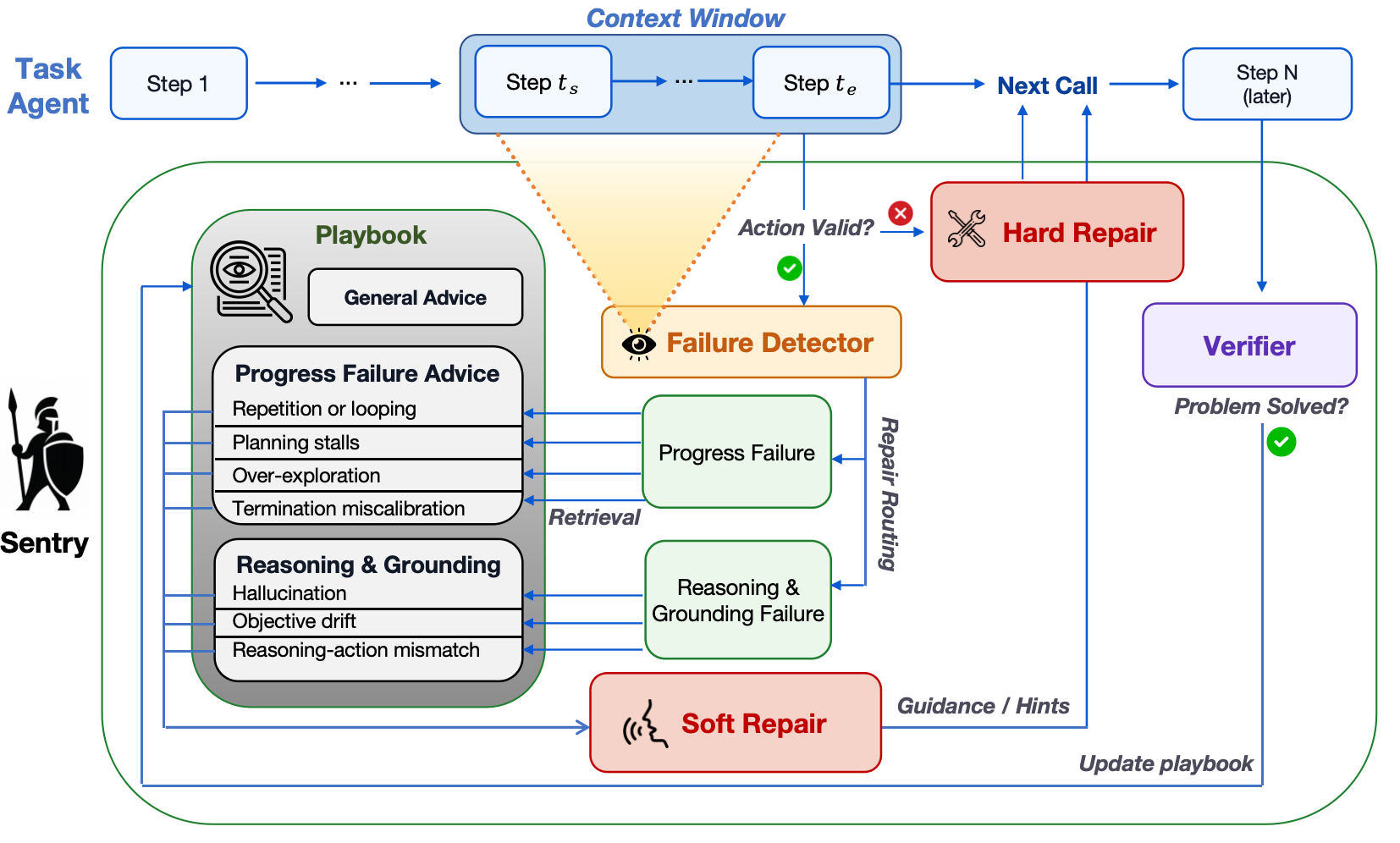
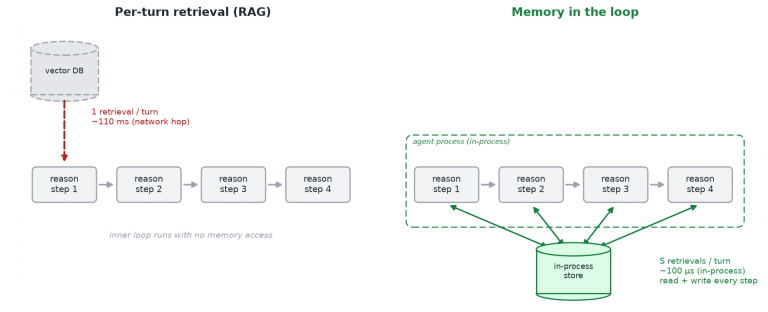
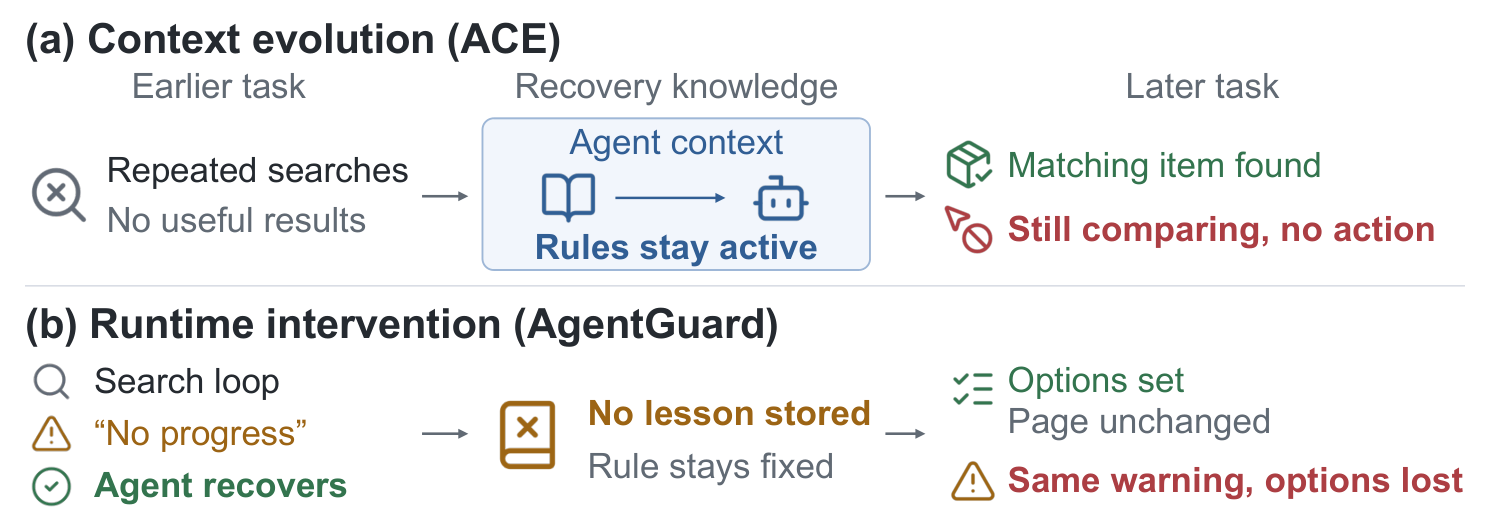
Researchers built Sentry, a supervision layer that runs alongside an LLM agent and manages a private “playbook” of failure lessons. The key architectural bet: failure knowledge should be conditionally exposed — only surfaced when the specific failure pattern is detected, never dumped wholesale into the agent’s context window. When Sentry detects a failure, it retrieves the relevant lesson via something resembling retrieval-augmented generation, guides the agent’s recovery, then checks — without access to task rewards — whether recovery actually happened. If it did, the lesson gets written back to the playbook; if it didn’t, it doesn’t. Across multiple agentic workflow benchmarks, Sentry beat the strongest runtime-intervention baseline by 37% on average, and the strongest context-evolution baseline by 39% on the two benchmarks where both were tested. Critically, the paper also found that dumping the full playbook into the agent’s context — even when the right lessons are technically available — lowered performance compared to conditional retrieval.
Cold read
Thirty-seven percent sounds transformative until you ask: 37% of what, on which tasks? The abstract names “multiple agentic benchmarks” without specifying which or how many, which is a classic soft spot — benchmark contamination and benchmark cherry-picking are both live risks in agentic eval right now. The “verified recovery without access to task rewards” mechanism is doing enormous load-bearing work here and gets no detail in the abstract — if that verification is itself an LLM judgment call, you’ve introduced a second failure mode dressed up as a solution. Lessons transferring to “held-out tasks” is promising but held-out doesn’t mean held-out-of-distribution; near-neighbor tasks in the same benchmark suite are not a proof of real-world generalization. Finally, this is a test-time learning paper: it assumes your agent runs enough similar failures to build a useful playbook, which is a generous assumption for low-volume or high-variance production environments.
What it means for you
- Signal maturity: 2/5 — promising lab result, zero production validation
- Who gets hurt: Teams currently burning engineering cycles on brittle prompt patches every time an agent breaks; also vendors selling “agent reliability” as a black-box product feature
- What breaks if this is true: The standard practice of stuffing all guardrails and lessons into a fat system prompt becomes an antipattern — conditional retrieval beats static context
- Why it might not land: The recovery verification mechanism is unaudited; if it misfires, bad lessons accumulate and the playbook poisons future runs — a compounding failure mode worse than no playbook at all
- Watch for: A production deployment report (not a benchmark paper) showing playbook stability over thousands of heterogeneous tasks — that’s the signal this is real
Forecast as of 2026-10-05
By Q3 2027, at least two agent-infrastructure startups (or one of the major agent frameworks — LangChain, LlamaIndex tier) will ship a named feature explicitly implementing conditional failure-lesson retrieval; but benchmark-to-production transfer will prove messier than the paper implies, and failure-verification accuracy will be publicly flagged as the core unsolved problem.
Source: Sentry: Learning to Recover from LLM Agent Failures at Test Time — Changxiu Ji, Amy Lu, Qizheng Zhang, Kunle Olukotun. https://arxiv.org/abs/2610.02994v1