Your AI Agents Just Got Faster — Or Did They Just Get Dumber Selectively?
Your AI Agents Just Got Faster — Or Did They Just Get Dumber Selectively?
Long-context inference is the silent budget killer in every agentic stack. A new paper claims models can teach themselves when not to read their own memory — and that skipping most of those reads costs you almost nothing. Almost.
What happened
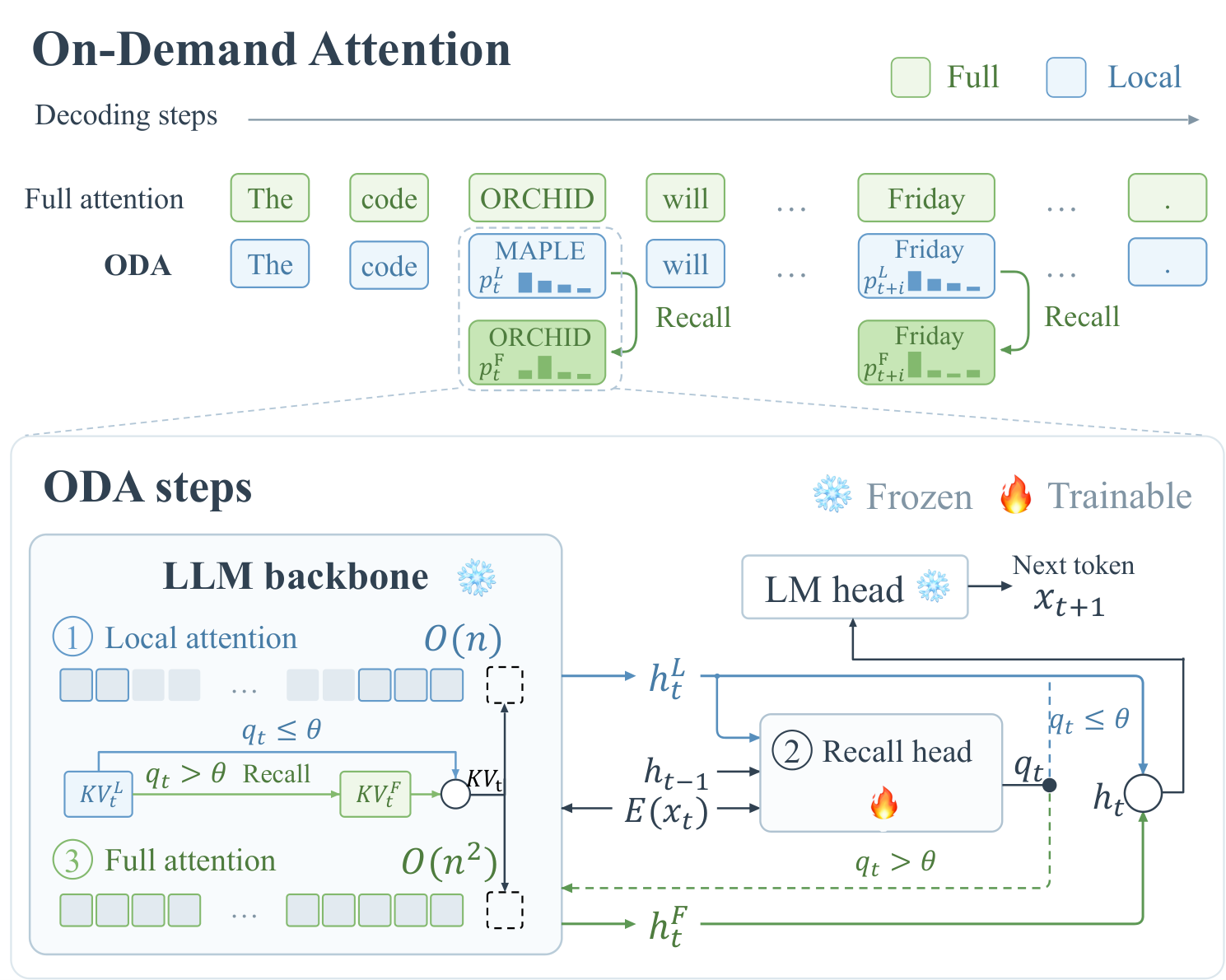
Researchers from a team including Haibo Feng and colleagues identified a structural waste in how large language models currently decode: at every single generation step, the model reads the entire accumulated KV cache — the full history — regardless of whether that history is actually useful for the next token. Their key finding: the model’s own internal decoding states already encode a signal predicting how beneficial a global memory read will be, before that read happens. They built On-Demand Attention (ODA) on top of this: a lightweight “recall head” trained separately on top of frozen pretrained weights that decides, step by step, whether to invoke full attention or skip it. The complete KV cache is preserved throughout, so nothing is discarded — it’s selective access, not deletion. Tested on Qwen and Gemma model families (including hybrid-attention architectures), ODA “substantially reduces global reads” while recovering “most of the performance lost under local attention.” The implementation runs inside vLLM with GPU-side conditional execution, meaning the reduced reads translate into actual wall-clock decoding speedups at long context window lengths — not just theoretical FLOP savings. No specific speedup numbers (e.g., 2×, 40% latency reduction) are reported in the abstract, which is worth noting.
Cold read
The abstract says ODA “recovers most of the performance lost under local attention” — that phrasing is doing a lot of work. “Most” is not “all,” and the gap matters enormously for agentic workflow tasks where a single missed context retrieval cascades into compounding errors. The benchmarks cover Qwen and Gemma families; there is zero mention of how this behaves on instruction-tuned or RLHF-refined variants, on code generation, or on domains where long-range dependencies are dense (legal documents, multi-step tool call histories). The recall head is trained — on what data, at what scale, with what distribution, at what cost — is entirely absent from the abstract, making replication risk non-trivial. The vLLM integration is a real signal of engineering seriousness, but “practical decoding speedups” without published numbers is a marketing sentence, not a result. And the hard problem — knowing when you don’t know what you need — is exactly where hallucination and factual consistency failures live; skipping global reads confidently on the wrong step is a silent failure mode.
What it means for you
- Signal maturity: 2/5 — Promising mechanism, but no published latency numbers and unknown training cost make this pre-adoptable
- Who gets hurt: Inference infrastructure vendors (Together, Fireworks, Modal) whose pricing moats partly depend on long-context being genuinely expensive to serve
- What breaks if this is true: The economic case for retrieval-augmented generation as a cost-control workaround weakens — if native long-context gets cheap enough, the RAG pipeline complexity tax becomes hard to justify
- Why it might not land: The recall head requires training; if it doesn’t generalize across task types or model versions, operators face a fine-tuning dependency on every model upgrade cycle — that’s a maintenance tax most teams won’t pay
- Watch for: A reproducible benchmark from a third party (not the authors) showing <10% quality degradation at >50% global-read reduction on a standard long-context eval like RULER or LongBench — that’s the number that should move your decisions
Forecast as of 2026-09-18
By Q3 2027, at least one major inference serving framework (vLLM, SGLang, or TensorRT-LLM) will ship a production-grade selective-attention feature drawing on this line of research — but adoption among startups building on top of hosted APIs will remain under 5% because it requires model-level integration they don’t control.
Source: On-Demand Attention: Language Models Know When to Recall — Haibo Feng, Ruiqi Liang, Hanyang Peng, Shiqi Yu. https://arxiv.org/abs/2609.20734v1