You Can Now Match GPT-3 13B for 5% of the Compute. Sort Of.
You Can Now Match GPT-3 13B for 5% of the Compute. Sort Of.
Scaling laws were supposed to be physics — immutable, lab-tested, the bedrock of every AI budget deck. A new paper from NYU says architectural choices can literally bend the exponent. If that holds up outside the lab, the entire “just buy more H100s” strategy is wrong.
What happened
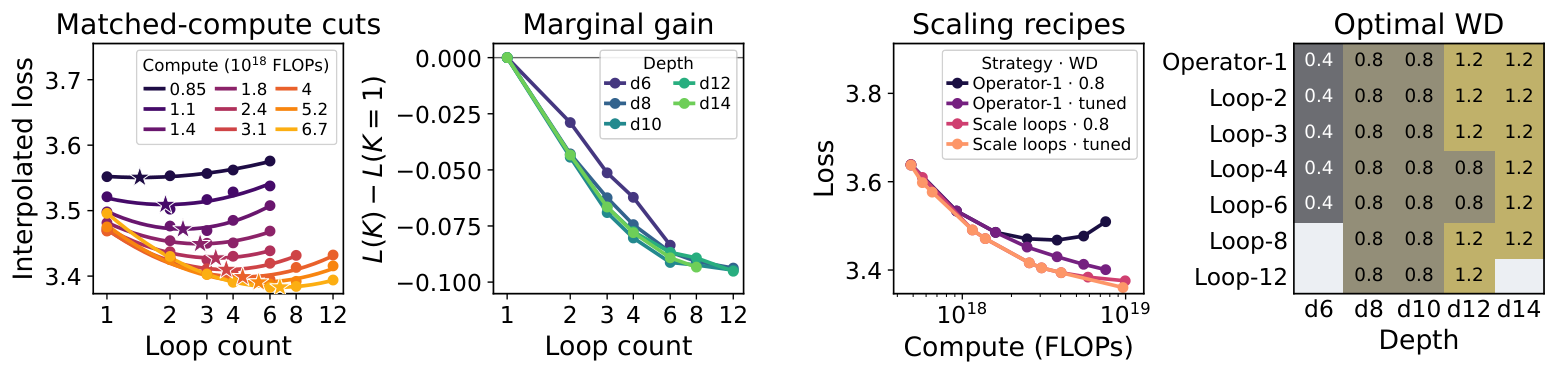
Researchers from Andrew Gordon Wilson’s group tested whether architecture alone can change how fast loss improves as you pour in more compute — the scaling exponent itself, not just the intercept. Their anchoring architecture is the looped transformer (a large language model variant where the same block of weights is traversed multiple times), used here as a mechanism for model growth: you start small and increase the number of loops during training rather than adding new parameters. The headline result is striking — a 7.4B-parameter model-growth architecture matches GPT-3 13B on the CORE benchmark using roughly 20× less compute. Beyond looping, they also find that simply inserting a “boundary operator” — a normalization layer that reinjects an earlier block’s output — into a vanilla transformer produces compute-efficiency gains that grow with scale, though smaller ones. In data-constrained, multi-epoch settings, standard looping also acts as a regularizer, and the compute-optimal strategy is to increase loop count as scale increases. The underlying claim is unified under one lens: more usable depth per FLOP is the variable that matters, and these architectural tricks deliver it.
Cold read
The 20× compute claim is real but narrow: it’s one model size against one benchmark (CORE), and benchmark contamination is an ever-present caveat when comparing against GPT-3-era baselines. The abstract does not specify what hardware, training duration, or data mix underpins these results, which makes the exponent claims hard to independently verify or extrapolate to your stack. “Compute efficiency gains that increase with scale” is the most aggressive claim in the paper — the authors show this trend, but the range of scales tested is not disclosed in the abstract, and extrapolating a favorable trend is exactly how academic results fail to reproduce at production scale. Looped transformers are also not new (they appear in literature as Universal Transformers and similar); the novelty is in the growth mechanism and the exponent framing, but practitioners will need to see this work at 70B+ before making infrastructure bets. Finally, model growth during training adds engineering complexity — curriculum scheduling, loop-count decisions, checkpoint management — that the paper’s compute numbers almost certainly do not include.
What it means for you
- Signal maturity: 2/5 — single-group pre-publication result, no third-party reproduction yet
- Who gets hurt: Infrastructure-heavy startups whose moat is “we can afford to train big models” — if 20× efficiency is real and reproducible, that moat is a sandcastle
- What breaks if this is true: The CapEx justification for large GPU clusters at Series B/C AI companies collapses; efficiency-first challengers can close the capability gap with a fraction of the spend
- Why it might not land: Model growth schedules are brittle in practice; the gains shown on CORE may not transfer to instruction-following, RLHF fine-tuning, or multi-modal settings where depth recycling is less obviously beneficial
- Watch for: A major lab (Meta, Mistral, or a well-resourced open-source project) independently reproducing the exponent-bending claim at 30B+ parameters within the next two quarters — that would be the credibility threshold
Forecast as of 2026-09-18
By Q2 2027, at least one open-source replication attempt of the model-growth / looped-transformer exponent result will be published; it will confirm compute savings in the 5–10× range (not 20×) at scales above 13B parameters, with the gap explained by data-mix sensitivity and growth-schedule tuning costs.
Source: How Model Growth, Recursion, and Boundary Operators Influence Scaling Exponents — Zixi Chen, Akshay Vegesna, Samip Dahal, Andrew Gordon Wilson. https://arxiv.org/abs/2609.19107v1