Your AI Agent’s Memory Is Bleeding You Dry—This Claims to Fix It
Your AI Agent’s Memory Is Bleeding You Dry—This Claims to Fix It
Every token your agent thinks, acts, and tool-calls is money. Agentic workloads burn orders of magnitude more tokens than chatbots, and the caching tricks keeping your costs down were quietly built for the wrong use case. A new paper says the mismatch is architectural, not incidental.
What happened

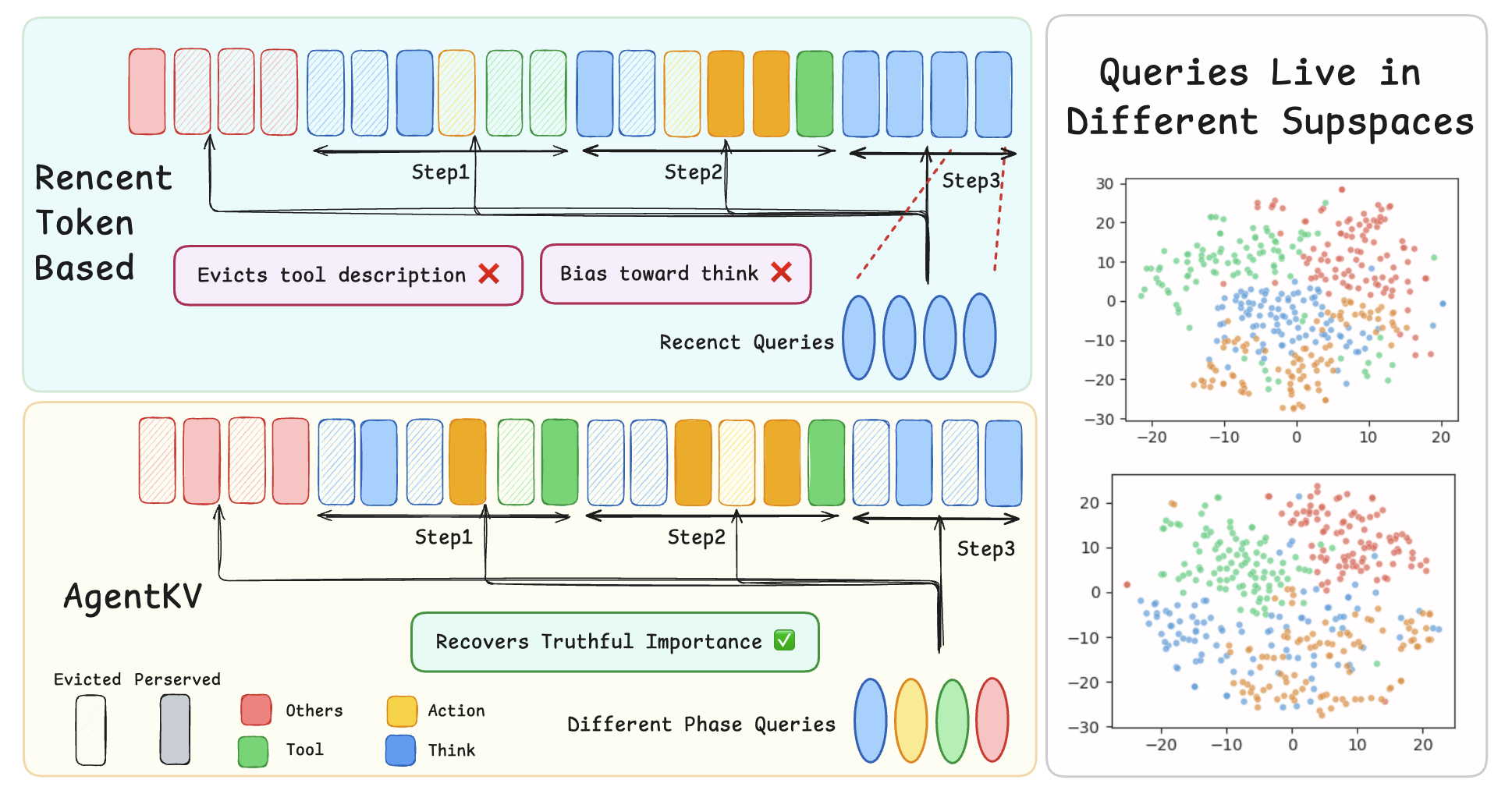
Researchers from (what appears to be an academic group) built AgentKV, a KV-cache eviction strategy designed specifically for agentic workflows rather than single-turn chat. The core finding: standard KV eviction methods assume the near future looks like the recent past—they score which cached keys to keep by sampling from the most recent tokens. That assumption holds fine for conversational models, but agentic AI generation cycles through distinct phases—think, act, tool, and others—that occupy measurably different query subspaces (verified via principal-angle analysis). Recency-based scoring therefore systematically throws away keys that upcoming phases actually need. AgentKV’s fix is simple in concept: maintain a small query buffer per phase and score cached keys against the union of all phase buffers. They also implement a persistent multi-turn serving path that carries compressed KV state across turns and compacts retained pages online. Across two models, six task domains, and three KV budget sizes, AgentKV beats R-KV by 5.5 task-score points and Tri-attention by 5.3 points, while delivering up to 1.80× output-token throughput over full-KV SGLang baseline. The code is public on GitHub.
Cold read
The benchmarks cover two unspecified models and six task domains—neither is named in the abstract, which makes independent reproducibility assessment impossible before you read the full paper. A 5.5-point average improvement sounds clean, but “task score” is a composite metric whose sensitivity to the specific agentic tasks chosen is unknown; cherry-picked domains could inflate this substantially. The 1.80× throughput claim is an up to figure—the average gain across all tested budgets and models is unquoted, which is the number that actually matters for your infrastructure bill. The persistent multi-turn serving path is a meaningful systems contribution, but it also adds operational complexity (page compaction, phase classification, buffer management) that the abstract doesn’t price in failure modes for. Finally, phase classification itself is a latent assumption: if your agent’s phases don’t decompose cleanly into think/act/tool boundaries—or if you’re using a model or prompting style that blurs them—the whole approach degrades toward standard recency scoring.
What it means for you
- Signal maturity: 2/5 — Academic prototype with public code; no production validation cited
- Who gets hurt: Inference infrastructure vendors and multi-agent orchestration platform builders currently selling on KV-cache efficiency as a differentiator
- What breaks if this is true: The context window cost models underlying current agentic API pricing are underoptimized; operators who adopted them early get margin-squeezed as more efficient alternatives ship
- Why it might not land: Phase boundary detection requires the serving layer to “know” what phase the agent is in—messy in practice when prompts are opaque, mixed, or model-specific; also the operational overhead of per-phase buffers may erode throughput gains at lower concurrency
- Watch for: SGLang or vLLM merging a phase-aware eviction strategy into their main branch—that’s the signal this left the lab
Forecast as of 2026-09-16
By Q3 2027, at least one major open-source inference framework (SGLang, vLLM, or TensorRT-LLM) will ship a phase-aware or structured-eviction KV cache mode in a stable release, citing or directly building on this line of work; if none does, the idea died in the integration gap between research and production serving stacks.
Source: AgentKV: Phase-Aware KV Eviction for Agentic LLMs — Taowen Tony Liu, Jeffrey T. H. Wong, Can Xiao, Bowen Yang, Hao Mark Chen, Yiren Zhao. https://arxiv.org/abs/2609.14872v1