Your Agent Benchmark Bill Is About to Get Slashed — Or Is It?
Your Agent Benchmark Bill Is About to Get Slashed — Or Is It?
Running frontier models on agentic benchmarks costs thousands of dollars a pop, and you’re doing it dozens of times per development cycle. A new paper claims it can kill up to 44% of those input tokens before the run even finishes. Before you cancel your AWS budget alerts, read the fine print.
What happened
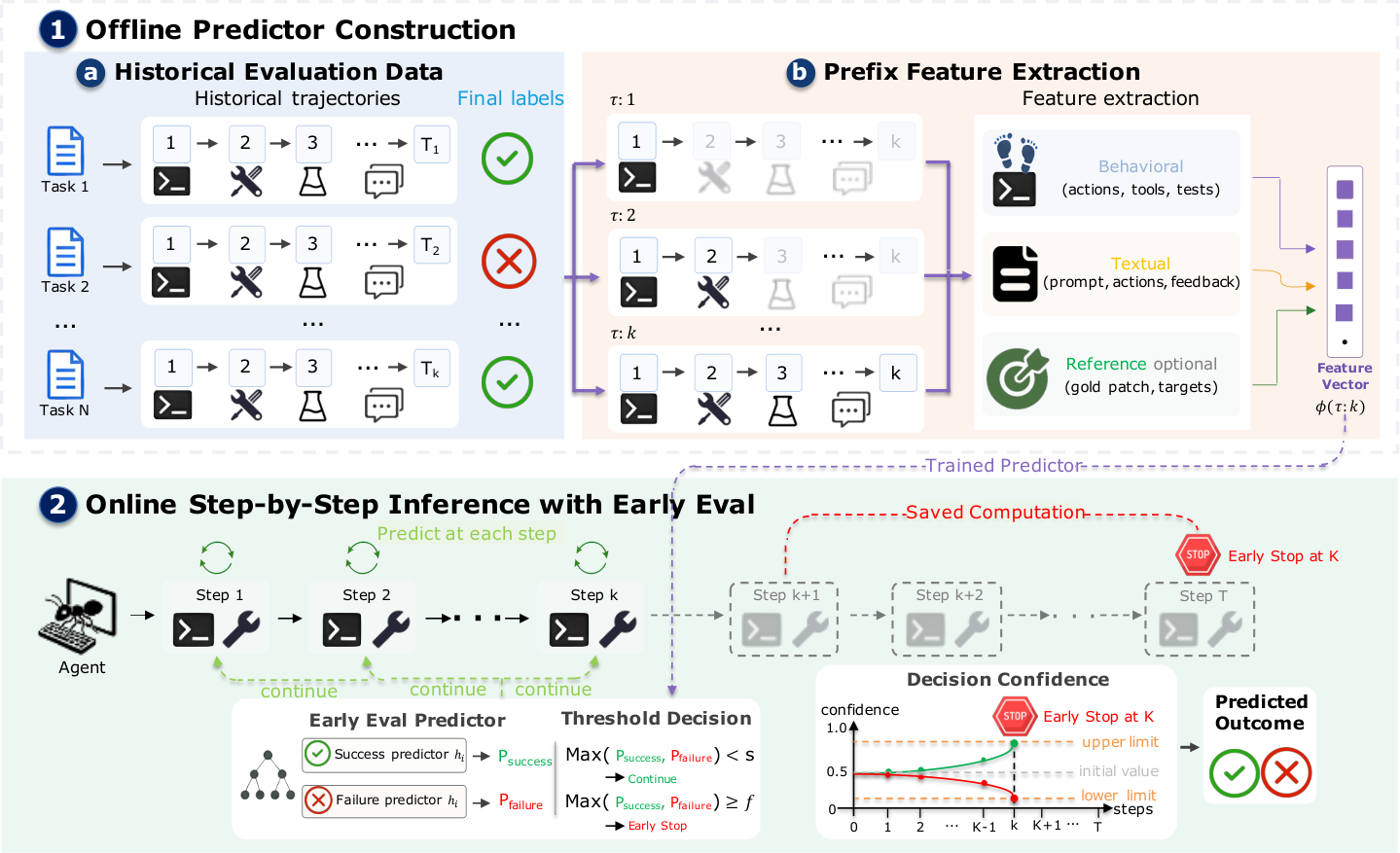
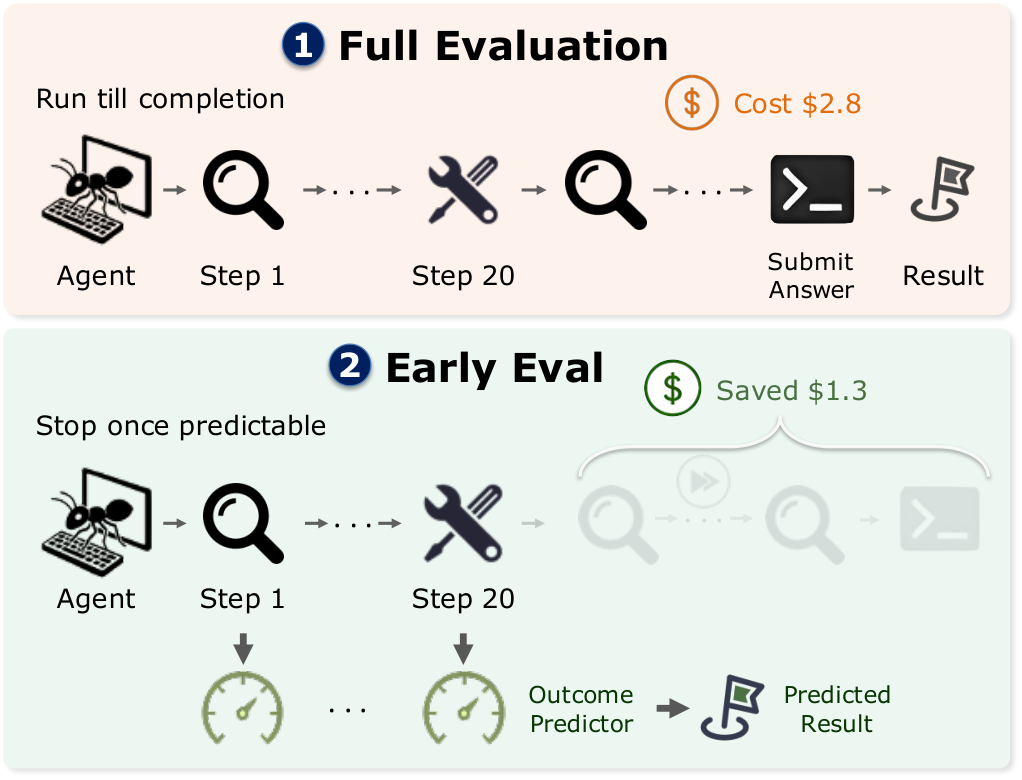
Researchers from Shanghai and Singapore built EarlyEval, a framework that watches an agentic workflow mid-execution and bets on whether it will succeed or fail — then pulls the plug early if it’s confident enough. The mechanism is two LightGBM classifiers trained on behavioral signals, text features, and reference-solution features; when either crosses a calibrated confidence threshold, the run halts. Across three benchmarks — SWE-bench Verified, TerminalBench, and Toolathlon — the system eliminated 13%–26% of agent steps, cut up to 44.1% of input tokens and 29.4% of output tokens, and achieved 89%–97% prediction accuracy. The kicker: per-agent resolve rates shifted by only one to two percentage points on average, meaning your leaderboard numbers stay roughly intact while your bill shrinks. This is positioned as orthogonal to benchmark distillation, which reduces the number of tasks rather than the cost within each task — think of it as a golden dataset efficiency play, not a replacement for one.
Cold read
The 89%–97% accuracy sounds impressive until you remember that a 3%–11% misclassification rate on expensive frontier runs still means you’re killing tasks that would have succeeded — and in competitive agent development, even a one-to-two percentage point perturbation in resolve rates can matter enormously when you’re trying to detect whether a new prompt or fine-tune actually moved the needle. The benchmarks tested — SWE-bench Verified, TerminalBench, Toolathlon — are relatively well-understood coding/tool-use environments; there’s no evidence this generalizes to messier, open-ended multi-agent orchestration pipelines that many production teams actually run. The classifiers are trained on behavioral and reference-solution features, which implies you need labeled runs to train on first — a bootstrap cost the paper doesn’t quantify. LightGBM is lightweight, but it still requires a training regime tuned per benchmark, per model, and possibly per task distribution; this is not a drop-in tool. The token savings are also input-token-heavy (44.1% vs. 29.4% output), and on most frontier APIs, output tokens cost more — so the real dollar savings are likely lower than the headline numbers suggest.
What it means for you
- Signal maturity: 2/5 — Lab results on three benchmarks, no production validation, training overhead unstated
- Who gets hurt: AI DevOps teams at mid-stage startups paying $5K–$50K/month on evaluation runs for coding or tool-use agents; they’re the natural early adopters and the ones who’ll absorb the integration cost
- What breaks if this is true: Frontier model API vendors lose a meaningful slice of evaluation-cycle revenue as teams compress their benchmark spend — not catastrophic, but directionally bad for usage-based pricing assumptions
- Why it might not land: The classifier must be retrained per model and benchmark; if your agent or task distribution shifts (which it does constantly during active development), the early-stopping thresholds go stale and you’re flying blind on accuracy
- Watch for: An open-source release with pre-trained classifiers for SWE-bench — that’s the signal that this crosses from research artifact to usable tool
Forecast as of 2026-09-03
By Q2 2027, at least one major agent evaluation platform (e.g., a SWE-bench leaderboard host or an eval-as-a-service startup) will have publicly integrated early stopping as an optional cost-reduction feature — but it will remain opt-in with caveats, because the resolve-rate perturbation risk will make most serious researchers unwilling to use it for primary benchmark submissions.
Source: EarlyEval: Cheaper Agent Evaluation via Early Outcome Prediction — Yuling Shi, Zhensu Sun, Junsen Dong, Chengcheng Wan, David Lo, Xiaodong Gu. https://arxiv.org/abs/2609.02783v1