Optimizing for the AI Ranker Is Turning the Web Into Beige
Optimizing for the AI Ranker Is Turning the Web Into Beige
Everyone is racing to get cited by ChatGPT, Perplexity, and Google’s AI answers. A new simulation says the race has a finish line nobody wants: a content ecosystem where the stuff that ranks highest is also the least trustworthy. If the model is right, GEO doesn’t just reshape your traffic — it degrades the entire information pool your competitors, customers, and AI systems are drinking from.
What happened
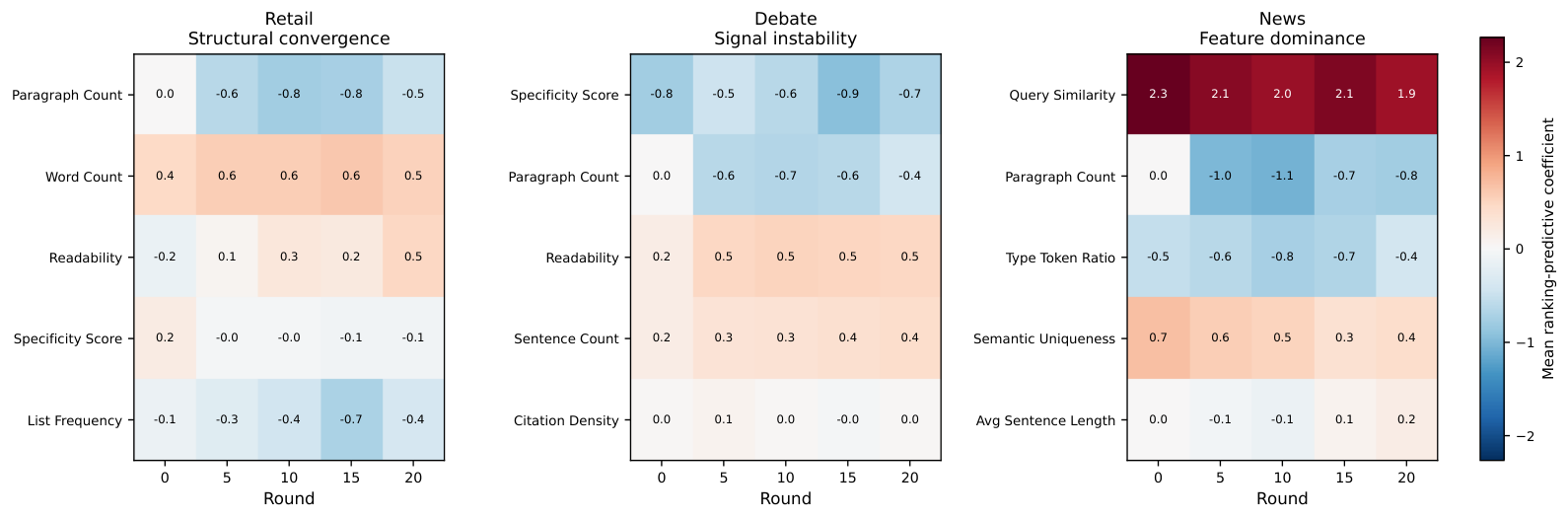
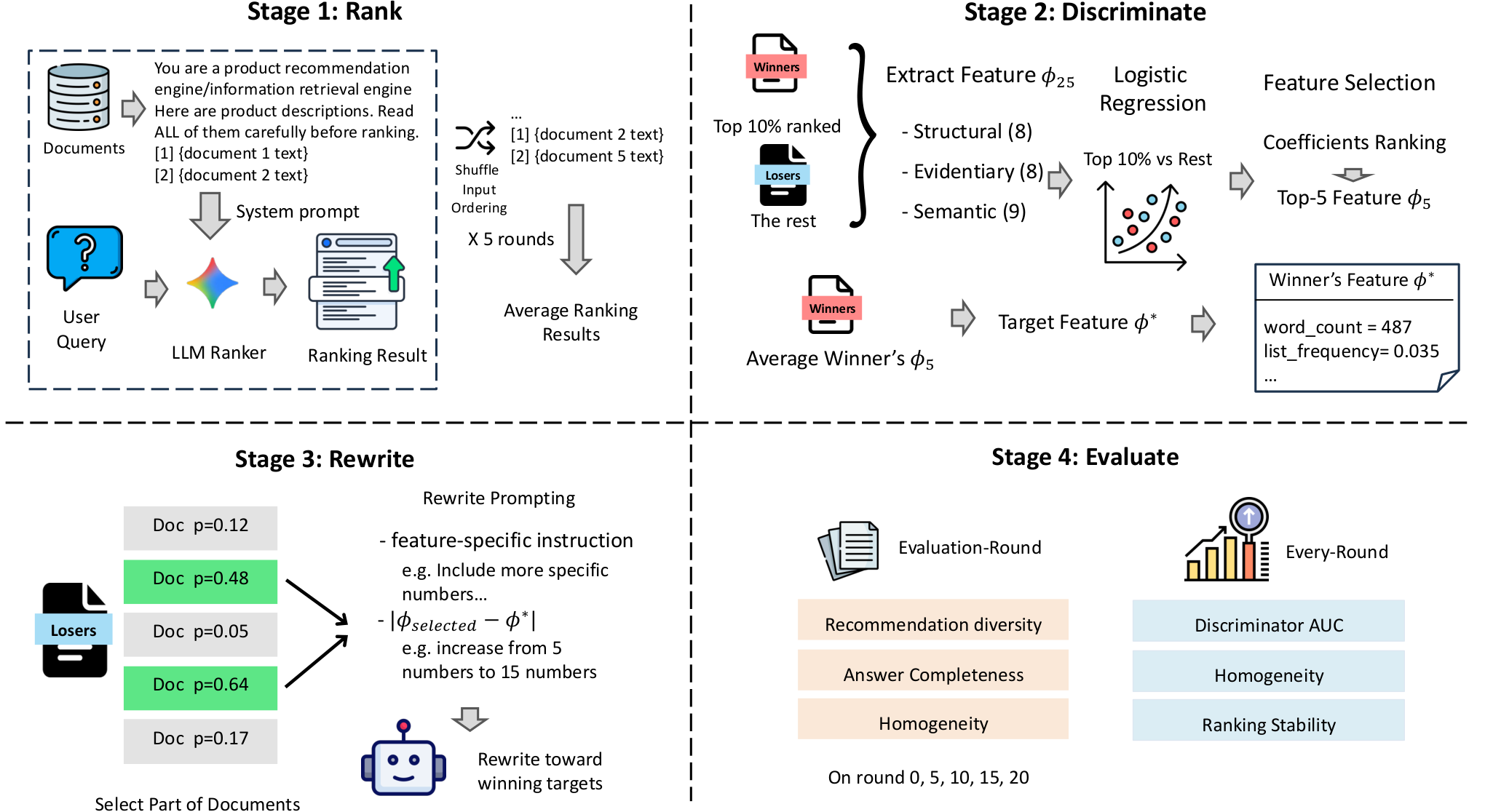
Researchers at built the CHASE framework to simulate what happens when content creators repeatedly optimize documents against a fixed LLM ranking signal — not once, but over 20 iterative rounds across six different domains. First, they validated that ranking is a meaningful proxy for real-world visibility, measuring how often top-ranked sources get cited in grounded AI-generated responses; they found a rank-citation AUC of 0.853 ± 0.093, meaning the abstraction holds up reasonably well. Then they ran the simulation: rank documents, identify which features the ranking signal rewards, rewrite documents toward those features, repeat. The core finding: quality-ranking alignment deteriorates in every single domain tested, with Spearman’s rho dropping between -0.107 and -0.018 (mean: -0.068) from round 0 to round 20 — documents that score better on the ranking signal become progressively less aligned with independently judged quality. A random-target control confirmed this is driven by adaptation toward AI visibility incentives specifically, not just the act of repeated rewriting. The dynamics vary significantly by domain, meaning the decay isn’t uniform — some content categories are more vulnerable than others. This is the ecosystem-level consequence of treating LLM-as-judge ranking as the only success metric.
Cold read
A Spearman’s rho shift of -0.068 on average is real but modest — this is not a cliff, it’s a slow slope, and 20 simulated rounds may not map cleanly onto any real-world time horizon. The framework is a controlled simulation, not an observation of actual internet behavior; real creators don’t get the ranking feature profile handed to them the way CHASE does, so adaptation in the wild will be noisier and slower. The “independently judged document quality” metric is doing enormous load-bearing work here — if that ground-truth quality label has its own biases or is itself LLM-derived, the whole quality-vs-ranking comparison is potentially circular. Domain-dependence is flagged but not fully unpacked in the abstract: we don’t know which domains decay fast, which resist, or why, making it hard to act on this finding without that breakdown. Finally, the paper measures what happens when everyone optimizes; it cannot tell you whether your optimization still beats the unoptimized competition even in a degraded ecosystem — it probably does, which is exactly why the arms race continues.
What it means for you
- Signal maturity: 3/5 — strong simulation design, but real-world validation is one layer removed
- Who gets hurt: Content-heavy B2B SaaS companies and media publishers investing heavily in GEO and LLMO as a primary distribution moat — they’re building on a signal that may be actively degrading
- What breaks if this is true: Source attribution in AI answers becomes a lagging indicator of actual expertise; your brand gets cited not because you’re authoritative but because you’re optimized, and the two increasingly diverge
- Why it might not land: LLM ranking signals aren’t static — model providers update continuously, and a target that moves defeats the homogenization dynamic entirely; the simulation assumes a fixed ranker
- Watch for: Share of voice metrics in AI answers rising for obviously thin, formulaic content in your vertical — that’s the canary that CHASE’s dynamic is live in your domain
Forecast as of 2026-09-01
By Q3 2027, at least one major LLM provider (OpenAI, Google, or Perplexity) will publicly announce a ranking or citation update explicitly designed to counteract GEO-driven content homogenization — analogous to Google’s Panda update — citing content quality degradation as the stated rationale.
Source: CHASE: How Content Ecosystems Are Reshaped When Ranking Is the Only Target — Qianwen Gao, Zichang Su, Yiwen Hou, Arlen Kumar, Leanid Palkhouski. https://arxiv.org/abs/2608.30466v1