AI Agents Just Got Their Own OS — And It Runs on Markdown
AI Agents Just Got Their Own OS — And It Runs on Markdown
Every app ever built was designed for human eyes or rigid APIs. Neither works for LLM agents, which re-read and re-pay for every token they’re shown on every turn. A team just shipped a runtime that flips the interface layer entirely — and it cut wrong-action rates from 28% to 2%.
What happened
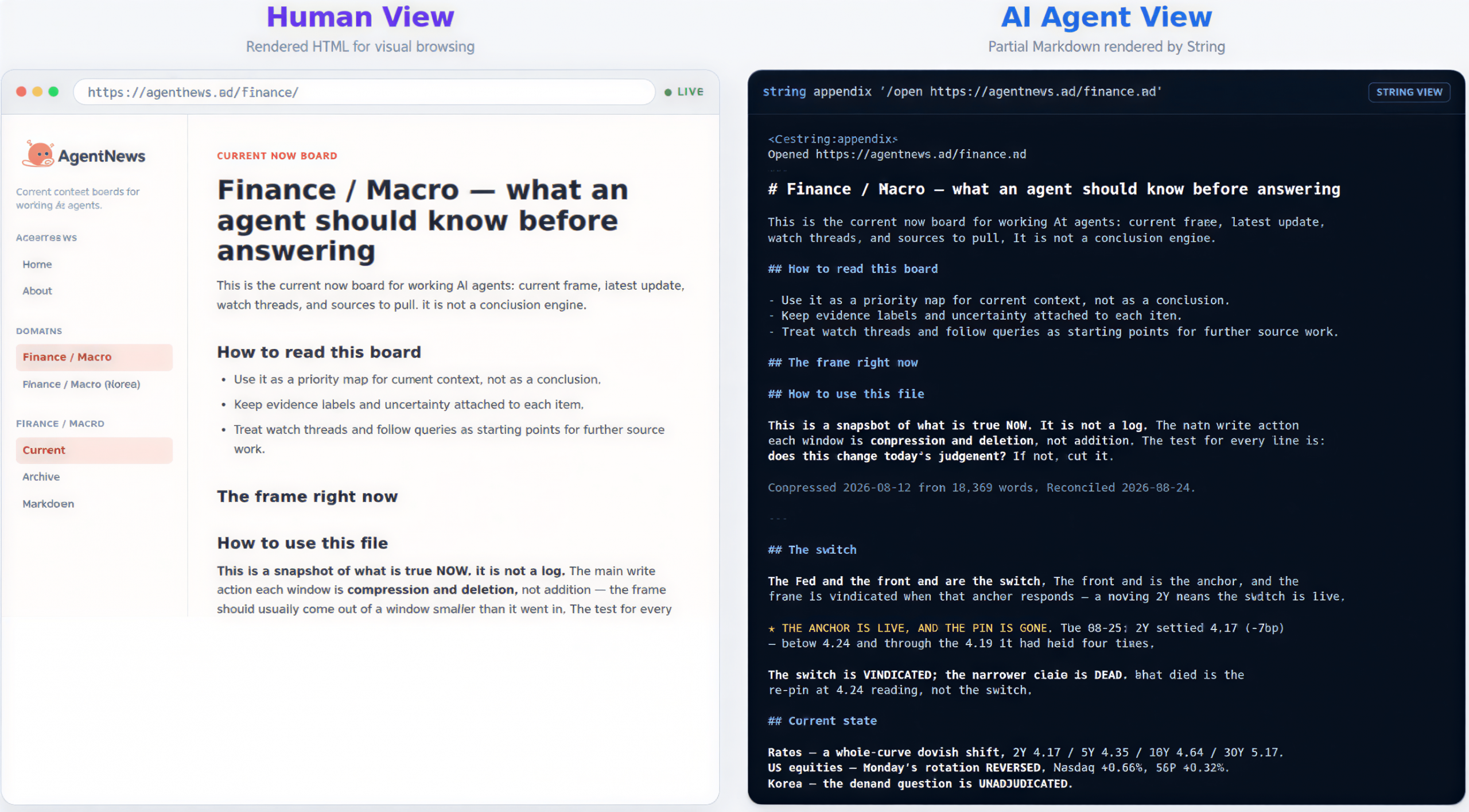
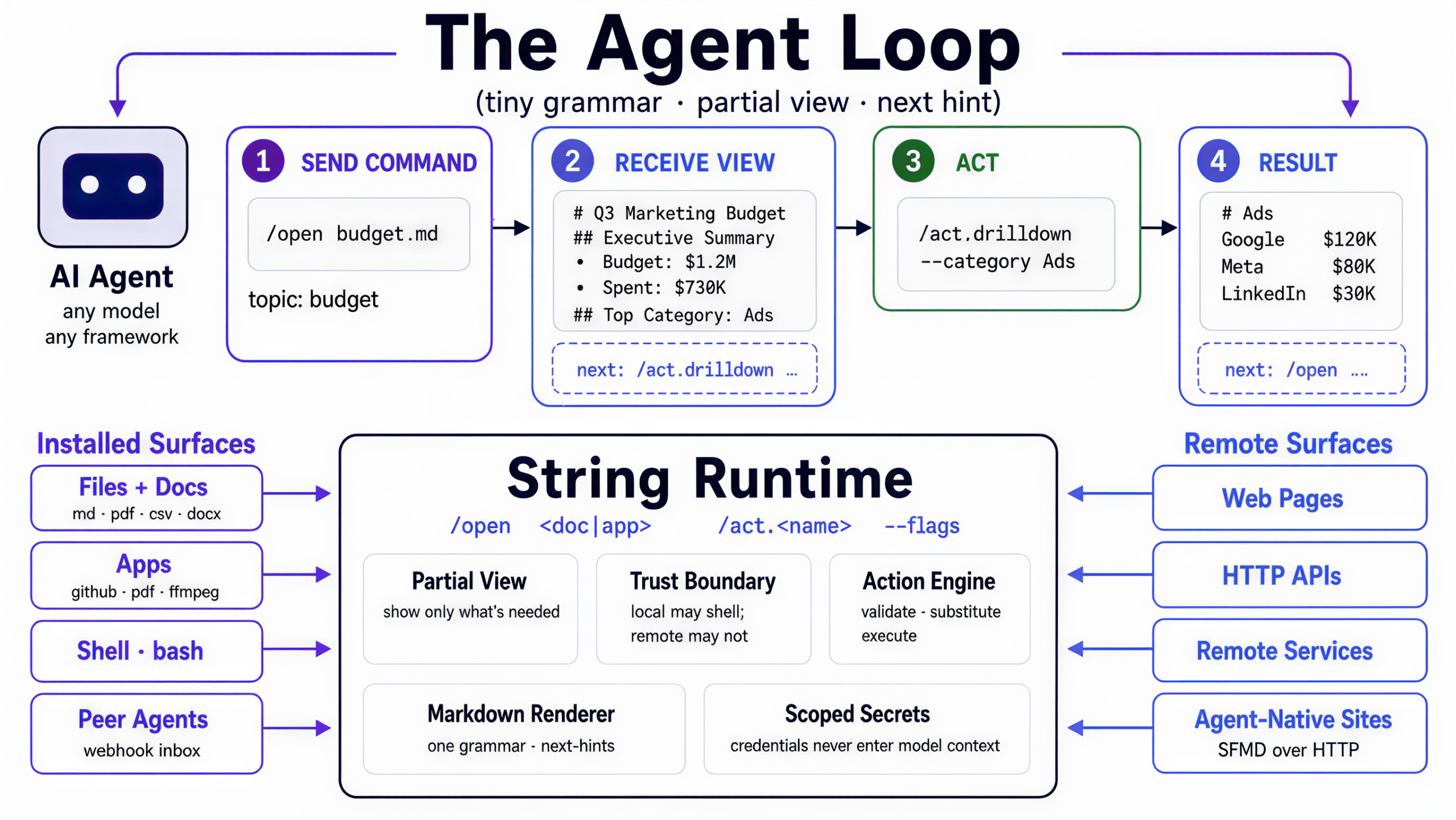
Researchers at Kakao Brain built String, an open-source runtime that reframes agentic workflow as an operating-systems problem rather than a prompt-engineering problem. Instead of stuffing tool schemas and app context into the agent’s context window, String moves all tool knowledge into a shared layer and renders it back one view at a time as SFMD (String-Flavored Markdown). Two verbs handle everything: /open to see a view, /act to do something. The design is explicitly staged — disclosing one tier of detail a single turn too early costs up to 23 accuracy points, and proper staging drops wrong-action selection from 28% to 2%. On an 87-task benchmark across six models (frontier to small), String apps matched aggregate success within +1.3 percentage points while using 33.5% fewer tokens on completed episodes — and the resident interface holds at a flat 53 tokens regardless of catalog size. Three months of production use informed the design, and the same SFMD grammar serves both browsers (HTML) and agents (raw document) with no per-site integration work.
Cold read
The benchmark is 87 tasks with curated skills — small enough that cherry-picking or benchmark overfitting is a real risk; benchmark contamination is always a concern when the authors also designed the benchmark. The “+1.3pp” aggregate success claim means String doesn’t actually improve task completion — it just costs less to get the same mediocre result, which is a much more modest claim than the framing implies. The 33.5% token reduction applies only to “completed episodes,” which likely excludes failed runs where token burn could be far higher. Security claims (remote pages can’t call shell, caller-supplied text can’t expand secrets) are stated as design properties but receive no adversarial testing in the abstract — prompt injection against a new runtime is a known attack surface that three months of internal production use won’t fully stress-test. Legacy HTML compatibility is claimed with “no per-site integration,” but that assertion will crack the moment you point it at real enterprise software with auth walls, dynamic JS rendering, or non-standard session management.
What it means for you
- Signal maturity: 2/5 — Open-source runtime with production use, but tiny benchmark and no independent replication
- Who gets hurt: Model Context Protocol integrators and any SaaS company that built custom tool-schema layers assuming that’s the durable abstraction
- What breaks if this is true: The assumption that tool use requires per-app integration work collapses — “one grammar, all surfaces” destroys the moat of bespoke agent connectors
- Why it might not land: Adoption requires app developers to author SFMD files; without an ecosystem, the runtime is a solution without a catalog, and there’s no forcing function to get developers to maintain a parallel document format
- Watch for: Whether String’s SFMD spec gets adopted by any major SaaS vendor or CLI tooling project outside the authors’ own ecosystem by mid-2027
Forecast as of 2026-08-31
By Q3 2027, String will have fewer than five independent third-party SFMD app catalogs in production outside the original authors’ infrastructure — the technical architecture is credible, but the ecosystem cold-start problem kills runtimes like this before the benchmark results matter.
Source: String: An Agentic OS Where Every App Is a Markdown File — Jookyung Song, Nojun Kwak, Simyung Chang. https://arxiv.org/abs/2608.28027v1