Your Agent Is Burning Money on Context It Can’t Afford to Read
Your Agent Is Burning Money on Context It Can’t Afford to Read
Every tool call, every retrieval chunk, every multi-turn turn — your agentic pipeline’s context is a ticking cost meter. Engineers are already compressing inputs to survive, and every compression cuts accuracy. A new paper claims to have found a third door.
What happened
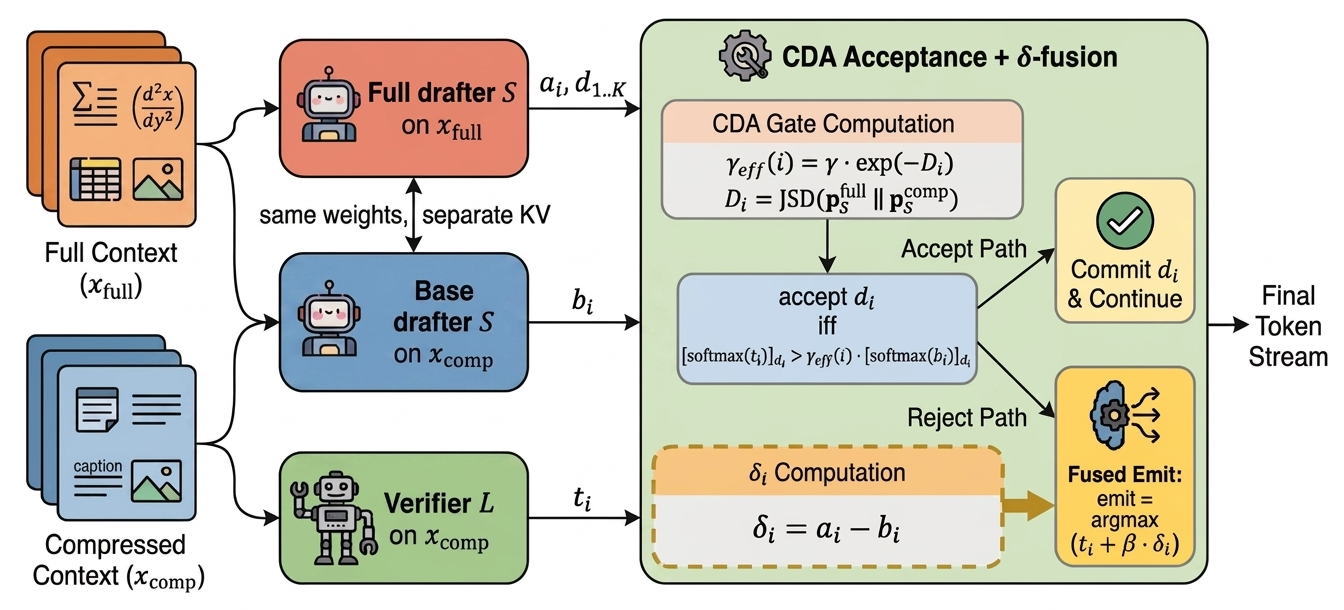
Researchers at (presumably) industry labs built AsymSpec, a speculative decoding variant designed specifically for agentic workflows where context balloons across retrieval-augmented generation, tool calls, and multi-turn exchanges. Standard speculative decoding requires the small “drafter” model and the large “verifier” model to see identical context — a hard constraint that has kept the technique from solving the accuracy-vs-cost squeeze in agentic settings. AsymSpec breaks that constraint: the lightweight drafter reads the full context, while the expensive verifier sees only a compressed version. The drafter nudges the verifier via a logit-fusion mechanism with a “divergence-aware acceptance gate” to keep the two models from drifting apart. Across four agentic capability benchmarks and two end-to-end agent benchmarks, the system hits roughly 90% of full-context accuracy, delivers 1.3–1.7× throughput speedups, and costs 0.2–0.3× the compute of running the full model on the full context — on isolated text capabilities. That last qualifier matters and we’ll get to it.
Cold read
The flagship number — 90% of full-context accuracy — sounds reassuring until you ask what the missing 10% costs in production. In agentic AI pipelines, a 10% accuracy gap doesn’t distribute evenly; it clusters on exactly the hard, multi-step reasoning tasks where context compression was already doing the most damage, and where errors compound across tool-call chains. The compute savings (0.2–0.3×) and speedups (1.3–1.7×) are reported specifically on “isolated text capabilities,” not the end-to-end benchmarks — a subtle but important scoping hedge that the abstract doesn’t fully resolve. The technique depends on the drafter’s logit-fusion reliably steering a larger verifier without access to the same context; how well the divergence-aware gate holds up as context asymmetry grows (think 128K-token agent histories) is undemonstrated here. Benchmark contamination is also a standing concern: benchmark contamination in agentic evaluations is notoriously hard to rule out, and we don’t know whether the two “end-to-end agent benchmarks” are genuinely out-of-distribution for these models. Finally, the method adds system complexity — two models with different context views, a custom acceptance gate — which is real operational overhead that the throughput numbers don’t capture.
What it means for you
- Signal maturity: 2/5 — lab result on benchmarks, no production deployment evidence
- Who gets hurt: Inference infrastructure vendors selling “just scale up context” as the answer to agentic latency; also any startup whose moat is “we run the full context, competitors compress”
- What breaks if this is true: The assumed tradeoff between context fidelity and inference cost dissolves, making aggressive context compression pipelines (and the startups optimizing them) a weaker value proposition
- Why it might not land: Operational complexity is the kill factor — deploying and synchronizing two models with asymmetric context access, a custom logit-fusion step, and a tuned acceptance gate is a significant MLOps lift that most teams running agentic workflows don’t have the infra or headcount to absorb
- Watch for: A major inference provider (Together, Fireworks, Anyscale-tier) shipping AsymSpec or a variant as a drop-in serving option — that’s the signal this crosses from paper to practice
Forecast as of 2026-08-27
No major inference provider will ship an AsymSpec-style asymmetric speculative decoding feature in production by Q2 2027; the method will remain a research baseline that influences architecture discussions without becoming a default serving primitive, largely due to the dual-model synchronization overhead.
Source: AsymSpec: Context-Asymmetric Speculative Decoding for Agentic LLMs — Sheng Liang, Yongyue Zhang, Nathanael Brian, Hang Lv, Hao Wang, Chen Zhang, Yong Liu. https://arxiv.org/abs/2608.26004v1