Your RAG Stack Is Lying About the Numbers—By Two Orders of Magnitude
Your RAG Stack Is Lying About the Numbers—By Two Orders of Magnitude
A chunk boundary between a figure and its unit header can silently transform lakhs into crores. For financial documents, that’s not a retrieval miss—it’s a compliance disaster waiting for a courtroom. One paper just made the problem measurable, and the numbers are ugly.
What happened
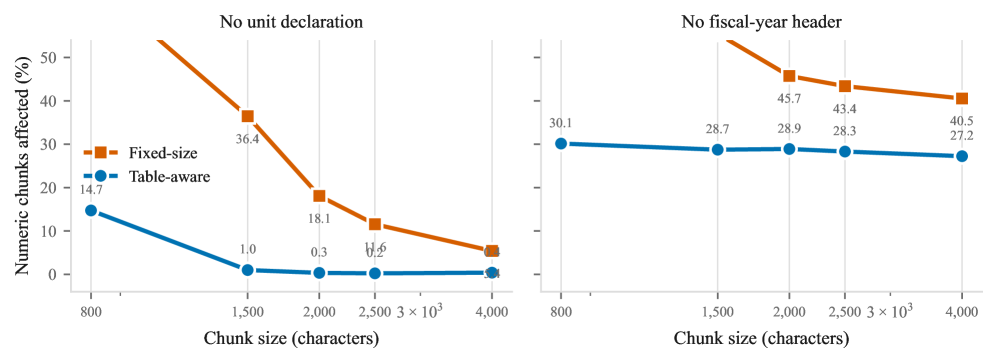
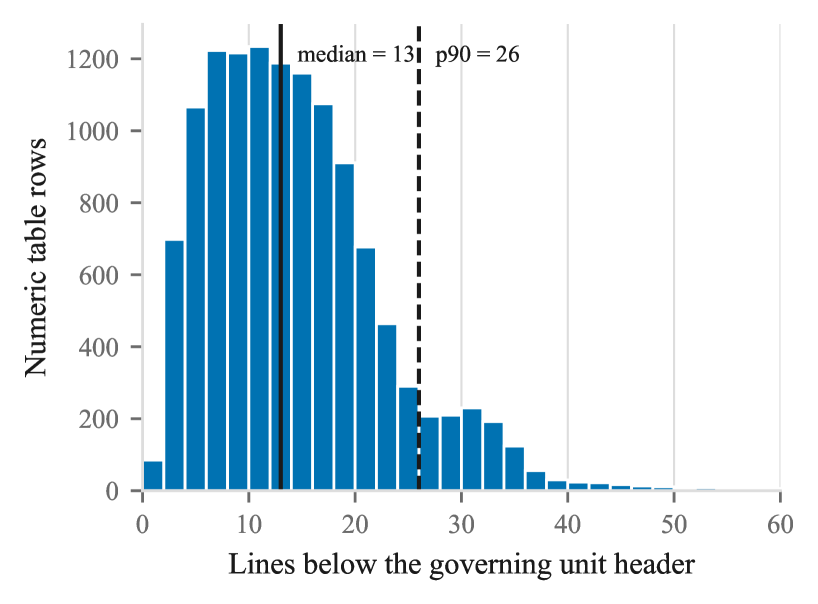
Researchers at tested retrieval-augmented generation on a 780-page government financial report and found that standard top-k embedding retrieval answered only 15.7% of 51 verified questions correctly. Their proposed system, READ (Reliable Embedding-free Agentic Document-search), scored 58.8%—a 43-point gap that clears a stringent Holm-corrected significance threshold (p = 2×10⁻⁵). The structural diagnosis is the more important finding: 86.8% of content lines in this document class are table rows, and the unit header for any given figure sits a median of 13 lines above it, meaning standard chunk boundaries routinely amputate a number from whether it is denominated in lakhs or crores—a 100× error. READ replaces embeddings-based similarity with three deterministic operations—normalized lexical search, structural navigation, and bounded span reads—exposed over the Model Context Protocol, creating a replayable agentic workflow rather than an opaque similarity score. Critically, the authors also report that BM25 alone is statistically indistinguishable from READ—the gain comes from escaping embedding-based retrieval entirely, not from the agentic loop per se.
Cold read
This is a single document, single domain, 51 questions—a dataset so narrow that “statistically significant” should be read as “not random noise” rather than “generalizable truth.” The 58.8% accuracy ceiling means READ is still wrong 41% of the time on a domain it was purpose-built for, which is not a production number for anything that touches financial compliance. The paper’s most honest line is buried: BM25 is statistically indistinguishable from READ, which means the authors have demonstrated that embeddings are bad for structured financial tables—not that their specific agent architecture is the solution. A tuned dense retrieval baseline still reaches 35.3%, so the gap closes considerably when the incumbent is optimized, narrowing READ’s lead to a still-meaningful but less dramatic 23.5 points. Founders should also note the retrieval precision and recall benchmark is self-constructed by the authors on a single government report; there is no independent golden dataset validation.
What it means for you
- Signal maturity: 2/5 — Single-domain proof of concept, no external replication
- Who gets hurt: Vendors selling generic RAG pipelines into finance, audit, tax, and regulatory use cases without document-structure awareness
- What breaks if this is true: The standard “chunk → embed → top-k” sales pitch for financial document intelligence products has a measurable 100× numeric error mode baked in by design
- Why it might not land: BM25 appears to match READ’s performance, so the moat is thin; any competent engineering team can replicate the gain without the proprietary agent architecture
- Watch for: Enterprise RAG vendors quietly shipping “table-aware chunking” or hybrid lexical/semantic retrieval as a default in their financial-document SKUs—that’s the market acknowledging the problem without crediting the paper
Forecast as of 2026-08-07
By Q2 2027, at least two of the major RAG infrastructure vendors (Vectara, LlamaIndex, Cohere) will have shipped documented table-aware or structure-preserving chunking as a named product feature for financial document verticals—but embedding-based retrieval will remain the default pipeline for general-purpose deployments, confirming the paper’s finding matters narrowly and slowly.
Source: Beyond Top-K: Replacing Black-Box Retrieval with Interpretable Agentic Operations — Sagar Tamang, Ayush Vyas, Tabarakul Hazarika. https://arxiv.org/abs/2608.06305v1