Your AI Agent’s Memory Bill Is About to Drop 57% — If This Holds
Your AI Agent’s Memory Bill Is About to Drop 57% — If This Holds
Every long-running agent you deploy is silently burning tokens just to remember what happened five minutes ago. A new architecture claims to kill that overhead entirely — no LLM calls, no token spend, for anything except the final answer. The catch: you’ve heard this kind of claim before.
What happened
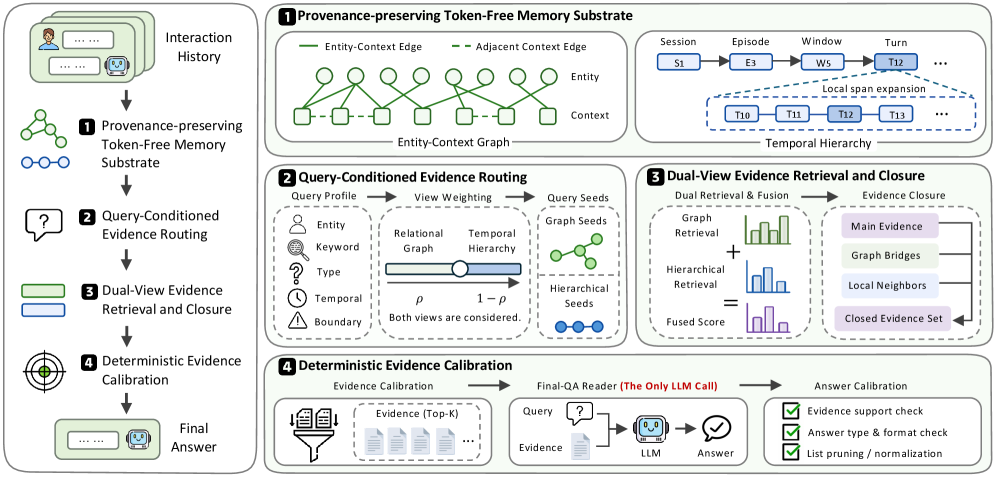
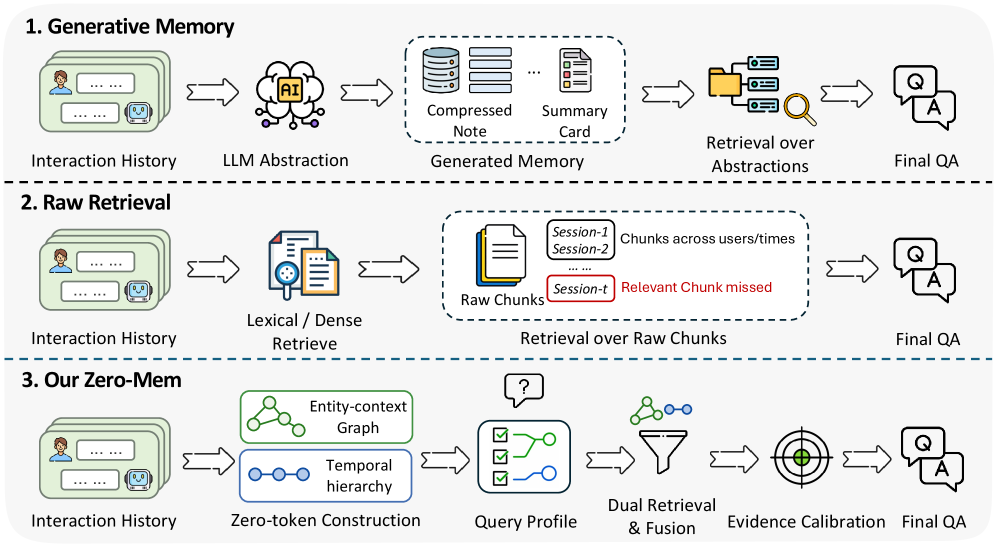
Researchers from a multi-institution team introduced Zero-Mem, an agent memory system that performs all memory operations — storage, indexing, and retrieval — without invoking an LLM or consuming any LLM tokens outside of the final question-answering step. The insight is structural: instead of generating compressed summaries or intermediate records (the standard approach), Zero-Mem preserves the raw interaction traces and organizes them two ways simultaneously. A knowledge graph maps entity-to-entity connections across sessions; a temporal hierarchy preserves conversational locality and session state. At query time, the system blends signals from both views using deterministic calibration — no generation, no sampling — to discard conflicting evidence before passing retrieved traces to the final LLM reader. On long-memory and long-context QA benchmarks, Zero-Mem delivers competitive accuracy while cutting memory-operation time by 57.6% relative to the fastest baseline tested. Encoder computation (e.g., embedding the traces) is explicitly carved out and accounted for separately, which is an honest methodological disclosure that also limits how cleanly you can call this “zero-cost.”
Cold read
“Competitive performance” is doing a lot of work here — it is not “best performance,” and the abstract never claims it. Trading accuracy headroom for latency savings is a real engineering tradeoff, not a free lunch, and founders should read the full benchmark tables before assuming parity. The 57.6% time reduction is measured against the fastest existing baseline, not the most accurate one; cherry-picking the comparison baseline is a classic way to inflate a delta. The system still requires an encoder pass over all interaction traces, which means token-equivalent compute exists — it’s just off the LLM API invoice, which matters differently depending on whether you’re running your own inference stack or paying per-token to OpenAI. The agent memory vs. context window tradeoff is real and unsolved: preserving raw traces verbatim (rather than summarizing) is a defensible design choice for factual consistency, but it creates a scaling problem as session history grows that the abstract does not address. Code is not yet public — peer review is pending — so independent replication is zero at this stage.
What it means for you
- Signal maturity: 2/5 — Pre-peer-review, no public code, “competitive” ≠ “state of the art”
- Who gets hurt: Infrastructure layers selling LLM-powered memory-as-a-service (think managed agent memory APIs that charge on memory-operation tokens)
- What breaks if this is true: The cost model for long-horizon agentic workflows changes materially — memory overhead goes from an O(n) token cost to a latency and storage problem, which is structurally cheaper at scale
- Why it might not land: Raw trace preservation doesn’t compress; enterprise agents running months-long interactions will hit storage and retrieval-quality ceilings the paper doesn’t characterize
- Watch for: Post-peer-review code drop on the GitHub repo (TheMoon0815/Zero-mem) and whether any third party reproduces the 57.6% figure on a different benchmark suite
Forecast as of 2026-08-03
By Q2 2027, at least one major open-source agent framework (LangGraph, AutoGen, or a direct successor) will incorporate a deterministic, generation-free memory retrieval option explicitly citing this line of work — but it will be an opt-in module, not the default, because accuracy tradeoffs on complex multi-hop queries will prove too steep for general use.
Source: Zero-Mem: Zero-Token Memory Operations for LLM Agents — Yilin Xiao, Zhehan Zhu, Yujing Zhang, Jin Chen, Zijin Hong, Luyao Zhuang, Qinggang Zhang, Shengyuan Chen, Xiaocao Ouyang, Lingfei Ren, Xiao Huang. https://arxiv.org/abs/2607.29377v1